



A federal judge has allowed part of a civil rights lawsuit brought by a California family alleging anti-Asian discrimination in college admissions to move forward, giving the case a potentially significant path toward discovery of university admissions data.
The lawsuit was filed by Nan Zhong and his son, Stanley Zhong, whose experience has become a focal point in the broader debate over whether highly qualified Asian American students face disadvantages in the admissions processes of selective U.S. universities.
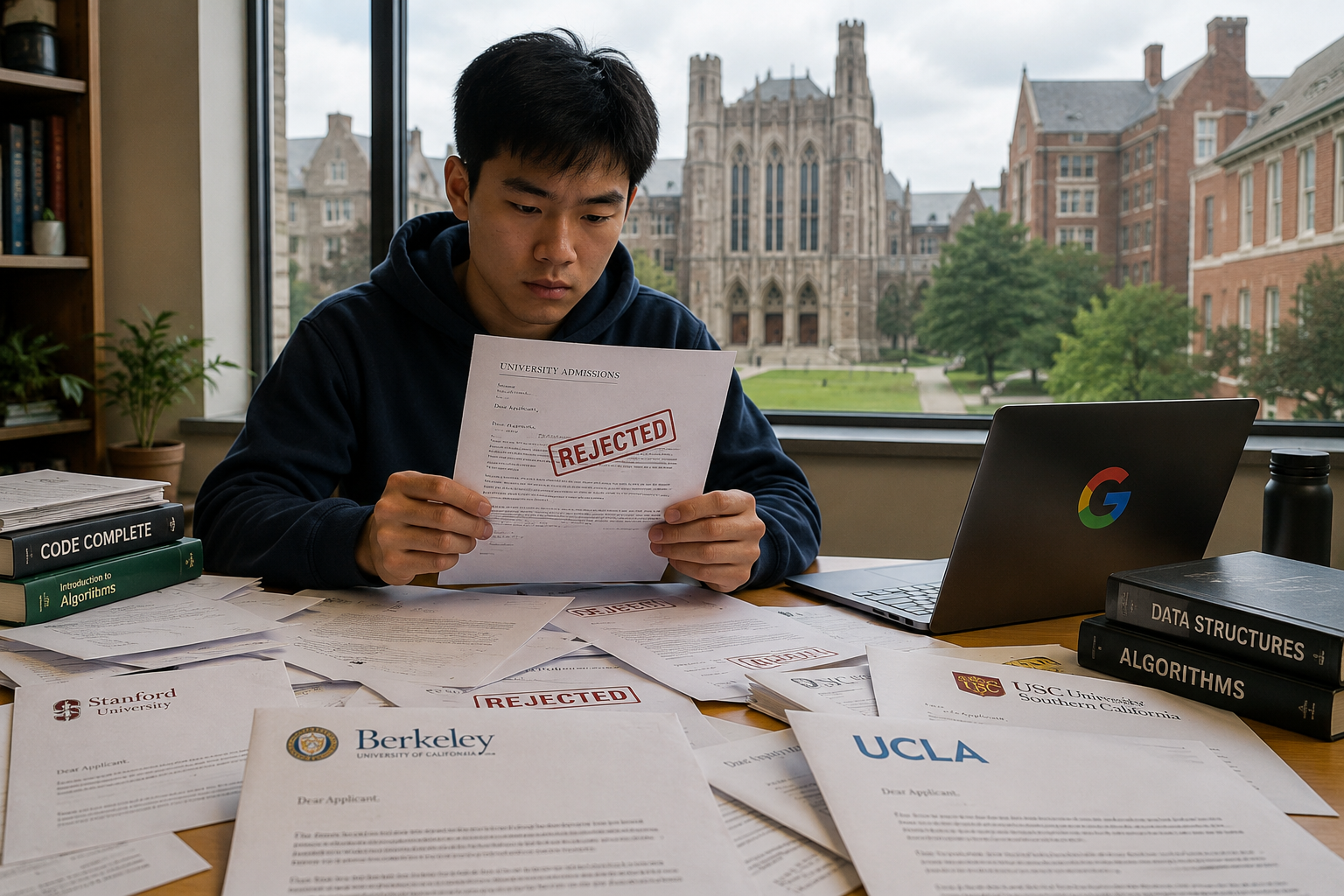
Stanley Zhong, now 21, was rejected by 16 of the 18 colleges to which he applied after graduating from Henry M. Gunn High School in Palo Alto, California, in 2023. His academic record included a 1590 SAT score, a 4.42 weighted GPA and a ranking in the top 9% of his graduating class. He had also developed a free electronic-signature startup and participated in coding competitions.
Soon after the college rejections, Google hired Zhong as a full-time software engineer. According to his family’s lawsuit, the position typically requires a Ph.D. or equivalent practical experience. Google had first identified Zhong’s programming abilities when he was 13.
The contrast between Zhong’s college admissions results and his subsequent employment has become central to his family’s argument that academic and professional qualifications alone do not explain how some Asian American applicants fare at highly selective universities.
The lawsuit alleges that universities have used admissions practices that disadvantage highly qualified Asian American applicants because of their race. The allegations have not been proven in court, and the universities have disputed them.
READ: Indian student from Hyderabad dies in U.S. amid job search struggles (August 27, 2026)
Court ruling opens door to admissions data
The latest development concerns the University of Washington. U.S. District Judge James L. Robart denied the university defendants’ motion to dismiss Zhong’s Title VI claim while dismissing several other claims. The decision allows the case to proceed in part, potentially permitting the family to seek internal university communications, admissions records and statistical data.
Nan Zhong described the ruling as a major development because discovery could provide information about how applicants were evaluated.
The University of Washington, however, said the court dismissed many of the claims and emphasized the highly competitive nature of its Allen School. The university also said it prioritizes Washington residents, meaning that most out-of-state applicants are not admitted regardless of their qualifications.
The case therefore enters a stage where the allegations can face greater scrutiny against the university’s actual admissions records.
A larger Asian American admissions debate
For Asian American families, the case touches on a question that has been at the center of U.S. college admissions debates for years: whether students from a group that performs strongly on conventional academic measures can nonetheless be disadvantaged by selective admissions systems.
The issue received national attention during the litigation involving Harvard College and the University of North Carolina.
In 2023, the U.S. Supreme Court ruled that the race-conscious admissions programs used by Harvard and UNC violated the Equal Protection Clause of the 14th Amendment. The Court held that the programs could not use race in the manner challenged in those cases.
The Harvard litigation had also included allegations that Asian American applicants were disadvantaged by the university’s admissions process. The Supreme Court’s ruling, however, focused on the broader legality of race-conscious admissions and did not establish that Harvard had intentionally discriminated against Asian American applicants.
That distinction remains important in evaluating the Zhong litigation. The Supreme Court’s decision changed the legal landscape for universities, but it did not eliminate every potential dispute over racial discrimination in admissions. A university can face allegations that its admissions practices discriminate against applicants even when it says race is not directly used as an admissions criterion.
The Zhong family’s lawsuits seek to test that question through specific university admissions practices.
Why the Zhong case matters to Asian American families
Zhong’s father has said the lawsuit is not simply about his son’s college experience.
He told Fox News Digital that the family wants to prevent the same experience from affecting his younger son and future generations. He also said that numerous Asian American families contacted the family after Stanley’s story became public, describing their own experiences with highly qualified students being rejected by selective colleges.
That response illustrates why the case has resonated beyond one Palo Alto family.
For many Asian American parents, academic achievement has traditionally been viewed as the clearest route to educational opportunity. The possibility that race could still influence an admissions outcome therefore raises concerns about whether traditional measures of merit receive equal weight for all applicants.
But selective college admissions are also extraordinarily competitive. A high SAT score, strong grades or impressive extracurricular achievements do not guarantee admission to an elite institution. Universities routinely reject large numbers of applicants with exceptional credentials, and individual rejection decisions cannot by themselves establish racial discrimination.
That is why the discovery phase of the Zhong case could become important.
If admissions data and internal communications are produced, they could provide a more detailed picture of how Asian American applicants were evaluated and whether race played a prohibited role.
READ: Yale names Navin Kartik Melamed Professor of Economics (August 28, 2026)
Beyond one student’s rejection
Stanley Zhong’s story presents a striking contrast. A student rejected by most of the highly selective colleges he applied to was nevertheless recruited by one of the world’s most prominent technology companies and hired as a software engineer.
His experience does not, by itself, prove that universities discriminated against him because he is Asian American.
But it has raised a question that has persisted among Asian American families: what happens when a student’s measurable academic and technical achievements appear to conflict with the outcome of highly selective college admissions?
The answer may depend on what the evidence shows.
The University of Washington has defended its admissions process, while Zhong’s family argues that the only way to determine whether discrimination occurred is to examine the university’s admissions data and decision-making process.
As the lawsuit moves toward discovery, the case could become another important test of how universities balance holistic admissions, diversity objectives and the legal requirement not to discriminate on the basis of race.
For Asian American students and their families, the stakes extend beyond Stanley Zhong. The litigation could help determine whether concerns about unequal treatment in elite college admissions are supported by evidence or whether individual outcomes are being interpreted as proof of a broader pattern without sufficient data.
Either way, the case has reopened one of the most contentious questions in American higher education: whether a system designed to create a diverse student body can do so without unfairly disadvantaging applicants because of their race.