



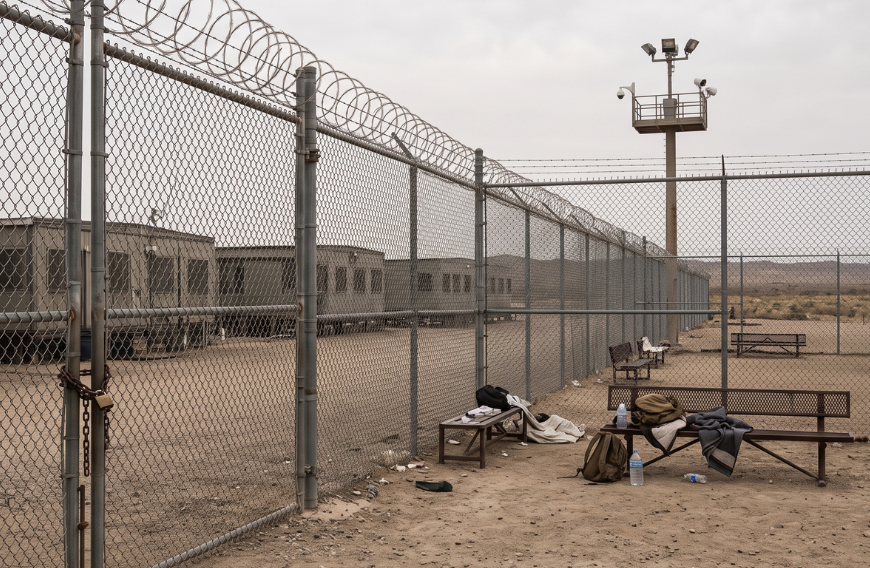
A South Asian American advocacy group is asking the U.S. Supreme Court to protect immigrants from being held for months or even years without a meaningful opportunity to seek release on bond, warning that prolonged detention can create additional hardships for members of the South Asian diaspora.
The South Asian American Justice Collaborative (SAAJCO), along with the American Immigration Lawyers Association, American Immigration Council, Asian Law Caucus, Sikh Coalition and RAICES, filed an amicus curiae brief in the Supreme Court in Genalo v. Black.
The case could have significant implications for immigrants who are detained during removal proceedings, including members of South Asian communities who may face lengthy separation from their families, communities and religious institutions.
At issue is whether the government can continue holding immigrants under mandatory detention laws for extended periods without providing a bond hearing to determine whether continued detention is necessary.
READ: US citizen deported to Mexico returns to Texas as lawmakers seek to curb ICE detention (September 1, 2026)
SAAJCO said mandatory detention can sweep up people who may pose little or no danger or flight risk. For South Asian immigrants, the organization said, prolonged detention can also create challenges involving religious practices, dietary requirements and access to meaningful language assistance.
“A government should not be able to deprive people of their liberty for months or years without having to justify that detention. For South Asian communities, prolonged detention can bring additional harms, including barriers to religious practice, religious dietary requirements, and meaningful language access. Meaningful judicial review is a basic safeguard against unchecked government power and essential to our democracy,” said Kalpana V. Peddibhotla, Executive Director of the South Asian American Justice Collaborative (SAAJCO).
The organization is particularly highlighting the impact detention can have on immigrant families and communities as the Supreme Court prepares to examine the limits of mandatory immigration detention.
For many South Asian immigrants, prolonged detention can mean being separated from spouses, children, parents and other relatives while their immigration cases move through the courts. The coalition also argues that extended confinement can make it harder for detainees to find attorneys and meaningfully participate in their cases.
SAAJCO’s brief is supported by several immigration and civil rights organizations, which argue that lengthy detention without judicial review raises fundamental due process concerns.
“Indefinite or prolonged confinement without meaningful judicial review, especially for purely civil immigration violations, directly conflicts with America’s commitment to equal justice before the law.
When the government seeks to hold human beings for an extended period, fundamental fairness requires an opportunity to challenge that detention before a neutral decision-maker. The Court should reaffirm that liberty does not depend on immigration status and that due process remains a core American value,” said Jeff Joseph, president of the American Immigration Lawyers Association (AILA).
The Asian Law Caucus also pointed to the impact of detention on families, jobs, health and community ties, describing cases involving immigrants who spent months or years in detention before ultimately prevailing in their immigration cases.
“Behind the legal arguments in our amicus brief are real people losing months and years of their lives in detention. They are parents separated from their children, family members missing the funerals of loved ones, community members ripped from their jobs and neighborhoods. They are people whose health rapidly deteriorates while waiting for care and release, like Rodrigo, who was left to cover an open wound – with shrink wrap saved from his dinner. Others endured years of needless detention only to ultimately win their cases and return home. These stories show the profound human cost of a system that forces people to remain locked and away while they fight for the right to remain with their families,” said Evelyn Wiese, Asian Law Caucus Immigrant Justice Program Director.
READ: ICE arrests hit record high under Trump with nearly 50,000 detained in July (August 26, 2026)
The Sikh Coalition said members of immigrant communities can face compounded hardship when they remain separated from their families and communities for prolonged periods.
“Too many individuals across our country are suffering in long-term detention after being targeted by an overly aggressive immigration enforcement regime. When these individuals are kept from their families, their livelihoods, and their communities for long stretches of time, the suffering is compounded. We must move towards an immigration system that holds justice in a higher esteem than cruelty,” said Munmeeth Soni, Legal Director, Sikh Coalition.
The Supreme Court is scheduled to hear Genalo v. Black on Oct. 13.
The justices will consider whether detention under 8 U.S.C. § 1226(c) can become unreasonably prolonged, triggering a constitutional requirement for a bond hearing. The court will also consider whether the government must establish by clear and convincing evidence that continued detention is justified.
For South Asian immigrant communities, the ruling could determine how long people can remain in immigration detention without an opportunity for a judge to assess whether they should continue to be held.