



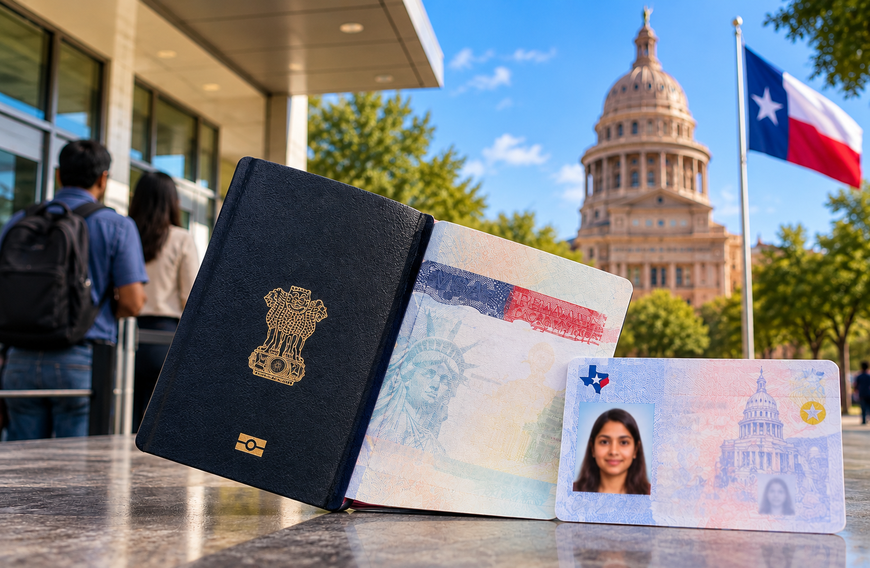
Texas will continue allowing certain foreign nationals to use a foreign passport containing an expired U.S. visa as primary identification when applying for a state driver’s license or identification card, provided they have a valid I-94 and the document is verified through the federal SAVE system.
The Texas Department of Public Safety adopted amendments to its identification rules after receiving hundreds of objections to a proposed change that would have removed an expired U.S. visa, when accompanied by a foreign passport and valid I-94, from the list of acceptable primary identification documents.
The final rule, filed with the Texas Secretary of State on August 31, will take effect September 20, according to the Texas Register.
The decision follows updated guidance from the U.S. Department of Homeland Security that a foreign passport containing a visa that is facially expired may still be used for applicant identification, as long as the document is verified through the Systematic Alien Verification for Entitlements, or SAVE, program.
“Therefore, amendments to subsection (1)(F) and (G) are no longer required,” the Texas Department of Public Safety said in its response to public comments.
The development is particularly relevant to nonimmigrants who remain lawfully in the United States under a valid period of admission even though the visa stamp in their passport has expired.
READ: USCIS marks 25th anniversary of September 11 attacks (September 11, 2026)
What the Texas rule allows
Under the adopted version of §15.24, a foreign passport with a U.S. Department of State visa, whether valid or expired, remains a form of primary identification when accompanied by an unexpired I-94 marked valid for a fixed duration.
The rule also covers foreign passports with a valid or expired U.S. visa and an I-94 marked valid for the duration of stay, when accompanied by appropriate documentation.
For applicants who were not required under federal law to obtain a visa to enter the United States, the visa requirement may be waived under the rule.
An applicant for an original Texas driver’s license or identification certificate generally must present one piece of primary identification, one piece of secondary identification plus two supporting documents, or two pieces of secondary identification.
The Texas DPS classifies the foreign passport-and-visa documents under primary identification.
664 people opposed the proposed change
The Texas DPS said written comments were submitted by the Executive Committee of the American Immigration Lawyers Association’s Texas chapter, Berry Appleman & Leiden LLP, BAL Community and 664 individuals opposing the proposed removal of the expired-visa provision.
Another 10 individuals also submitted comments concerning the same provision.
The proposed amendments had been published in the June 26, 2026, issue of the Texas Register, with the department accepting comments through July 27.
The final rule retained the provision after DHS provided updated guidance to Texas officials.
Immigration attorney and commentator Sabrina L. [as identified in the supplied X post] highlighted the development on X, saying advocacy had helped prevent the change and that Texas received updated DHS guidance confirming that a valid passport with an expired visa could remain acceptable for REAL ID purposes when properly verified.
Why the I-94 matters
The distinction between a visa and an I-94 is important for nonimmigrants.
A U.S. visa generally allows a foreign national to seek admission to the United States. The I-94 records the person’s admission and authorized period of stay.
The official CBP I-94 system describes the I-94 as the traveler’s lawful record of admission and allows eligible nonimmigrants to retrieve and print their most recent record.
That means an expired visa stamp does not necessarily mean that a person has lost lawful status or must immediately leave the United States. A person can, depending on the circumstances, remain in the country under a valid I-94 even after the visa used for entry has expired.
The Texas rule is focused on identification and verification, rather than treating an expired visa as proof of an immigration benefit by itself.
READ: X user alleges US workers fear H-1B retaliation (September 10, 2026)
SAVE verification remains central
Texas said the documents must be verified through DHS’s SAVE program.
SAVE, administered by U.S. Citizenship and Immigration Services, provides federal, state and local agencies with information used to verify immigration status when determining eligibility for licenses and other benefits.
USCIS says SAVE does not itself decide whether an applicant qualifies for a particular benefit or license. Instead, the agency issuing the benefit or license makes that determination after receiving verification information.
USCIS also says SAVE can use information such as an I-94 number, visa number, foreign passport number or other immigration identifiers to conduct verification.
The REAL ID framework likewise requires states to use SAVE to verify the legal presence of non-U.S. citizens applying for a driver’s license or identification card.
What this means for visa holders
For a nonimmigrant in Texas, the adopted rule means an expired visa stamp does not by itself eliminate the foreign passport-and-I-94 combination as an acceptable form of primary identification.
However, applicants still need to satisfy the specific requirements of the Texas DPS rule, including having an unexpired I-94 and providing documents that can be verified.
The rule also does not mean an expired visa can be used to establish a new period of admission or extend immigration status. The I-94 remains critical in determining the person’s authorized period of stay.
The final Texas rule therefore preserves a distinction that is important for many foreign nationals: the expiration of a visa stamp and the expiration of authorized stay are not necessarily the same event.