




For Indian immigrants in the U.S., getting an H-1B visa can feel like the finish line. For Bay Area software engineer Karthik Kadambi, it turned out to be the beginning of another challenge: figuring out how to keep track of everything that comes with building a life in America while maintaining legal status.
Four years after moving to the United States, Kadambi has built a career in the Bay Area. But alongside his professional journey has been another, less visible one, involving I-94 records, H-1B timelines, a spouse on H-4 visa, international travel, financial accounts in two countries, property obligations and the responsibility of keeping track of his parents’ affairs back in India.
What started as a collection of manageable tasks eventually became something much harder to keep inside his head.
 “I didn’t realize any of this was a system I needed to actively manage until about a year in. Looking back, though, the complexity had actually started even before I landed, with the I-797B, the petition approval notice.
At first each piece felt separate and manageable. I got my I-94 at entry and didn’t think much more about it. I signed a year-long apartment lease without connecting it to anything immigration-related. Life just moved forward,” he said.
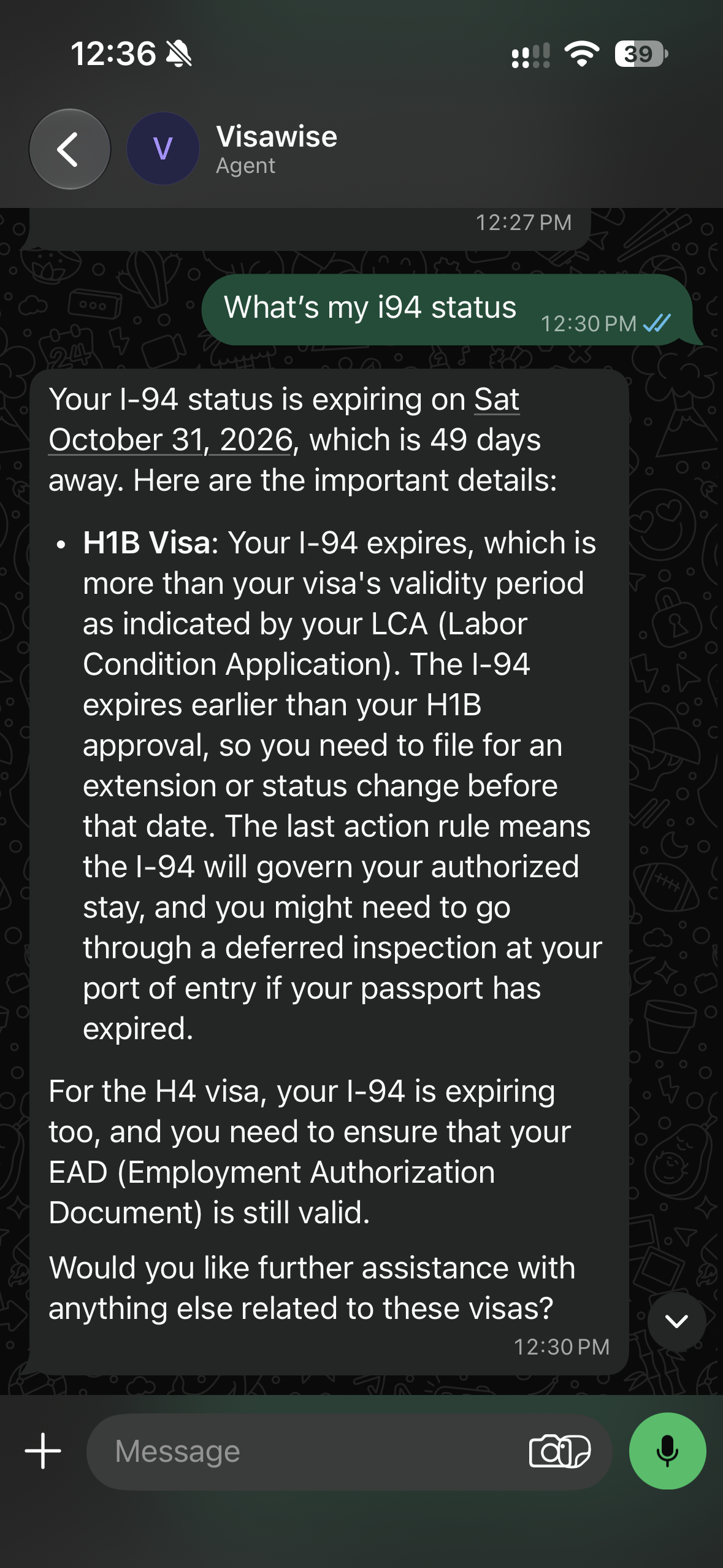
About a year later, several deadlines converged. His lease was up for renewal, an extension of his immigration status was in progress, and a trip to India had resulted in a new I-94 with a new “stay until” date, superseding the date on his I-797A.
He suddenly had to determine whether his lease would extend beyond his authorized stay, whether his immigration extension would be approved before his existing status expired and which document ultimately governed his status.
The realization extended beyond immigration paperwork. He was also managing his parents’ finances and insurance in India from thousands of miles away, keeping track of maintenance and payments for a family property, and juggling smaller financial obligations and accounts in both countries.
Each responsibility operated on its own timeline, with little connection between them. What initially seemed like a matter of remembering a few important dates had become an exercise in reconciling overlapping records involving immigration documents, leases, family finances and property obligations.
“Honestly, it was a brain drain,” he said.
That was when he realized the information could no longer simply remain in his head. “This needed to actually live somewhere, tracked deliberately,” he said.
That “brain drain” is a particularly revealing description of the experience of living on a temporary visa. The burden is not necessarily measured by the number of hours spent filling out forms. It is the constant awareness that something important could be approaching while a visa holder is simultaneously trying to work, travel, maintain a household and manage responsibilities thousands of miles away.
READ: No more 60 days? DHS targets H-1B, L-1 and other foreign workers (September 10, 2026)
“Honestly, it’s hard to put an exact number on it, and I’d be skeptical of anyone who gives you a precise figure.
But, I can tell you what it looks like for me. In an average month, it’s probably a few hours doing the following: checking a status, confirming a date, updating a record somewhere. But that’s misleading, because the real cost isn’t the active hours. It’s the background awareness that never fully turns off. You’re always half-tracking something like an extension in progress, a lease renewal approaching, whether a trip abroad is safe to plan yet. That doesn’t show up as hours on a clock, but it’s there constantly, in the back of your mind.
And that vigilance isn’t paranoia, the stakes are genuinely high. Get one of these dates wrong, or miss one entirely, and you’re not just late on paperwork, you can fall out of status.
Overstaying, even unintentionally, can mean accruing unlawful presence, which can trigger a multi-year reentry bar if you leave the country afterward. A missed extension deadline or a misread I-94 date isn’t a minor slip, it can mean months or years of consequences, sometimes for your whole family if their status depends on yours.
Then certain periods spike hard on top of that. Filing an extension, planning international travel, renewing a lease near a status deadline, these can each eat a full day or more of research, document-gathering, and double-checking that you haven’t missed something. And if you have dependents, a spouse on H4 for example, you’re not just tracking your own status anymore. You’re tracking theirs too, and their status is often tied directly to decisions you make about your own.
So, it’s not a huge number of clock-hours most weeks. It’s the constant low-grade vigilance, knowing that a single missed date could carry consequences you can’t easily undo, that actually wears people down. That’s the part that doesn’t show up in a time-tracking app, but it’s the real toll.”
For Kadambi, some of the most difficult parts were not necessarily the obvious ones. Immigration documents can look straightforward until different documents, travel and timelines begin interacting with each other.
“A few things surprised me more than I expected, given how much is supposedly at stake in getting them right:
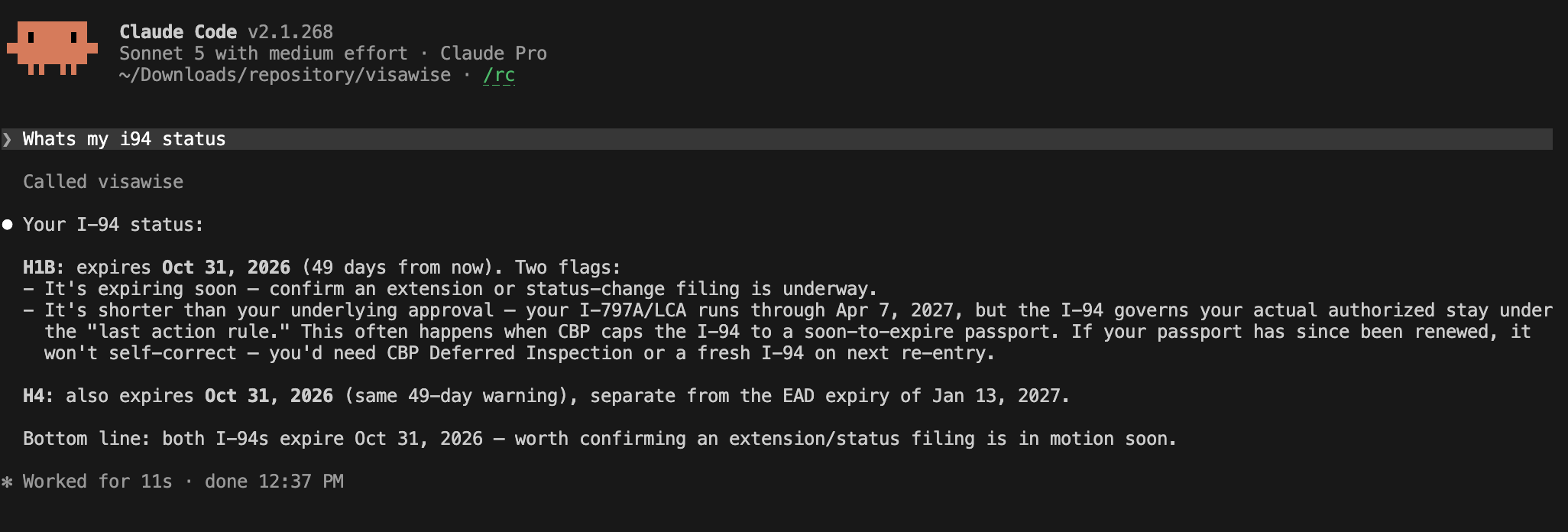
- The I-94 can silently override your approval notice. Your I-94 is supposed to match the validity date on your I-797B, but if it doesn’t, if the I-94 date is earlier, that shorter date is what actually governs how long you can stay. Nobody tells you this clearly. You just have to know to check.
- Every re-entry resets the clock, even over an existing valid document. I assumed once I had a valid I-797A with an attached I-94 slip, I was covered until it expired. But travel internationally and re-enter, and CBP issues a brand new electronic I-94 on the spot, one that overrides the older slip, whether the new date is better or worse for you.
- A visa stamp and an I-94 are not the same thing, and confusing them is genuinely risky. The stamp is what gets you back into the country. The I-94 is what governs how long you’re allowed to stay once you’re in. I’ve seen people (myself included, early on) assume that as long as their stamp was valid, they were fine, without realizing it says nothing about their actual authorized stay.
- The PERM-to-I-140 window is only 180 days. Once your labor certification is approved, the employer has to file the I-140 within 180 days, or it expires and the whole process, including recruitment, effectively starts over.
- There’s a second, unrelated 180-day clock after I-140 approval. Once your I-140 has been approved for 180 days, it’s protected, an employer withdrawing it afterward generally can’t undo it. But before that 180-day mark, if the employer pulls it or the company closes, you can lose the approval entirely. Two completely different 180-day rules, both quietly deciding whether years of paperwork still count.”
 The problem, Kadambi said, is that these details are rarely experienced as one connected timeline.
“None of these are obscure edge cases. They’re things that apply to a huge number of people on work visas, and there’s no single place that walks you through them as they actually happen to you, in order, with your own dates. You mostly learn them by almost getting them wrong.”
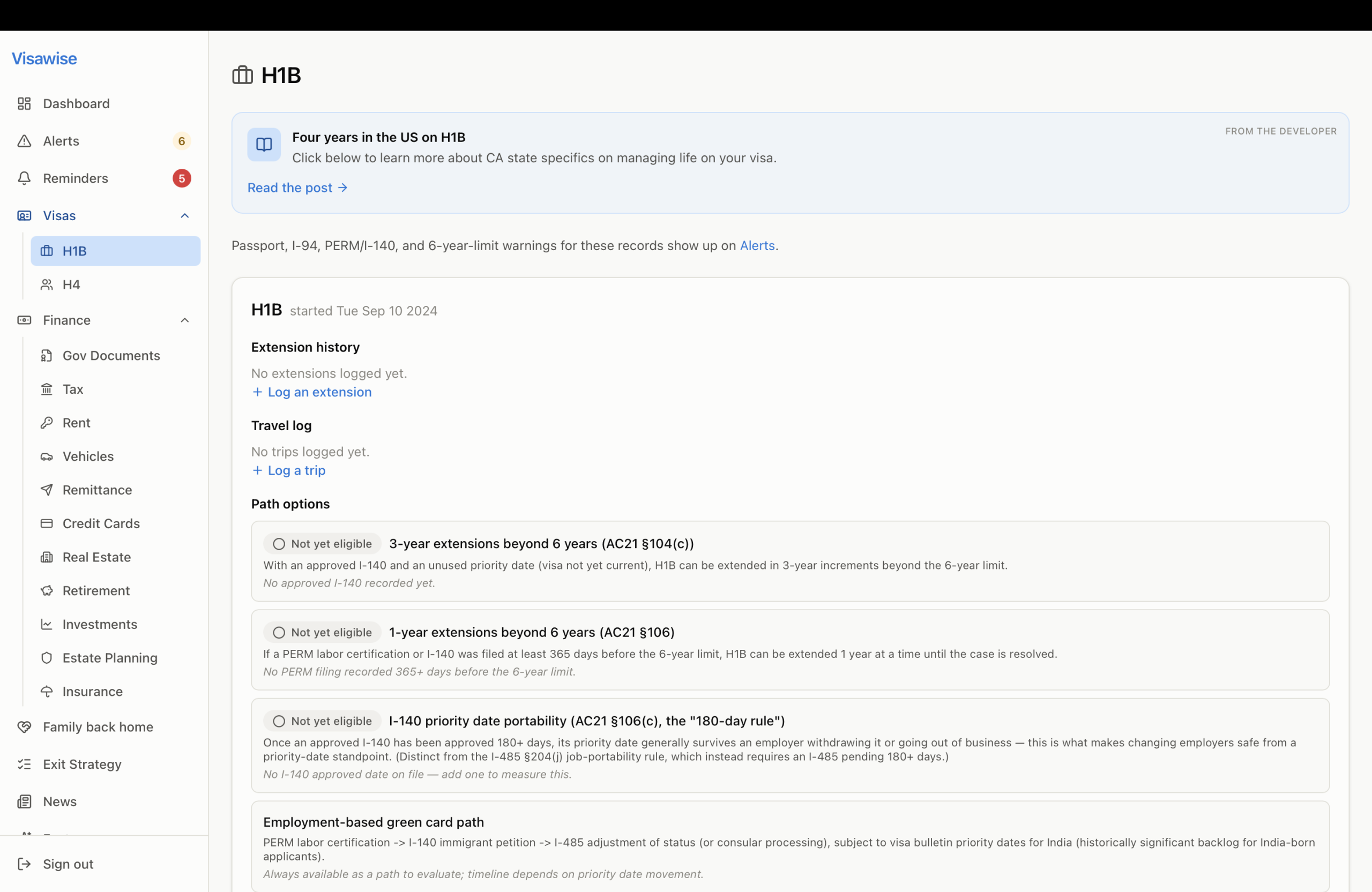
That experience eventually led Kadambi to build Visawise, a free desktop application for Mac and Windows that is currently in private beta. The idea came directly from the frustration of having important information spread across different places.
“At its core, Visawise gives you one place to put the things that used to live scattered across emails, notes apps, and your own memory. Your visa timeline, your finances across countries, and the people back home who depend on you keeping track of things too.”
A user enters their own information rather than connecting Visawise directly to government systems.
“When you sign up, you set up a profile (your birth country and destination country) and add your visa record, your visa type and your original start date. From there, Visawise computes the things that actually matter. Your status clock (like the H1B six-year timeline), your nearest key date, and how many days you have left, based on the rules for your specific visa type.”
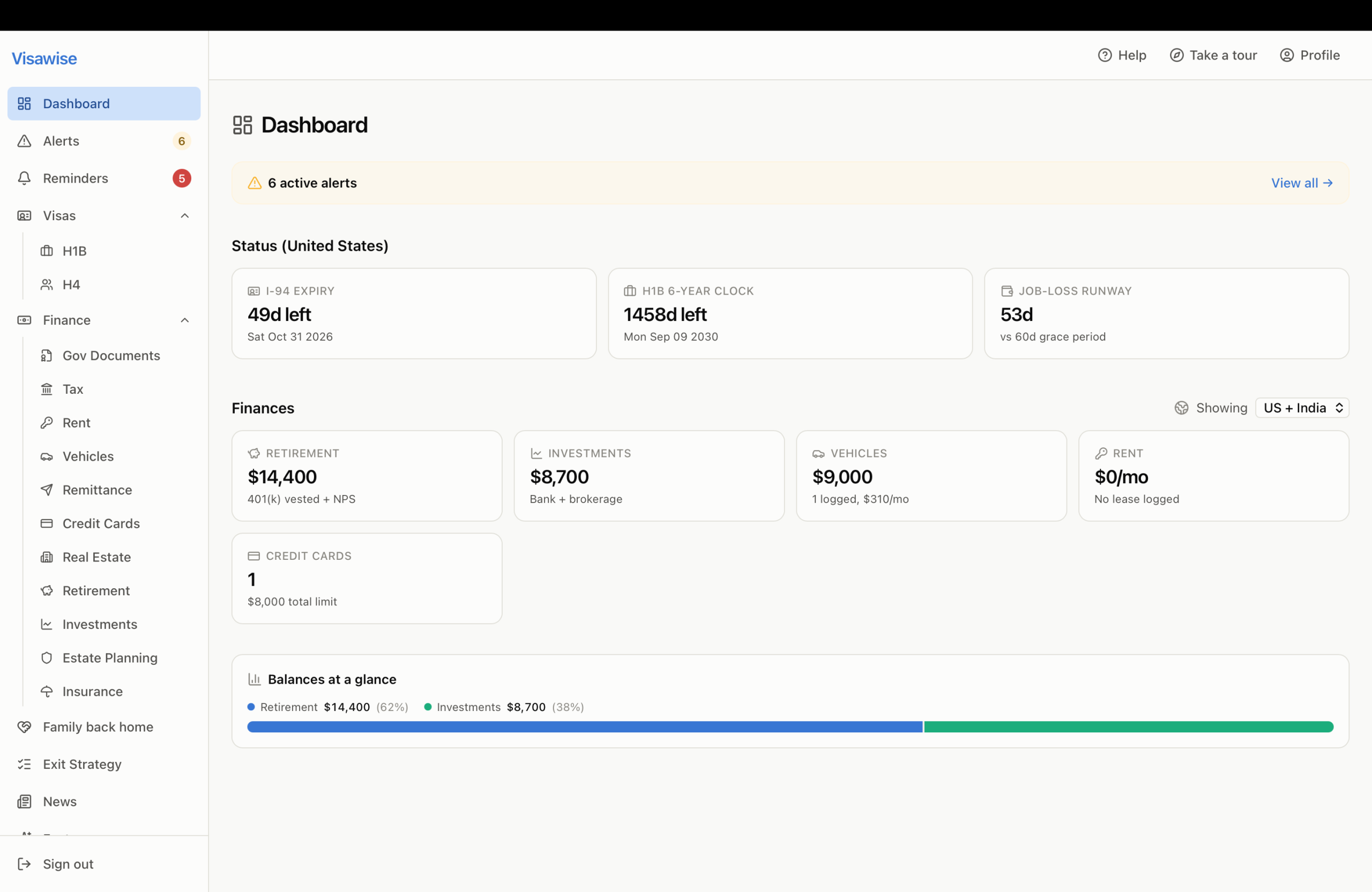
The dashboard is designed to bring together the different parts of an immigrant’s life that Kadambi found himself tracking separately.
“From the dashboard, you can go section by section and fill in the rest of your life as it actually applies to you:
- Visa details: your specific key dates (I-94 expiry and the like) and status attributes, entered as they happen to you
- Finance: gov documents, taxes, rent, vehicles, remittances, credit cards, real estate, retirement accounts (401(k), NPS, Social Security), investments, and estate planning, covering both US and India
- Family back home: the people, accounts, and assets you’re keeping track of on their behalf
- Reminders and alerts: a running list of what’s approaching or already overdue, surfaced automatically once you’ve entered the underlying dates”
But Kadambi draws a clear line between organizing information and automatically obtaining it.
“None of this pulls data automatically, you enter it yourself, the same way you’d enter it into a spreadsheet. The difference is that once it’s in, Visawise understands the relationships between these dates (which document currently governs your status, what’s about to expire, what depends on what) and surfaces that for you, instead of leaving you to reconstruct it from memory every time.”
The application also avoids asking users to store some of their most sensitive identifying information.
 “Visawise deliberately doesn’t ask for sensitive identifiers. No government ID numbers (no SSN, no passport number), no bank account numbers, no full credit card numbers, only the last 4 digits, the same amount a receipt would show you. For gov documents specifically, it tracks which ones you have or still need and their expiry dates, not the number itself. The goal is knowing what you have and when it needs attention, not holding onto the sensitive data itself.”
The current private beta includes H-1B and H-4 tracking, cross-border financial information, family information, a dashboard, onboarding tools, optional email reminders and a local-first desktop application.
“Right now, in private beta, here’s what’s actually working:
- Visa timeline tracking for H1B and H4, including status clocks (like the six-year H1B timeline), key dates, and automatically computed alerts as deadlines approach
- Cross-border finance tracking across the US and India – taxes, retirement accounts (401(k), NPS, Social Security), investments, real estate, vehicles, remittances, rent, credit cards, gov documents, and estate planning
- Family back home tracking for the people, accounts, and assets you’re keeping an eye on remotely
- A dashboard that surfaces what actually needs attention, instead of requiring you to check every section manually
- An onboarding checklist that nudges new users toward filling in the sections that make the dashboard actually useful, rather than dropping them into an empty app
- Optional email reminders, sent through your own Resend account if you choose to set one up, nothing sent on your behalf otherwise
- A local-first desktop app for Mac and Windows, free, with auto-updates, and your data stored on your own machine.”
Kadambi is also candid about the fact that Visawise is still being developed.
“It’s still early. Being in private beta means the feature set is going to keep evolving based on what people actually run into using it, which is a big part of why I’m sharing it now instead of waiting for it to feel ‘finished.’”
The connection between an H-1B holder and an H-4 spouse is particularly important to the platform because Kadambi experienced that dynamic himself.
“The core idea is that each visa holder in your household, yourself, and any dependents like a spouse on H4, gets their own record. So if your status is tied to your spouse’s, or theirs to yours, both timelines live in the same place instead of one of you tracking things in your head and the other tracking things separately, or not at all.”
Users enter key dates for each person’s immigration status, such as their start date and I-94, and VisaWise applies the rules for the relevant visa type to determine status timelines and which date governs their stay. Kadambi says the private beta still has gaps, including the lack of name fields for multiple dependents with the same visa type.
The platform is designed as “local-first,” with visa, financial and family data stored in a SQLite database on the user’s device rather than on Kadambi’s servers, with no cloud sync or account-based data storage. However, some limited information can leave the device: an anonymous usage ping, an update check and, if users configure them, optional email reminders sent through their own Resend account.
Kadambi added:
“That’s the complete list. No analytics SDKs, no ad trackers, nothing sold or shared. And the update check and telemetry both go to infrastructure I run myself, not a third party.”
The application is currently designed specifically for H-1B workers and their H-4 dependents rather than trying to cover every immigration category at once.
“Right now, specifically, H1B workers and their H4 dependents, spouses and children whose status is tied to the primary visa holder’s. That’s not a marketing choice, it’s literally who I built it for myself, on H1B, and my spouse, on H4.”
That narrow focus is deliberate.
“It’s not a general “immigrants” tool yet, even though that’s the direction I’d like it to grow toward. International students on F1/OPT, other employment-based visa categories, green card applicants further along in the process, these are genuinely different situations with different rules, timelines, and paperwork. Right now, the actual rules-pack logic, the specific key dates, the six-year clock, all of it is built and tested against the H1B and H4 experience specifically, since that’s the one I actually understand from the inside.”
He said expanding the platform is part of the long-term plan.
“Expanding to more visa profiles is an intentional part of the plan, not just a maybe. I just didn’t want to launch by guessing at rules for visa categories I’ve never personally navigated. Starting narrow and accurate, then expanding deliberately as I actually understand each new situation (or partner with someone who does), felt like the more honest way to build this.”
For now, Kadambi does not plan to charge users.
“Yes, it’s intended to stay free. There’s no pricing page planned, no premium tier, no ads.”
The reason is partly practical and partly personal.
“Part of why is practical. It genuinely doesn’t cost much to run. It’s a desktop app with no server-side infrastructure to speak of, your data lives on your own machine, so I’m not paying to host or store anyone’s information. The small pieces of infrastructure it does use run on free tiers of existing services, so at this scale the actual cost to me is close to zero.”
He continued:
“The other part is simple. This is a weekend passion project for me. I built it because I genuinely needed it and use it myself, and I intend to keep improving it in my own time, adding more visa types and covering more of what people actually run into as I go, because I want the tool I wish existed to actually exist, for myself and for other people in the same situation.”
Building a product around sensitive immigration and financial information led Kadambi to make it a local-first desktop app rather than a cloud service, keeping visa documents, financial details and family information off remote servers. “The stronger guarantee isn’t ‘trust my server security,’ it’s ‘there’s no server holding this at all,’” he said.
Kadambi also designed the app to minimize sensitive data collection, storing only the last four digits of cards and tracking government ID expiration dates without storing the numbers themselves. He also built installation-specific security credentials and emphasized precise privacy claims, saying, “I’d rather be precisely honest than broadly reassuring.”
Kadambi also makes no claim that immigration attorneys or CPAs have formally validated the platform’s rules.
“The rules built into Visawise right now come from my own lived experience navigating H1B and H4 status, plus my own careful research into the actual USCIS and CBP rules, the kind of research I did specifically because I got burned by not knowing things like the I-94-versus-I-797B precedence issue we talked about earlier. But that’s different from having an immigration attorney or a CPA formally review the logic and sign off on it.”
He said professional review is something he hopes to pursue.
“That’s actually exactly why the disclaimers exist throughout the app, on the rent page, the vehicles page, the H1B status banner, everywhere. They’re not boilerplate. They’re there because I know the difference between “I researched this carefully” and “a licensed professional has validated this,” and I don’t want anyone mistaking the first for the second.”
He added:
“Bringing in actual professional review, an immigration attorney checking the rules logic, a CPA looking at the tax-related sections, is something I’d genuinely like to do as this grows. It’s not something I can claim has already happened, and I’d rather say that plainly than let the disclaimers do the work of hiding that gap.”
In an exclusive update to The American Bazaar, Kadambi also shared what could be coming next for Visawise. Future releases are expected to explore integration with large language models, including Claude and open models, as well as WhatsApp custom-agent integrations.
The planned features are intended to follow the same user-controlled approach as the rest of the application, with users controlling the AI and WhatsApp agent integrations in their own environments.
The longer-term ambition is to make the platform useful beyond the H-1B and H-4 population, but Kadambi said he wants that expansion to happen only when the relevant immigration rules can be handled responsibly.
That approach also explains why he does not define success simply through downloads or user numbers.
“Honestly, success for me isn’t a user count or a growth chart. It’s whether the people actually using it a year from now would say it removed real anxiety from their lives, the same anxiety I described at the start of this conversation.”
He said the anonymous usage data can provide one measure of whether people are actually relying on the product.
READ: DHS changes green card rules for children born to foreign government employees (September 5, 2026)
“I do have some real signal to go on, though, not just anecdotes. The anonymous usage data I mentioned earlier, which sections people actually fill in, and how many active installs there are, tells me honestly whether people are using this or if it’s sitting untouched after download. A year out, I’d want to see that data showing real, ongoing use, not just a download followed by silence, since that’s the difference between “people liked the idea” and “people actually trust it with their information over time.”
And ultimately, his benchmark is whether the application can prevent another H-1B holder from experiencing the same uncertainty he did.
“More concretely, a few things I’d genuinely hope are true a year out that it covers more than just H1B and H4 by then, because people in other visa situations reached out and told me what they needed. That the rules and alerts have had real eyes on them beyond just mine, ideally an immigration attorney or a CPA who’s actually reviewed the logic, not just me researching carefully on my own. And that there’s a small group of people who’ve been using it long enough to have caught a deadline they would have otherwise missed, because that’s the entire reason I built this in the first place.”
His definition of success comes back to the same anxiety that started the project.
“If a year from now it’s still free, still local-first, still something people trust with information this sensitive, the usage data shows people actually returning to it, and it’s helped a handful of people avoid the kind of scare I had, that’s success to me. Everything else, growth for its own sake, matters much less than whether it’s actually doing the one thing it was built to do.”
So why not simply use a spreadsheet?
Kadambi has a straightforward answer.
“I get this question a lot, and it’s fair. A spreadsheet can absolutely hold the raw data, dates, names, numbers. What it can’t do is understand the rules.”
He explained:
“Take the I-94 example, the fact that a fresh I-94 on re-entry can override the date on your existing I-797A isn’t something a spreadsheet knows or flags for you. You still have to remember that rule yourself, notice the conflict yourself, and manually recalculate what it means for your lease, your extension, everything downstream. A spreadsheet stores information. It doesn’t understand what that information means or when it should be raising a flag.”
There is another problem, he said: remembering to check the spreadsheet in the first place.
“The other problem is that a spreadsheet only works if you remember to open it. It doesn’t proactively tell you a deadline is approaching, doesn’t tie your visa clock to your lease dates automatically, and doesn’t surface what actually needs your attention this week versus what’s fine for now. That’s the exact same “living in my head” problem, just moved into a different file.”
And that brings Kadambi back to the experience that started the entire project.
“What I actually needed wasn’t a place to store data. It was something that understood the relationships between these documents, computed my real status automatically, and told me what mattered before it became urgent. That’s a fundamentally different thing from a spreadsheet, even a very well-organized one. At some point building that logic properly just becomes software, whether you call it that or not.”