



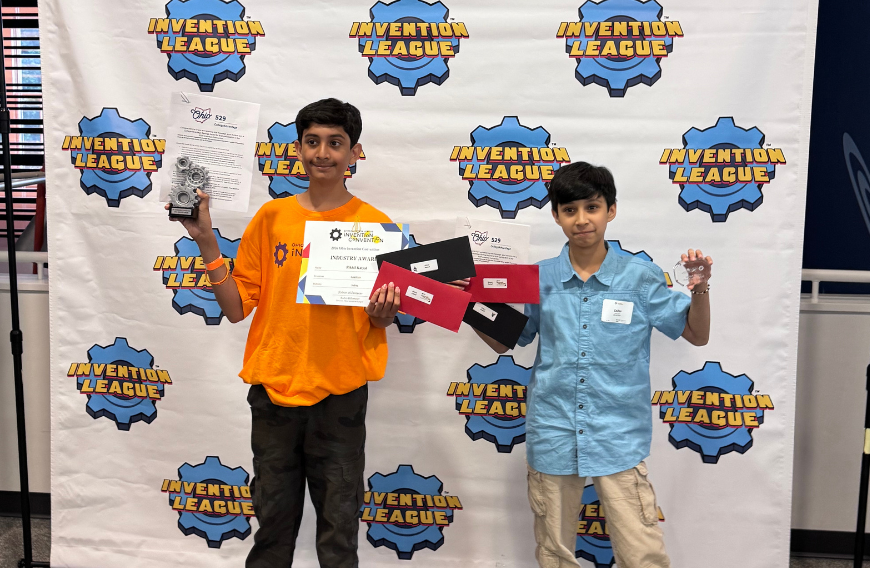
Two Indian American brothers from Powell, Ohio, are turning everyday observations into inventions designed to solve problems that affect people around them.
Rikhil Katyal, 13, and his younger brother Zaiden Katyal, 11, both took home major honors at the 2026 Ohio Invention Convention Showcase and Awards Ceremony, held July 18 at COSI in Columbus.
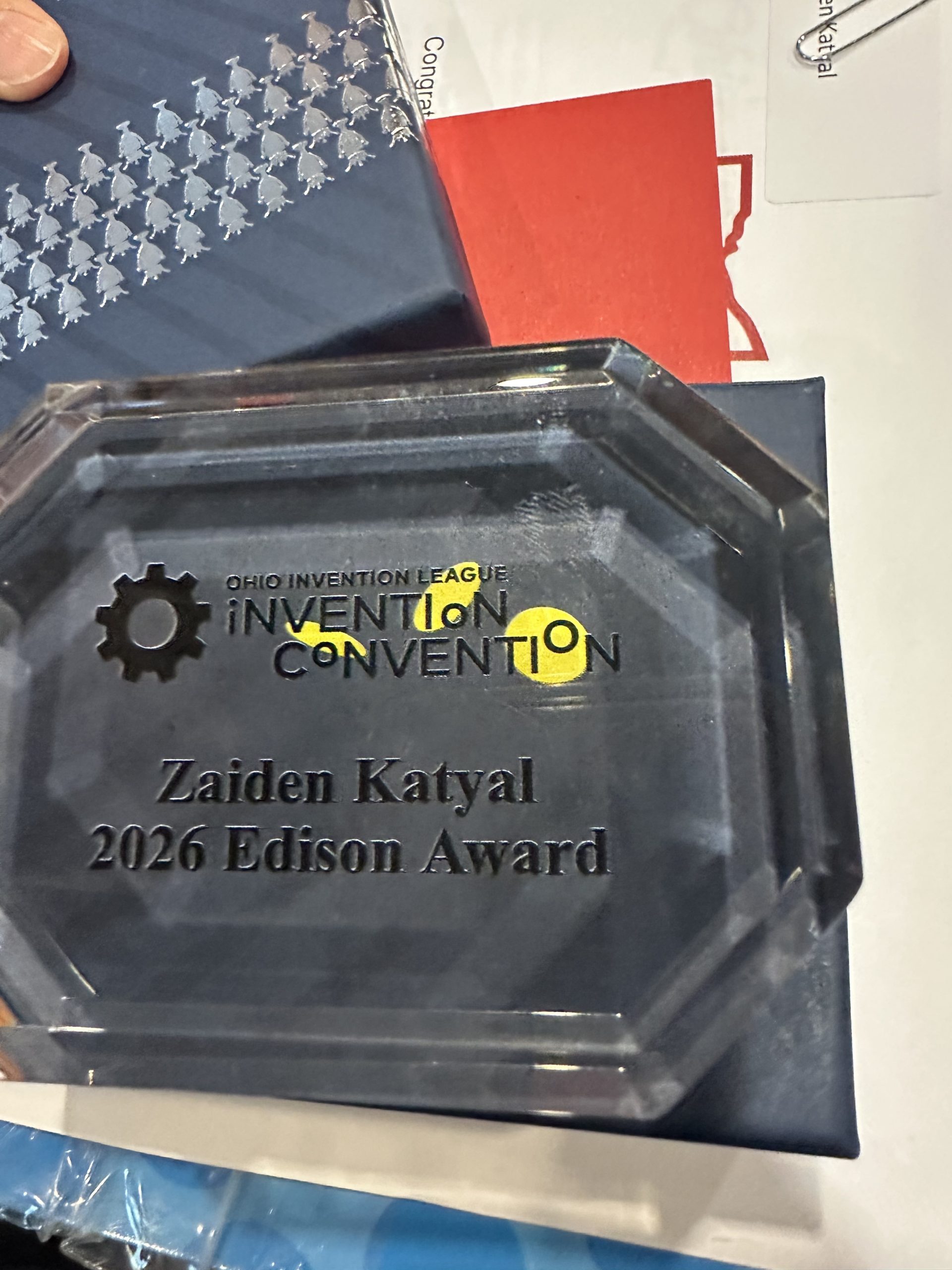
Zaiden, now a sixth grader, received the Grand Prize Edison Award in the kindergarten through fifth-grade division for MicroClean, a prototype that detects airborne microplastics and filters them through a three-stage system.
Rikhil, an eighth grader, received the Industry Safety Award for SafeHalo, a prototype designed to warn young e-bike and personal-mobility riders about hazards and instability before a crash.
The recognition puts both brothers on the path to represent Ohio at the Invention Convention U.S. Nationals.
For the two young inventors, however, the projects are about more than competitions. Their ideas have grown out of things they have seen, experienced and questioned, including during family trips to India.
Zaiden’s idea for MicroClean took shape after a visit to Delhi, where the city’s pollution made him think about what people might be breathing without realizing it.
READ: Neha Gupta wins inaugural Deepak Raj Rising Star Award (September 17, 2026)
Speaking exclusively to The American Bazaar, brothers Rikhil and Zaiden Katyal opened up about the experiences that shaped their inventions, their connection to India, the role their parents played in supporting their work, and what they hope other young students take away from their journey.
Zaiden’s idea for MicroClean took shape after a visit to Delhi, where the city’s pollution made him think about what people might be breathing without realizing it.
“I remember a lot of pollution, and I could feel dust when I was breathing in India.”
During his research, Zaiden also came across an article about a mother in Delhi whose baby was hospitalized. He said the story made him think further about the effects of pollution.
“I read an article about a mom in Delhi whose baby was in the hospital and refused to drink water or milk from a bottle because of constant coughing from the pollution there.”
Zaiden then began looking into microplastics, a less visible component of pollution that he said is becoming a growing concern as plastic production increases.
“Microplastics are a newer part of pollution, but they affect everyone, and they’re silent – you can’t see them. From what I researched, they can cause really severe health problems like strokes and heart problems and lung problems. And it’s a man-made problem that’s only growing as plastic production grows.”
His experience traveling between the United States and India also influenced the way he looked at the problem.
“Being Indian let me see more of the world when we travel to India, and that’s what inspired me to build MicroClean,” he said. “In some places in India you see streets littered with plastic and other waste. I think people don’t know it’s causing microplastics in the air that are harming all of us.”
Rikhil has similarly drawn inspiration from what he has observed during trips to India. His award-winning SafeHalo was developed with young riders in mind after he noticed the risks faced by his own friends while riding e-bikes.
“My friends and I ride e-bikes together all the time, and I saw a lot of them crash and get hurt.”
The project could have applications beyond e-bikes, he said. During a recent trip to India, Rikhil noticed another group of riders navigating busy roads.
“On a recent trip to India I went to a lot of different cities and saw so many people on motorcycles —whole families crammed together on one bike in hectic traffic. I think SafeHalo could be used for motorcycles too.”
Building an invention from an idea is not always straightforward. Rikhil said creating a working prototype required him to learn about components and how they fit together largely through trial and error.
“Making a working prototype was the hardest part. I had no knowledge of the parts or how to put them together, so I had to learn as I went. I watched YouTube videos and read how other people fixed it when it wasn’t working after I connected the pieces,” he noted.
The brothers have already worked on six invention projects between them before either has reached high school.
Rikhil’s earlier work includes Cyberbud, a project focused on cyberbullying and online safety, and Allagon, an early concept for a handheld device that would use light spectroscopy to scan food for ingredients that could trigger allergies in children. Allagon did not progress to a working prototype.
Zaiden previously developed Robraille, an accessibility-focused project that won third place at an earlier Ohio State Invention Convention. He also created ScamZapper, a fraud-prevention project that received an Industry, Government & Safety Award.
Their parents have played an important role as the brothers moved from ideas to physical prototypes.
“They helped me whenever I struggled by encouraging me, and when my sensor broke and MicroClean wasn’t working, they bought me a new sensor to get it working again,” Zaiden said.
Rikhil said his parents have also encouraged him to keep experimenting when a project does not immediately work. “My parents encouraged me and pushed me to keep inventing and to keep trying when I was building a prototype. Now they’re helping me turn these inventions into real businesses for when I grow up.”
The brothers’ success also reflects the diversity of young inventors taking part in the Ohio competition, according to Rikhil.
READ: Indian American student wins entrepreneurship and AI pitch competition (March 11, 2026)
“The competitions are really diverse, and there are other Indian Americans there. The competition is actually really tough.”
For the brothers, their Indian American background has given them another perspective from which to look at everyday problems, but they also want other children to see invention as something accessible to them.
“Inventing is for everyone, because it’s about solving real problems. Sometimes you have a unique perspective to solve something that no one else has,” Rikhil said.
Zaiden echoed that idea, emphasizing that invention is not simply about producing a finished device.
“Inventing is for everyone! It’s not just about making something. It’s about the thought and the process that comes with it for future inventions.”
With MicroClean and SafeHalo now headed toward further testing and the national competition, the brothers plan to continue gathering feedback from engineers, environmental researchers, riders and safety professionals.
For Rikhil and Zaiden, the journey from observing a problem to building a possible solution has already begun. And before either brother has even entered high school, they have shown how curiosity, family support and experiences across two countries can become the starting point for new ideas.