



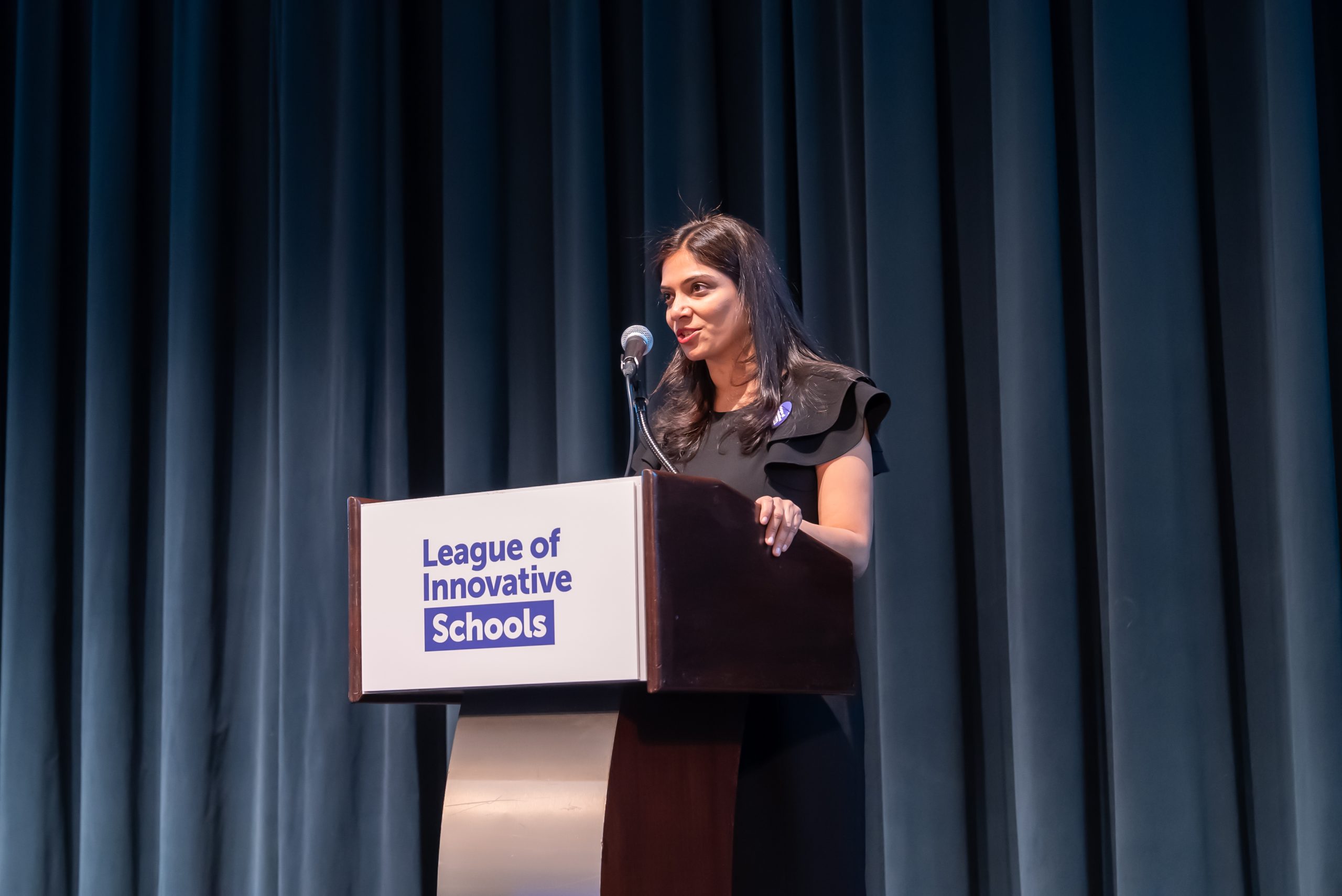
Education has never suffered from a shortage of people trying to reinvent it. New technologies, teaching models, and reforms regularly promise to transform how children learn, but far fewer make the journey from a promising idea to something that works across real classrooms and communities. As artificial intelligence brings a new wave of possibilities, distinguishing meaningful change from innovation for innovation’s sake has become increasingly important.
Chaula Gupta has spent more than two decades grappling with that challenge from different sides of the education ecosystem. Born and educated in India before building much of her career in the United States, she has worked with social entrepreneurs at Ashoka, education entrepreneurs at Teach For America, school leaders in Chicago, and now educators and innovators at Digital Promise.

As vice president and chief program officer at Digital Promise, Gupta oversees national programs and a growing international portfolio focused on research, technology, and innovation in education. Her perspective is grounded in a lesson that has followed her throughout her career: A good idea alone is rarely enough. What matters is whether it can reach students and educators, adapt to different communities, and create lasting change.
In this conversation, Gupta reflects on what two decades in education have taught her about scaling innovation, the opportunities and limits of AI, what India and the United States can learn from one another, and how schools can better prepare young people for the world they will inherit.
1. You began your academic journey in India and have now spent more than two decades working across education, social entrepreneurship, and innovation in the United States. Looking back, what first drew you to education, and what has kept you committed to it?
I would say that I fell into education rather than making an intentional choice to work in the sector. I have always known that I wanted to do purposeful work, alongside good people, with opportunities for professional growth. I followed where that search led me, from social entrepreneurship to education entrepreneurship and then to public education more broadly. I am glad to say that what I am doing now combines all three of my must-haves: purpose, people, and professional growth.
What I find fascinating about the field of education is that it forces you to take a future-forward outlook. We are looking 15 to 20 years into the future and asking: What will the world be like then? What do kids need to learn now to be ready for the challenges and opportunities of that future world?
The vast majority of people you meet in education are future-looking optimists who believe that all children, no matter their circumstances in life, deserve an education that is meaningful and fulfilling. It is a privilege to work alongside them and help answer these questions in partnership with students and families.
2. You have worked with social entrepreneurs, school leaders, funders, researchers, and technology organizations. After seeing education reform from so many different angles, what do you think we still misunderstand about how meaningful change actually happens?
Working in education can sometimes be frustrating because the needle on educational outcomes moves slowly. Scale doesn’t work in education the way it works in some other social sectors. In health care, for example, if you figure out a new vaccine or a new treatment, you can scale it across the world with a fair amount of fidelity in implementation and outcomes.
But in education, scale means significant adaptation, not just replication. Districts, schools, and communities can take an idea that has worked elsewhere, but they have to translate and adapt it for their context. For instance, if the math textbook I used growing up in India taught me fractions using pies or asked me to calculate profits for a lemonade stand, I might get the right steps, but I wouldn’t connect with the problem at all. But if it asked me to calculate how many bags of Holi powder I need for a group of 20, if each bag is enough for four, I immediately connect with the problem, and the learning outcomes last longer.
Now scale this across all subjects and grade levels and think about the effort needed to scale. People get frustrated with the slow pace and keep trying to fund silver bullets that inevitably fail to show outcomes.
So, if you want meaningful change, fund the people, not the ideas. Fund communities. They will find the best ideas and make them work for their context.

3. We are at a moment of enormous excitement around AI and education. Where do you see genuine potential for AI to improve how young people learn, and where do you think we need to be more cautious about assuming technology itself is the solution?
Public education has survived several new developments that were meant to completely upend and disrupt it, including the commercial internet in the 1990s, personal computers in the 1980s, and even the graphing calculator in the 1970s.
What’s different about AI is the pace of its evolution. By the time a district has culled through dozens of AI tools, vetted and selected a tool, trained educators on it, rolled it out, and just started to collect data, AI models have already evolved exponentially, making the district wonder if they bought the wrong tool.
This is why any AI strategy in education should first focus on teaching and learning goals, and then explore how technology can advance them. Second, build a foundation of AI literacy for everyone, students, educators, and even parents, so everyone can develop good judgment about which uses of AI promote deep learning and which cause cognitive offloading. Lastly, rather than relying entirely on vendors, build internal capacity among staff to wield and refine AI tools as needed.
4. A recurring theme in your career has been taking promising ideas and helping them reach more people. What separates an innovation that looks exciting in a pilot from one that can actually scale and create lasting impact?
The first thing I ask is: Is this a solution in search of a problem?
There are lots of innovations that attempt to solve the symptoms of a problem without ever getting to its root cause. Some even make the problem worse. For example, many social enterprise companies that use the Buy One Donate One model only end up padding their profits while destroying local maker economies. The One Laptop Per Child education initiative failed because it delivered mini-laptops to classrooms that had no electricity, connectivity, adequate teacher training, or access to basic repair parts. So first, I always look for problem-solution fit.
Second, I look at the entrepreneur behind the idea. A strong entrepreneur can take a mediocre idea and refine it based on user feedback until it is truly excellent. I look for entrepreneurs who are motivated by a desire to solve the problem, rather than simply to be an entrepreneur. I look for people who will not rest until they have had a lasting impact on the problem.
READ: Education and India’s long argument with the future (
5. With roots in India and much of your professional life spent in American education, you have a particularly interesting vantage point on both countries. Where do you see opportunities for India and the United States to learn from one another when it comes to education, technology, and innovation?
Every year, my team at Digital Promise organizes a global convening that brings together leaders from across the world in a city to study that education system’s unique strengths. For instance, whole-child learning in Finland, digital equity in Uruguay, and AI for teaching in China. So, we are constantly looking for opportunities for education systems to learn from one another.
The Indian education system is remarkable for the pace and scale of change. A national AI curriculum is being implemented starting this school year. India has rolled out national AI literacy programs, digital education platforms, and teacher training across the country. That kind of scale and pace is enviable for U.S. education systems.
Meanwhile, U.S. systems allow for a lot more locally driven policy and innovation. Parent voice and engagement matter a lot to principals and superintendents.
I think the two systems can borrow from each other and find an equilibrium between national scaling initiatives and local influence over how schools serve students.
6. After more than 20 years in this work, what gives you the greatest hope about the next generation of learners and educators, and if you could change one thing about how we prepare young people for the future, what would it be?
What I admire about today’s learners is how deeply they care about their community and their environment. They are savvy about the interconnectedness of global systems, they know what their rights are, and they are not afraid to demand them. And so, we need to start treating them as the active agents of their lives that they are, rather than as passive receivers to be filled with facts and information.
I would like schools to mirror the real world that their students are graduating into. In the real world, initiative trumps compliance, problem-solving trumps mindless repetition, competence trumps tenure, and often collaboration trumps competition.
But schools still prioritize obedience, test scores without meaningful application, grade-based movement, and competition among students. We need to better align the learning that happens in schools with the skills required in the real world: executive functioning, reasoning, decision-making, communication, collaboration, and many more future-ready skills.
Pragya Raj Singh is a development professional working at the intersection of global partnerships, social innovation, and India-U.S. engagement.