



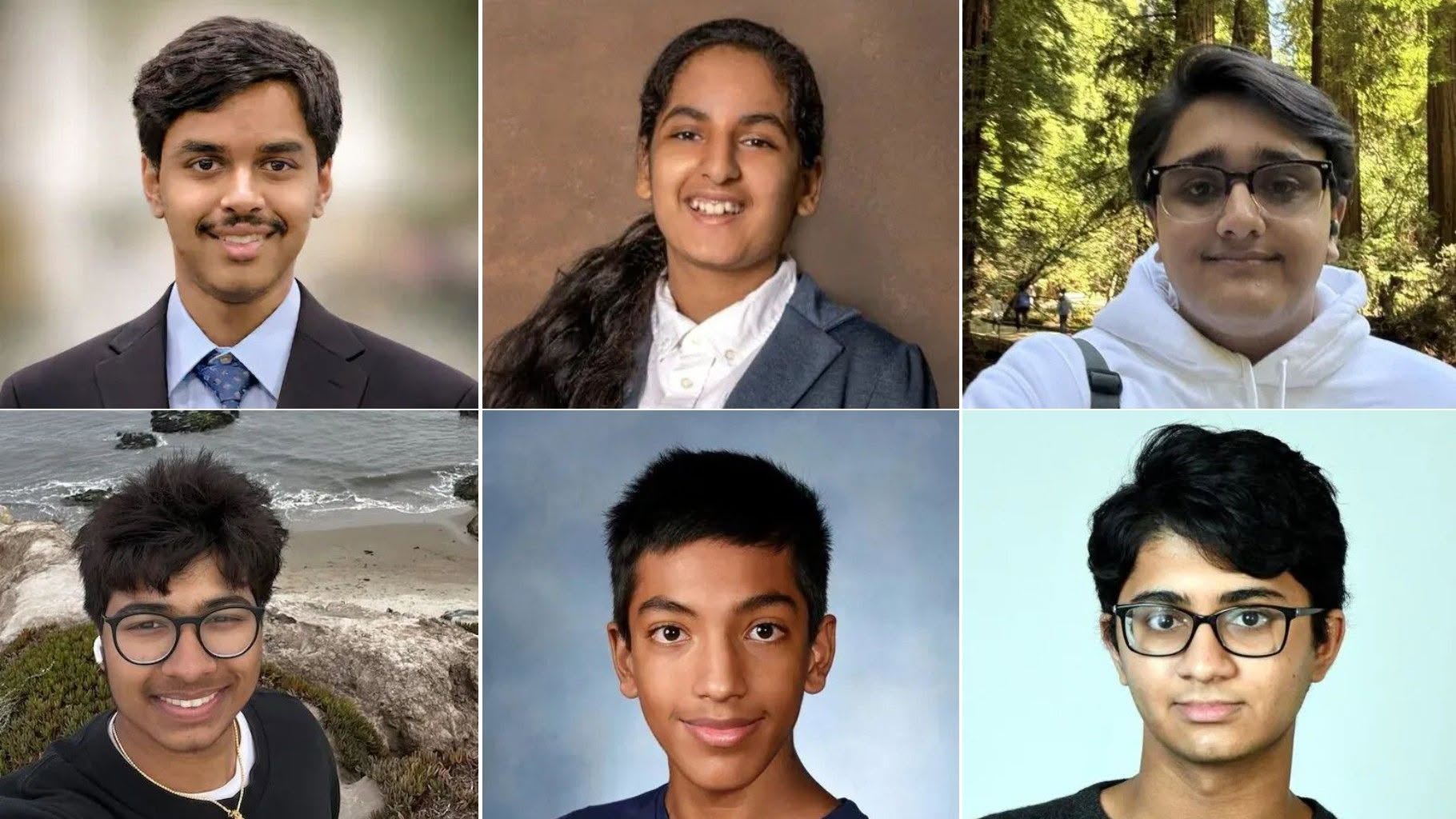
Six Indian American students are among the recipients of the 2026 Davidson Fellows Scholarship, earning awards of up to $100,000 for ambitious scientific work addressing challenges ranging from aviation safety and crop disease to nuclear energy, malaria prevention and drug discovery.
Aditya Sengupta, 18, of Bellevue, Washington, received the program’s top honor – a $100,000 Davidson Fellow Laureate scholarship – for developing a system designed to improve predictions of clear air turbulence.
Four other Indian national students earned $50,000 scholarships: Tanishka Aglave of Valrico, Florida; Hitaishi Chillara of Leander, Texas; Praadhyumn Indaana of Montvale, New Jersey; and Rajarshi Mandal of Lexington, Massachusetts. Pavan Subramani of Morgantown, West Virginia, was awarded a $25,000 scholarship.
The Davidson Institute awards $100,000, $50,000 and $25,000 scholarships to students 18 and younger for significant work in fields ranging from science, technology and mathematics to literature, music and philosophy.
For Sengupta, the inspiration came from something familiar to millions of air travelers: unexpectedly rough skies.
After experiencing sudden and frightening turbulence on flights, he began wondering why the phenomenon – which can occur without visible clouds or storms – remains so difficult to predict.
His answer was ForeCAT, a machine-learning system that combines atmospheric physics with computing to predict the likelihood and severity of clear air turbulence. Sengupta said his results showed significant improvements over existing forecasting approaches used in aviation.
“Being named a Davidson Fellow is an incredible honor because it gives me the opportunity to join a community of young people who are curious, ambitious, and passionate about using their ideas to improve lives,” he said.
READ: 7 Indian American sophomores win Wisconsin University research fellowships (
Sengupta is also involved in robotics and STEM outreach. His VEX Robotics team placed first in the United States and second at the World Championship, and he has earned recognition at the Regeneron International Science and Engineering Fair and National Junior Science and Humanities Symposium. In college, he plans to study computing and the sciences.
For 17-year-old Tanishka Aglave, the scientific problem she set out to solve was much closer to home.
The daughter of a Florida citrus grower, Aglave watched citrus greening disease damage trees and threaten farming families across the state. The experience sparked her interest in plant pathology and led her to search for an environmentally friendly way to combat the devastating disease.
Her approach combines a bactericide derived from curry leaf extract, localized thermal therapy to help plants absorb the treatment and a computer-vision application that allows growers to assess disease severity from photographs of leaves.
Aglave spent more than 300 hours refining the treatment and its delivery system. When conventional trunk-injection syringes leaked and injured young trees, she designed and tested 3D-printed prototypes until she developed a smaller infusion system.
“I hope my work gives citrus growers hope and can help support the rejuvenation of citrus farming in Florida,” she said.
A senior at Strawberry Crest High School IB in Tampa, Aglave has received top honors at the Regeneron International Science and Engineering Fair, and her findings have been published in the American Phytopathological Society’s Plant Disease journal.
While Aglave looked to Florida’s citrus groves, Hitaishi Chillara, 17, turned his attention billions of miles outward – to the relationship between galaxies and the supermassive black holes at their centers.
Chillara, a student at the Texas Academy of Mathematics & Science, developed a computational framework combining cosmological simulations, telescope observations and machine learning to investigate whether the colors and brightness of galaxies can offer clues about the mass of these celestial objects.
His work could help scientists make greater use of the enormous quantities of imaging data produced by sky surveys, including the Vera C. Rubin Observatory’s Legacy Survey of Space and Time.
Chillara’s interest in artificial intelligence began unexpectedly with a toy robot dog. Curious about how it remained balanced while walking, he began exploring inverse kinematics and robot learning. He now hopes to study astrophysics and electrical engineering and pursue work connecting AI, astronomy and robotics.
“I am grateful to be named a Davidson Fellow,” Chillara said, adding that he hopes to encourage other young people to develop the same habit of careful questioning that guides his scientific pursuits.
Praadhyumn Indaana applied a different intersection of physics and computing to the challenge of nuclear energy safety.
Indaana, 17, developed a physics-guided neural network to improve predictions of critical heat flux — a dangerous threshold in nuclear reactors at which heat transfer can suddenly deteriorate.
Working independently over eight months, the Stanford Online High School student trained the system using data from more than 10,000 experiments. It reduced average prediction error from a 63 percent baseline for conventional physics formulas to 5.5 percent.
Indaana’s interests span materials science, quantum physics, computing and nuclear fusion. He was invited to the USA Physics Team camp as a top-20 participant in the U.S. Physics Olympiad and has achieved Gold level in the USA Computing Olympiad. He intends to major in physics.
Sixteen-year-old Rajarshi Mandal applied mathematics to another global challenge: preventing malaria.
A rising junior at Lexington High School, Mandal developed a modeling approach aimed at determining how limited supplies of insecticide-treated mosquito nets can be distributed for maximum impact.
Rather than allocating nets primarily according to population, his model incorporates changing factors such as insecticide resistance, climate-driven fluctuations in malaria transmission and the deterioration of nets over time.
In testing, Mandal’s approach prevented twice as many infections using the same number of nets, according to information accompanying his fellowship.
Mandal has pursued advanced mathematics and computing beyond his high school curriculum, with a particular interest in applying those skills to problems in health and biology. Away from academics, he is an accomplished pianist who has performed twice at Carnegie Hall and holds a black belt in karate.
Pavan Subramani, 17, turned to computational science in search of a faster route to potential new medicines.
Subramani became interested in drug discovery as a sophomore after reading about a promising pharmaceutical treatment targeting a protein involved in inflammatory conditions that ultimately failed in clinical trials. Wanting to understand why, he taught himself Python and began modeling and screening therapeutic compounds on his laptop.
His work focuses on the Receptor for Advanced Glycation End products, or RAGE, a target associated with inflammatory diseases. Subramani developed an approach combining generative diffusion models with molecular dynamics simulations to speed the process of identifying potential drug candidates.
Using deep neural networks, his framework filtered a database of 883 million compounds and identified small-molecule candidates predicted to have stronger affinity for RAGE and better safety profiles than existing alternatives.
The project earned Subramani a third-place Grand Award in chemistry at the Regeneron International Science and Engineering Fair. A senior at Morgantown High School, he is interested in computational chemistry and biophysics and plans to major in chemistry or applied physics.
Beyond academics, Subramani founded The Substance Safety Project, a nonprofit focused on substance-abuse advocacy that has raised more than $10,000, distributed 750 drug-disposal packets and conducted educational workshops reaching more than 1,500 people.
The Davidson Institute, a national nonprofit supporting profoundly gifted young people, established the Davidson Fellows Scholarship to recognize students who have completed significant work with the potential to benefit society. The program has awarded more than $10 million in scholarships.
Taken together, the six young scientists are drawing on fields ranging from artificial intelligence and physics to biology and mathematics to pursue questions with implications far beyond the classroom.