



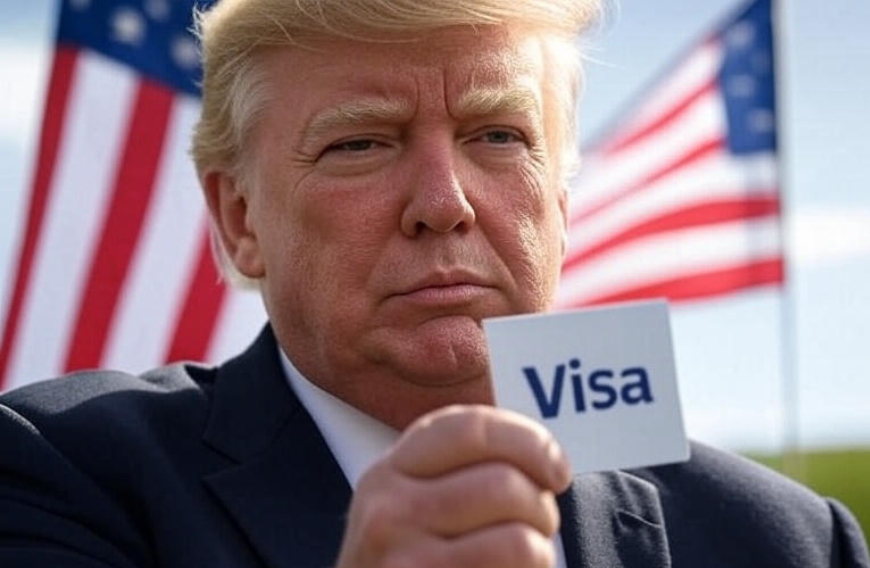
President Donald Trump has signed an executive order directing federal agencies to scrutinize H-1B visa applications from employers that have recently laid off, or plan to lay off, similarly situated U.S. workers.
The order, signed on September 18, directs the Secretaries of State, Labor and Homeland Security to consider an employer’s recent or planned layoffs when processing H-1B labor condition applications, petitions and visas. The administration says the move is intended to strengthen oversight of the H-1B program and prevent employers from using foreign workers to displace American employees.
Under the order, the Department of Labor will also begin, within 30 days, reviewing data from previously submitted labor condition applications to determine whether additional action against sponsoring employers may be warranted under federal law.
The White House said the policy will involve greater coordination among the Departments of State, Labor, Homeland Security, Commerce and Education, as well as the Small Business Administration. Agencies will share information related to wages, employment conditions, industries and job specialization when administering the H-1B program.
The executive order follows the Trump administration’s broader effort to tighten oversight of the H-1B program, which allows U.S. employers to hire foreign workers for specialty occupations.
The White House has alleged that some employers and outsourcing companies have abused the program by hiring lower-paid foreign workers and displacing U.S. employees. The executive order cites cases in which U.S. workers were allegedly laid off and later replaced by H-1B workers. Those assertions are part of the administration’s justification for the new policy.
The order also says agencies have identified potential violations involving H-1B employers, including alleged misrepresentation of job duties, working conditions and worker qualifications.
Separately, Trump signed a proclamation renewing a $100,000 fee requirement for certain new H-1B visa applications, extending a measure first introduced in September 2025. Current H-1B visa holders and certain workers already covered by the program are treated differently under the administration’s rules.
The $100,000 fee has faced legal challenges. Reuters reported that a federal appeals court is reviewing the administration’s appeal of a ruling that blocked implementation of the fee.
The latest executive order does not itself prohibit employers from laying off U.S. workers and subsequently sponsoring H-1B workers. Instead, it instructs federal agencies to take such layoffs into account when reviewing H-1B-related applications and directs the Labor Department to review previously filed applications for potential violations.
The administration’s actions are likely to increase scrutiny of companies that rely heavily on H-1B workers, particularly technology and outsourcing businesses, as federal agencies expand coordination over employment and immigration data.