



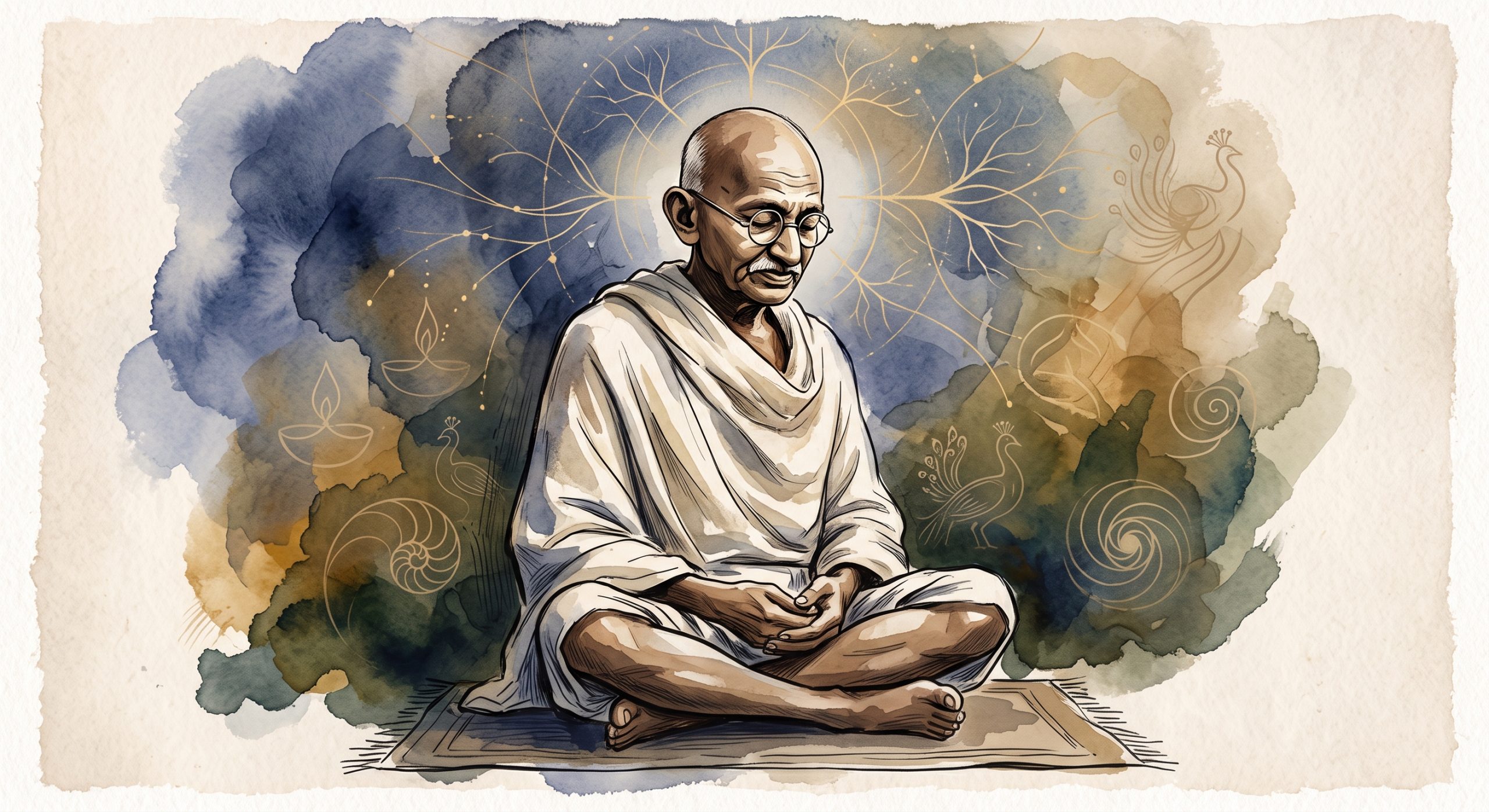
Today, Oct. 2, Mahatma Gandhi would have been 157 years old. In an era in which we are increasingly forced to reconsider what we mean by intelligence, Gandhi’s teachings offer an unusually enlightened perspective.
At a time when AI can increasingly interact with the physical world, we have become preoccupied with a simple question: What does it mean to be intelligent?
The obvious answer is that intelligence is the ability to learn, reason, solve problems and adapt. That definition has served us reasonably well. It is also the definition that much of artificial intelligence has implicitly adopted. The more capable a machine becomes at performing tasks that once required human cognition, the more readily we call it intelligent.
But Gandhi would have challenged that definition.
For Gandhi, intelligence was not simply about how much one could know or how quickly one could reason. It was about the quality of the intellect and, ultimately, its relationship to truth, experience, humility and conscience.
Gandhi was remarkably candid about his own intellectual abilities. He once wrote, “I look upon myself as a dull person. I take more time than others in understanding some things, but I do not care.” He then made a distinction that is particularly relevant today: “There is a limit to man’s progress in intelligence; but the development of the qualities of the heart knows no bounds.”
That is a striking statement coming from one of the most consequential thinkers and political leaders of the twentieth century. Gandhi was not dismissing intelligence. He was placing it within a larger conception of human development.
He believed that intelligence could be powerful, but intelligence alone was insufficient.
READ: Sreedhar Potarazu | What Kipling’s “If—” Can teach us about the thinking errors we never teach our children (September 12, 2026)
Gandhi’s interpretation becomes even more interesting when he discusses what he called prajna, a Sanskrit concept that can be translated as wisdom, discernment or higher understanding. In his interpretation of the Bhagavad Gita, Gandhi distinguishes ordinary intellect from an intellect that is free from the distortions created by emotion, preference and desire.
“The intellect, thus coloured, cannot reach any sure conclusion,” Gandhi wrote. He argued that intellect becomes wisdom when it is “free from distortion, preferences, aversion and the colouring of propensities.”
He offered a wonderfully simple analogy: “Pure intellect is a thermometer. A thermometer never has fever itself.”
The metaphor is remarkably relevant to artificial intelligence.
Today’s AI s can process enormous quantities of information but still hallucinate.
Gandhi would have described the problem differently. His position was that that information and intelligence are not the same thing.
Gandhi understood this distinction long before computers existed.
He wrote that “some have more and some less intelligence. This is not considered important. Emphasis is laid on the purity of intelligence.” For Gandhi, the important question was not how much intelligence a person possessed but what that intelligence was capable of becoming. “A spark of prajna, Wisdom, is enough,” he wrote.
This raises an important question for the age of AI. If intelligence is measured primarily by the quantity of information a system can process, the machine will almost inevitably outperform the human. A large language model can access and synthesize more information than any individual human could possibly acquire in a lifetime.
But that does not necessarily answer the more fundamental question: Can the machine understand what matters?
Gandhi’s conception of intelligence suggests that understanding is inseparable from discernment.
This is where his ideas about truth become particularly important. Gandhi eventually described his relationship with truth in extraordinarily ambitious terms. “Instead of saying that God is Truth,” he wrote, “I say that truth is God.” He went on to describe truth as “pure intelligence.”
For Gandhi, truth was not simply a collection of correct statements. It was something to be pursued through one’s life. Knowledge therefore was not merely something acquired. It was something experienced.
AI can describe pain without experiencing pain. It can explain love without loving. It can identify a face without necessarily having the embodied experience of seeing another human being.
This distinction between describing an experience and having an experience may ultimately become one of the most important distinctions between artificial and human intelligence.
Gandhi understood the importance of experience. He repeatedly emphasized that intellect alone had limits. In one of his writings, he argued that intellect can be useful in acquiring knowledge, but that some forms of understanding require a different faculty altogether.
He also resisted the idea that intelligence was primarily developed through books. Gandhi wrote that the belief that intelligence can be developed only through reading was “utterly false.” He argued that the mind could be developed through intelligently performed work because the individual had to understand why a particular action was being taken.
That idea has an unexpected connection to one of the most important developments occurring in AI today: the movement from language models toward systems that interact with the physical world.
For years, AI largely lived inside computers. It learned from text, images, audio and data.
Increasingly, however, researchers are attempting to build systems that perceive environments, understand physical relationships, manipulate objects and take actions.
In other words, AI is moving from information toward experience.
READ: Sreedhar Potarazu | Recursive self improvement: First, know what “self” means (September 19, 2026)
Gandhi might have recognized something important in this transition. Intelligence does not develop solely by absorbing representations of the world. It develops through interaction with the world.
That brings us to perhaps the most important distinction of all: the difference between vision and perception. And our interpretation affects what we do.
Gandhi’s conception of intelligence was similarly inseparable from action. He did not regard knowledge as an end in itself. Knowledge had to be connected to conduct. Reason had to be connected to conscience. Intelligence had to be connected to truth.
He was therefore skeptical of reason when reason became detached from everything else. “Rationalists are admirable beings,” Gandhi wrote, “rationalism is a hideous monster when it claims for itself omnipotence.”
We make decisions through a complicated interaction among reason, emotion, memory, perception, values, relationships and experience.
Gandhi went even further. “If you want something really important to be done,” he wrote, “you must not merely satisfy reason, you must move the heart also.”
That is not an argument against intelligence. It is an argument for a larger definition of intelligence.
Perhaps the greatest lesson Gandhi offers us today is that we should be careful about declaring a machine intelligent simply because it performs an intellectual task.
We may be measuring the wrong thing.
The ability to calculate is intelligence of one kind. The ability to recognize patterns is another. The ability to reason is another. The ability to perceive the world and act within it is another.
But wisdom requires something more.
It requires knowing what deserves our attention. It requires distinguishing what is true from what is merely plausible. It requires recognizing when our own assumptions are distorting what we see. And perhaps most importantly, it requires understanding the consequences of what we do with what we know.
Gandhi’s genius was not that he possessed more information than everyone around him. It was that he placed knowledge within a framework of truth, humility, experience and conscience.
He reminds us that intelligence without wisdom can become merely cleverness, knowledge without humility can become arrogance,
On this 157th birth anniversary Gandhi reminds us that the ultimate measure of intelligence is not how much we can know, but how wisely we use what we know in the pursuit of truth.