



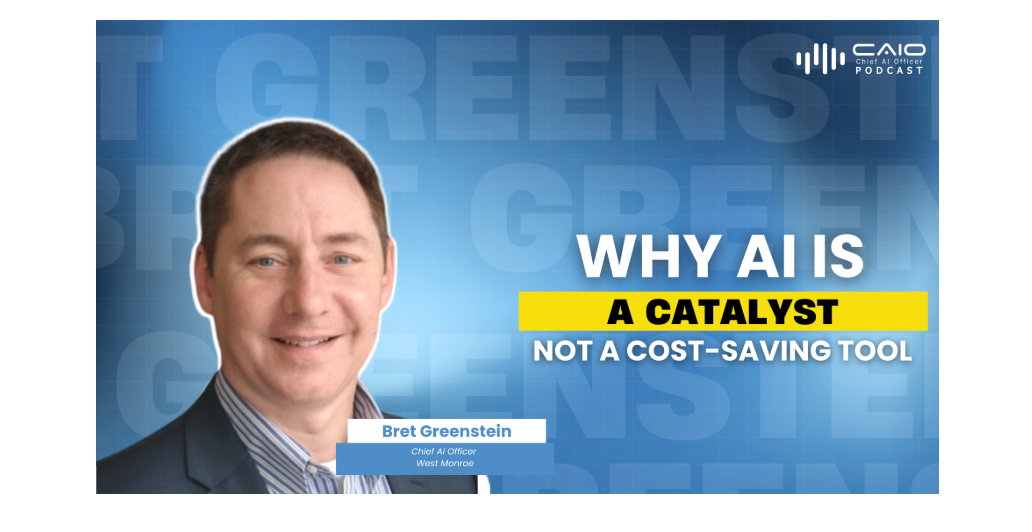
Editor’s note: This article is based on insights from a podcast series. The views expressed in the podcast reflect the speakers’ perspectives and do not necessarily represent those of this publication. Readers are encouraged to explore the full podcast for additional context.
Artificial intelligence is transforming the way organizations operate, but turning AI hype into real business value remains a challenge for many companies. In a recent episode of the “CAIO Connect” podcast, host Sanjay Puri sat down with Bret Greenstein, Chief AI Officer at West Monroe, to explore how organizations can move beyond experimentation and start achieving meaningful results with AI.
With more than three decades of experience in AI and data transformation having worked with companies such as IBM, PwC, and Cognizant — Greenstein brings a deep understanding of how technology can reshape businesses. During his conversation he shared practical insights on AI adoption, workforce transformation, and the future of intelligent systems.
One of the key themes Greenstein highlighted on the CAIO Connect Podcast is that many organizations treat AI as a technology experiment rather than a business transformation tool.
According to Greenstein, AI should not simply be used to showcase innovation, it should solve real problems and improve how businesses operate, “They will spend money on shiny products. They will set up a lab somewhere and prove that something can be done. And that is not enough to deliver outcomes. And so, I find people get stuck in POCs forever, science experiments. They’re not influencing people, behavior, and process. They’re proving how smart they are to use AI. And so that has probably been the biggest inhibitor to really getting good outcomes.”
READ: Former Swedish prime minister Stefan Löfven on AI and the future of work (August 25, 2026)
Another important takeaway from the conversation is the role of organizational culture in AI success.
Greenstein emphasized that many AI initiatives fail not because of poor technology but because of misaligned leadership and culture. Organizations sometimes treat AI as the responsibility of technologists alone. In reality, successful AI projects require collaboration between business leaders and technical teams.
When business leaders understand how AI can transform operations whether in sales, marketing, supply chains, or customer support AI initiatives become much more impactful, “As an experiment, I tried to start a business using AI. So, I asked it to create a marketing team, a finance team, a sales team, a product team, and it created sub-agents to do those things. And what I found was it works really fast and it just keeps giving me to-dos.”
During the discussion on the, Greenstein shared a powerful analogy: AI tools are similar to word processors for writers.
He explained, “I don’t think giving word processors to people who couldn’t write, make great writers. And I think giving these tools to people who don’t understand what software means to a business, you’re not going to suddenly magically produce great software. But when you give those people these tools, they can produce much faster.”
Developers, analysts, and designers who can clearly define problems and envision solutions will benefit the most from AI tools. AI accelerates execution but human creativity and vision still drive innovation.
Greenstein also introduced the idea of “agentic transformation” — “it’s the combination of traditional business process reengineering, but optimizing business processes for the work that AI can do… in an agentic transformation, you understand what AI is good at, strengths and weaknesses, where you could apply it to the different activities. You’ve got to decompose work, not as a process, but a series of activities that produce an outcome.”
READ: NYU’s Dr. Hoda A. Alkhzaimi on sovereign AI, technology convergence, and the future of global governance (August 10, 2026)
Rather than simply automating existing processes, organizations should rethink how work is structured. AI excels at tasks such as analyzing documents, summarizing information, extracting insights, and handling repetitive activities. By shifting these tasks to AI systems, employees can focus on higher-value activities like critical thinking, strategy, and decision-making.
As Greenstein explained during his conversation, this shift allows teams to move faster and unlock new levels of productivity.
Another challenge discussed on the podcast is how companies measure AI success. Many organizations focus only on cost savings, which can limit the perceived value of AI, “although there is likely (an) opportunity for cost savings, that’s not the issue. It’s just that people maniacally focus on the wrong thing, and they’re focused on activity instead of on outcomes.”
Greenstein argues that the real benefits come from improved outcomes such as faster decision-making, increased productivity, and better customer experiences. Instead of asking how AI reduces costs, companies should ask how it enables teams to accomplish more.
At the end of the episode, Puri asked Greenstein for one piece of advice for new Chief AI Officers.
His answer was simple but powerful: listen to the business first.
Understanding what matters to customers, employees, and leadership is essential. AI should always support the organization’s broader goals, rather than being deployed simply because it is exciting technology.