



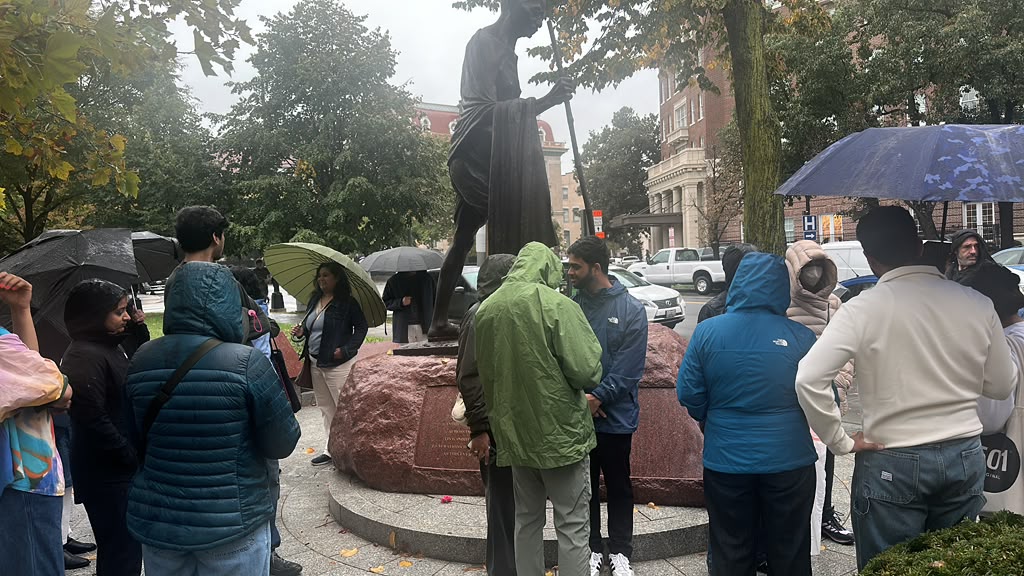
Last Sunday in Washington, a few dozen people stood in steady rain around the Gandhi statue on Massachusetts Avenue. Supporters of the Indian Overseas Congress and Hindus for Human Rights held umbrellas over their placards while a speaker with a megaphone talked over the passing traffic. It was a small gathering with a large message: India’s democracy is under threat, and the world is not paying attention.
The speakers argued that India’s institutions, including its judiciary and election machinery, have been bent toward the ruling party. Courts delay hearings on electoral disputes, they said, which leaves the burden on ordinary citizens. Getting back on a voter list after a deletion is slow, cumbersome and expensive. And America and other democracies, they added, have stayed quiet. These are the demonstrators’ claims, and the government rejects them. But events in Delhi since then have given them a sharper edge.
On Saturday, India’s capital was effectively sealed. The Cockroach Janta Party, a youth-led movement, had called a mass rally at Jantar Mantar to demand the resignation of Chief Election Commissioner Gyanesh Kumar. Around 25,000 police and paramilitary personnel were deployed across the city, and train services into New Delhi were suspended. Mobile internet was cut in the central business district, and dozens of metro stations and markets were shut. Reuters, citing a Home Ministry official, put the number detained at about 2,000, while The Hindu, citing police sources, said nearly 2,500. Those held reportedly included opposition politicians, journalists and lawyers, along with former chief ministers Mamata Banerjee, Arvind Kejriwal and Pinarayi Vijayan.
READ: Anupam Mittal recalls surrendering his US green card as American immigration uncertainty grows (October 12, 2026)
The movement’s founder, Abhijeet Dipke, was detained on an aircraft after it landed from Mumbai. A magistrate later released him and two associates on condition that they cause no breach of the peace for a year.
The grievance behind the protest is the Special Intensive Revision of the voter rolls. Protesters say it favors the ruling BJP, and Al Jazeera reports that the revision removed roughly 130 million names. The anger grew after The Indian Express reported that two election commissioners had questioned Kumar’s revisions. The Election Commission and the BJP deny any wrongdoing. BJP spokesman Sambit Patra dismissed the demonstrators as anarchic elements and said that the scenes at Jantar Mantar are not the real India.
Then, on Sunday, came the order that may matter most in the long run. Delhi Police Commissioner Anurag Kumar denotified Jantar Mantar as a designated protest site and named three replacements: Ramlila Maidan, Burari Ground and CBD Ground in east Delhi. The order says the change follows a committee’s recommendations, and a revised procedure for the new venues is to be issued separately.
Jantar Mantar has long been the capital’s traditional place of protest, a short walk from Parliament. Moving demonstrators to the city’s edges may be administratively tidy, but critics will read it as pushing dissent out of sight. It also follows the July protests at the same site, which ended with the education minister’s resignation after a crackdown that drew wide criticism. This time the target is the election system itself, a far more sensitive subject for any government.
International reaction has been mixed. The UN human rights office voiced concern over the mass detentions and urged respect for peaceful assembly. Amnesty International accused the authorities of trying to silence critics. India’s mission in Geneva called those concerns misplaced and an interference in internal affairs, saying that assembly rights in India are subject to reasonable restrictions. The demonstrators in Washington would say the voice still missing is Washington’s own.
READ: Indian American actor Imran Khan detained in Mumbai protest, Girlfriend Lekha Washington also held (October 10, 2026)
The government’s argument deserves a fair hearing. No democracy lets crowds choose where and when they gather, and officials can point to the violence that marred July’s march. But a democracy’s confidence shows in how it treats its critics. Closing down a capital of 20 million people to protect one election official, while the dispute over the voter rolls goes unanswered, does not look like confidence.
The remedy is simple, if politically costly. Publish the deletion data, open the appeals process, and allow an independent audit. If the rolls are clean, an audit will say so, and the protesters will have lost their strongest argument. If they are not, India’s voters deserve to know. Until then, a few umbrellas in the rain at Gandhi’s feet will not be the last such gathering.