



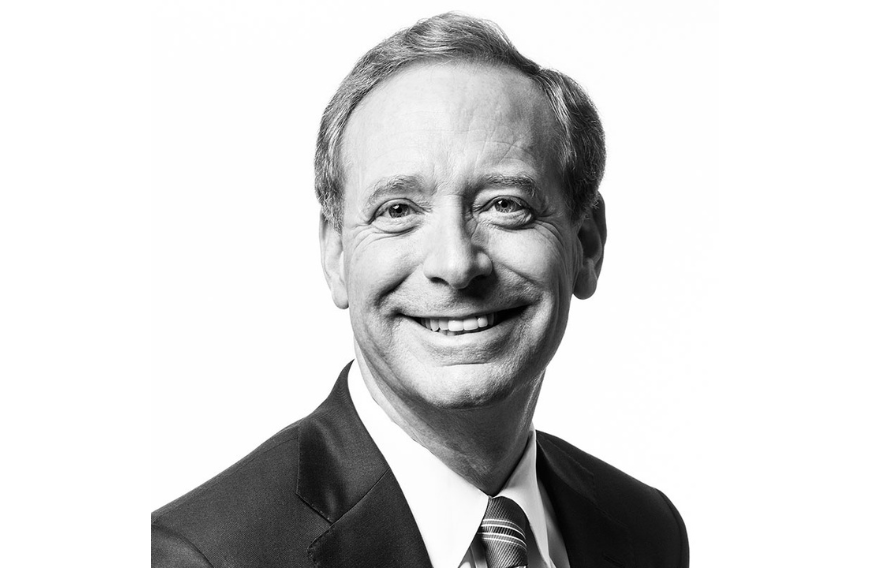
Microsoft President Brad Smith said in an interview with the BBC that artificial intelligence needs urgent global regulation. He said a set of global safety rules should require companies to notify victims when their systems are breached by rogue AI agents and provide an “emergency brake” to halt potentially harmful activity.
Smith also called for a legal requirement for companies to file incident reports.
“We know how to do this for other products,” Smith said. “We should build on that knowledge and think about how to apply it to AI.”
“Right now, your washing machine is subject to more safety rules than AI. Every carton of milk that you see in the grocery store is subject to safety rules and inspection.”
Smith said Britain was well-positioned to lead global AI regulation, citing the AI Security Institute, launched under former UK Prime Minister Rishi Sunak. He said officials in Washington viewed London differently from Brussels, whose approach to AI regulation is based on risk levels under the European Union’s AI Act.
READ: Microsoft, Nvidia unveil new AI laptop for Windows (October 7, 2026)
Britain’s institute has access to AI models before their public release under voluntary agreements with major developers, allowing it to assess their capabilities and risks.
Microsoft CEO Satya Nadella also weighed in on the issue in a post on X.
“We must assume a model is compromised and contain it from the start,” Nadella wrote. “Think of it like an emergency brake. Any authorized person should always be able to pause or shut down a model mid-task. More advanced models will require more advanced containment technologies that we need to standardize on.”
Nadella added that AI companies need to take an engineering-based approach to safety and separate models from the mechanisms that govern their actions. He referred to the technology as “superintelligence,” reflecting the terminology used in an executive order by President Donald Trump directing the federal government to adopt that term in place of “artificial intelligence.”
Nadella also appeared to push back against Trump’s call for AI companies to regulate themselves, arguing that stronger industry standards are needed to prevent harmful outcomes.
READ: Microsoft drafts AI code to keep models under human control (September 14, 2026)
The comments come amid a growing debate over AI regulation. Technology leaders recently attended a summit hosted by Trump, where they signed a “Joint Commitment on Frontier Responsibilities,” establishing a voluntary framework for companies to implement and regulate their own security controls. The agreement is not legally enforceable and carries no penalties.
OpenAI CEO Sam Altman recently said the benefits of AI justify accepting some risks and argued that the technology should remain broadly accessible to the public. He advocated a light regulatory approach while saying he did not accept “the really catastrophic risks,” including the possibility of “a serious loss of control to AI.”
Altman’s comments came shortly after Anthropic CEO Dario Amodei called for a slowdown in AI development, citing potential risks. Altman and other industry leaders, including Elon Musk, have also expressed concerns about the risks posed by increasingly advanced AI systems.