



AI’s origins lie in vision science. Some pioneers of artificial neural networks drew inspiration from how the human brain processes visual information. Today, AI is increasingly capable of detecting details that humans miss and perhaps open entirely new fields, as the microscopes did.
Learning Machines by Potarazu and Knoop: ‘Of Us’ and ‘For Us’: Humanity under the AI microscope (October 7, 2026)
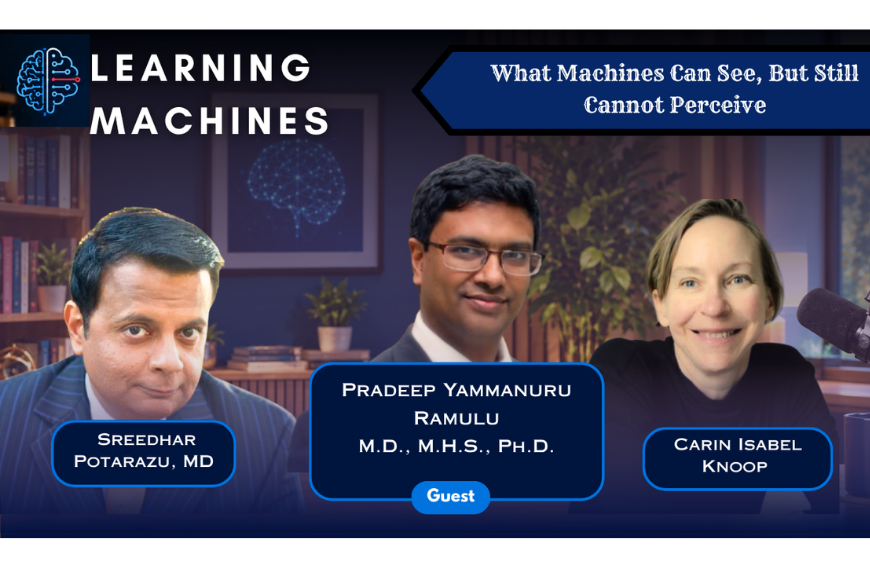
Today we focus on the distinction between identifying information and understanding its significance that AI forces, which we explored in Episode 6 of the “Learning Machines” podcast with Dr. Pradeep Y. Ramulu, Chairman of the Bascom Palmer Eye Institute. Dr. Ramulu is an internationally recognized glaucoma specialist and physician scientist. While our conversation began with AI and ophthalmology, it ultimately became a broader discussion about perception, expertise, medicine, technology and the nature of being human.
Information versus Understanding
Ramulu is convinced AI can change how we think about medical images. For example, a recent research paper showed that AI could determine a person’s sex from an optic nerve photograph with remarkable accuracy, even though clinicians examining the image could not.
“All of us who had been sitting there looking at the retina and optic nerves for decades had absolutely no idea,” Ramulu noted.
Ramulu suggested that as machines become increasingly capable of analyzing information, physicians may spend less time figuring out how to perform certain forms of analysis and more time determining what information should be collected in the first place. The focus shifts, he notes, to asking: “What information are we collecting? And are we collecting the right information to tell us what we need to know?”
Medicine has historically placed enormous value on the ability to recognize patterns and interpret them, including testing and patient history. AI increasingly has the potential to perform parts of that process faster and, in some circumstances, more accurately.. The physician’s value then moves toward deciding what questions need to be answered, determining whether the information is reliable and understanding what should be done with it.
But how much do physicians need to understand the mechanism behind a disease to treat it effectively? Medicine often works around a problem rather than solving its fundamental cause. Glaucoma provides a good example. Physicians can lower intraocular pressure and slow disease progression without fully explaining why pressure damages the optic nerve more severely in one patient than in another.
Ramulu recalled explaining the molecular reasons behind elevated eye pressure to a patient. The patient listened and then observed that the treatment being proposed did not seem to address the underlying problem. Much of medicine, he acknowledged, involves finding workarounds rather than correcting the original cause of a condition.
AI, on the other hand, may identify a pattern long before doctors understand why it exists. That could accelerate discovery, but it also creates a new form of intellectual dependence. If an algorithm tells us that a particular pattern predicts disease, how comfortable should we be using that prediction when we cannot explain the biological pathway that produced it? And if machines increasingly assume responsibility for recognizing patterns, what should physicians learn instead?
Watch the full episode on YouTube
Listen to the episode on Spotify
Never-Skilling vs Other-Skilling
Few people today need to know how to navigate using a paper map. Ramulu raised a similar concern about medicine and surgery. If robotic systems eventually perform increasingly sophisticated procedures, future physicians may become extremely skilled at operating within those systems while losing some of the manual and cognitive abilities that earlier generations considered fundamental.
However, we challenged the fashionable term “never-skilling,” proposing instead that technological progress might require “other-skilling.” The issue is not simply which skills will become obsolete, but which new skills professionals must acquire and which existing capabilities they should preserve.
The challenge is knowing which human capabilities may become essential precisely when technology fails. A surgeon trained primarily through automated systems may become highly proficient at supervising them, but what happens when an unfamiliar complication requires intervention beyond the machine’s capabilities?
Diagnosis vs Care
A physician who has an AI capable of analyzing an image or identifying a patient’s risk of progression will still have to explain the findings and recommend a course of action.
That recommendation depends on factors that extend beyond the image itself. The physician has to consider the patient’s age, health, finances, tolerance for risk, family responsibilities, expectations and willingness to undergo treatment. Two patients with nearly identical anatomical findings may make completely different decisions about what they want to do. “The doctor’s role really is to partner with people to help them decide what to do,” Ramulu explained. “And that’s a very, very human thing.”
A patient does not experience a diagnosis as a data point but as a change in the way they understand their future. Explaining what the diagnosis means, determining how much information a person is ready to absorb and understanding the emotional context in which that information is being delivered are all part of medicine.
Learning Machines by Potarazu and Knoop: The AI Nocebo Effect: When fear becomes the forecast (July 16, 2026)
Ramulu described how patients sometimes arrive frightened by information they have read, only to feel reassured after speaking with their physician. The medical facts may not have changed, but the tone, familiarity and confidence with which they are communicated can transform the patient’s experience. A physician must also judge when and how to introduce difficult information, without compromising the patient’s ability to make informed decisions.
Yet, Ramulu was careful not to claim that these abilities would forever remain beyond machines. He could imagine AI learning to interpret emotions, cultural context and patterns of communication.
What he found harder to imagine was a machine actually caring. When he suggested that people experiencing distress would turn to someone they trusted rather than a language model, we noted that increasing numbers of people already seek emotional support from AI. The distinction between simulating care and experiencing care may matter philosophically, but how much does it matter to the person receiving it?
Sight vs Perception
The distinction between sight, vision and perception also emerged during our conversation. One of us reflected on having spent years as an ophthalmologist believing he was helping people with their vision, only to recognize that much of his clinical work concerned their sight. Vision, in this broader sense, involves more than the physical functioning of the eyes. It is shaped by interpretation, experience, memory and meaning.
Ramulu’s own research into vision loss had led him to reconsider what patients actually mean when they say they want to see. Initially, it is natural to think about vision in functional terms.
Yet Ramulu acknowledged that his own research had, in a sense, been “short-sighted.” By measuring how vision loss affected people’s behaviour and daily activities, he had developed a detailed understanding of functional limitations. What those measurements did not fully capture was the experience of losing something people valued for its own sake. “There’s a certain element of seeing things just for the joy of seeing things,” he observed.
We often describe vision as though its purpose were to extract information from the environment. Cameras collect images while automated vision systems can identify objects and algorithms classify patterns. Yet human vision is also an experience. We see a landscape, a person’s face, a sunset or a familiar place, and the experience itself can have meaning that cannot be reduced to the information or classification contained in the image.
But this raised another question. Might researchers who can see also bring assumptions about disability and quality of life that deserve examination?
Greater ability does not necessarily guarantee greater happiness. Some people possess considerable physical, material and intellectual advantages yet remain profoundly dissatisfied, while others adapt to significant limitations and find meaning, gratitude and contentment. AI promises to enhance our abilities in extraordinary ways, but have we sufficiently considered what these enhancements give us and what they may cost?
As AI moves from computers into the physical world, smart glasses and other wearable systems may eventually allow machines to interpret much of what we see in real time. The technology could be enormously useful, but it also raises a subtler question about the experience of seeing.
If everything we encounter is immediately analyzed and labeled by a machine, do we risk turning perception into another stream of information that always has to be processed?
Knowledge vs Wisdom
Humans already struggle with information overload and AI promises to increase our ability to obtain answers, interpret information and make predictions. Yet greater access to information does not automatically tell us what deserves our attention.
Ramulu offered an interesting personal response to that problem when he described the importance of silence and meditation. He spoke of spending approximately twenty minutes each day in silence, with his eyes closed, describing this as perhaps the most important part of his day.
Searching vs Finding
Drawing on Indian philosophical traditions, Ramulu suggested that the accumulation of knowledge is not necessarily the same as wisdom. “In order to really know what’s important, you have to first learn what’s not important,” he observed. He invoked the distinction between the perishable and the imperishable, suggesting that acquiring more information may ultimately reveal the limitations of information itself.
But human beings also place value on things that resist measurement. We spend time with people who need us even when there is no economic return. We look at a beautiful view even though it produces no useful data. We care for patients when the amount of time required cannot be justified by a productivity metric.
The importance of such human qualities was illustrated by a story from Sreedhar’s own training. His mentor, the neuro-ophthalmologist J. Lawton Smith, sometimes devoted an entire eight-hour day to a single patient. When Sreedhar returned after taking a patient’s history, Smith would tell him, “You’re missing something. Go back in there. You’re not listening.” The lesson was not simply about collecting more information. It was about developing the patience and attention required to understand another human being.
A physician who refuses to adopt useful technology risks becoming less effective as medicine changes. At the same time, a physician who adopts technology while losing the human qualities that give medicine its meaning has also failed. Ramulu expressed the dilemma succinctly: “If you incorporate technology and lose your humanity, then you’ve lost the war.” Yet he also cautioned that preserving humanity while rejecting technological progress would leave medicine behind.