



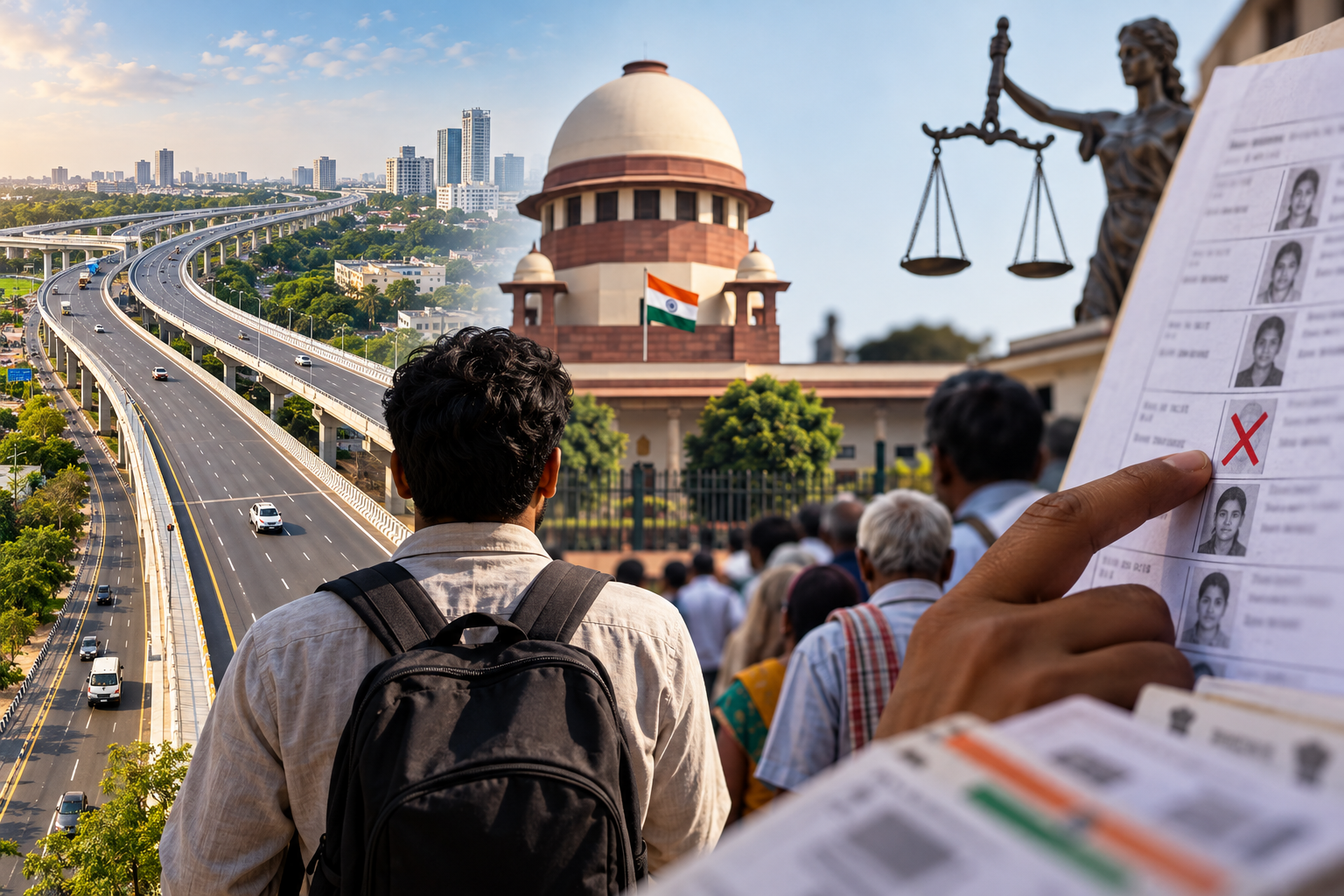
India can build a highway faster than it can restore a citizen’s confidence that the state will hear a complaint fairly. That gap is becoming one of the republic’s defining political problems.
The state’s capacity to deliver has grown visibly: expressways, digital payments, benefit transfers that reach a bank account without a middleman. The harder question is whether the institutions that authorise, scrutinise and restrain that power command comparable trust.
These achievements matter. A road can shorten a journey to hospital; a welfare payment can keep a household fed. But capacity answers only one question: what can the state accomplish? Constitutional government must answer another: what may it do, through which procedures, and subject to whose scrutiny?
READ: Why India’s future hinges on education: Satish Jha’s The Full Plate explores the stakes (March 27, 2026)
An election gives a government authority to act. It does not give it ownership of the institutions that decide whether its actions are lawful.
The distinction becomes tangible at the electoral roll. Before a citizen can choose a government, an administrative process must recognise that citizen’s entitlement to take part. Registration is where a constitutional promise becomes an entry in a working record, and an error there can stop the promise from reaching the person it belongs to.
Rolls must be revised. Deaths, duplicate registrations and changes of residence cannot be ignored, and an inaccurate register damages electoral equality. But revision is legitimate only if eligible citizens can understand decisions, contest mistakes and obtain correction before voting begins.
The controversy over Special Intensive Revision has too often collapsed different categories into competing totals. Names absent from a draft, entries proposed for deletion, registrations confirmed as ineligible and eligible voters wrongly excluded are four different things. Neither the opposition nor the election authorities should be allowed to pass one off as another. Repetition does not establish an allegation; an administrative total does not explain the person inside it.
In August 2025, the Supreme Court directed publication of the roughly 65 lakh names omitted from Bihar’s draft roll, with reasons for each exclusion. The order established neither that the omissions were wrongful nor that they were justified. It made them examinable. That is the essential starting point.
The next question is whether examination can produce a remedy in time. A migrant worker answering a notice sent to his village must travel home and lose wages. An elderly woman may need someone to read the notice to her. A tenant must prove an address through records built around settled households. For each of them, the procedure is formally available and practically out of reach.
The state must therefore count more than the entries it removes. It must establish how many affected people received intelligible notice, how many challenged the decision, and how many secured correction before the election. An appeal won after polling cannot return the vote that was lost.
No large electoral system will be free of error. Its constitutional quality lies in how it discovers and repairs mistakes, above all when the person affected has little money, influence or time. The standard is demanding without being impossible: reasons that can be inspected, assistance that can be reached, and review that finishes while the right can still be exercised.
This points to a principle Indian institutions rarely state: the party that controls the clock should bear the cost of delay. The record shows what happens when it does not. In 2019 a voter in Kerala found his name struck off before the Lok Sabha election. He had moved out only while his house was being repaired, and his wife and daughter remained on the roll. The High Court held that a person must be heard before his name is removed, but also that his case had become infructuous because the election was over. The law was on his side; the calendar was not.
Four years earlier, the Central Information Commission had ordered Delhi’s Chief Electoral Officer to pay ₹10,000 to a voter named Sumit, deleted without notice though he had never changed his address, who could not vote in the 2015 Assembly election. The Commission said every voter arbitrarily deleted in this way, and so prevented from voting, is entitled to the same compensation and to restoration within reasonable time. The order had the right instinct but the wrong currency. Money acknowledges a lost vote; it cannot return one.
What was once an individual misfortune has since become a matter of scale. Before West Bengal’s 2026 Assembly election, Muhammad Daud Ali, a 65-year-old former army technician, found that his name and those of his three children had been struck off the roll, though he held a passport and service records. Only his wife remained. They were among some nine million names removed, about one voter in eight. More than six million were marked absent or dead; another 2.7 million, Ali’s family among them, were left for tribunals to decide. With the rolls frozen, he asked how an election could be held before the disputes were settled. It was. Ali did not vote.
Then the tribunals began to rule. By August, records obtained under the Right to Information Act showed that they had decided barely two per cent of the appeals before them. Of the 82,782 they had decided, 75,443 ended with the voter restored to the roll, more than nine in ten. That does not establish that nine in ten of all deletions were wrong, since the cases decided first may not resemble those still waiting. It does show what examination found when examination finally came. In September the Election Commission told the Supreme Court that more than 37 lakh appeals remained pending and that, at the present pace, clearing them could take about twelve years. It asked for the number of tribunals to be more than doubled. The Calcutta High Court had earlier put the figure at twenty-one years. The Supreme Court said it could not fix a timeline. The safeguard works on the cases it reaches. On the Commission’s own arithmetic, it will reach the last of them after two more Assembly elections have come and gone.
READ: ‘The Full Plate’ and the kindness of readers (March 26, 2026)
The remedy is to reverse who bears the cost: a deletion the system cannot review before polling should not take effect for that poll. At Bengal’s scale, that would have kept millions of undecided names on the roll for one more election, and some of them would have been ineligible. On the tribunals’ early evidence, far more would have been voters. That cost is real, and it should be stated plainly. But an ineligible entry dilutes the count marginally, while a wrongful deletion removes a vote entirely, and only the second falls on someone who has done nothing wrong.
The same demand for inspectable decisions applies to political money. In February 2024, the Supreme Court struck down the electoral bonds scheme, holding that its concealment of political contributions violated citizens’ right to information. It was a concrete constitutional failure followed by a concrete correction. It proved both the danger of secrecy and the value of institutions able to overrule a government.
A donation is not a bribe, and a large company that wins a public contract has not thereby proved corruption. But citizens need enough information to examine the relationship between financing and government action. Without disclosure, legitimate decisions become indistinguishable from favours. Where proximity to power seems to decide access to contracts or regulatory relief, so firms learn that a patron matters more than a better product. Larger ones learn to treat political risk as a cost of doing business. Both lessons corrode the rules on which investment and competition depend.
India needs enterprises that can compete with the world, and that ambition is itself an argument for scrutiny. Transparent procurement, reasoned regulatory decisions and competition rules that bind the influential as firmly as their rivals are not obstacles to national champions. They are what would make the title credible. A champion that cannot survive independent examination is only a favourite.
Investigative agencies face a related test. Opposition membership cannot confer immunity from prosecution, and joining the governing party is not evidence of innocence. What matters is consistency: what triggers an investigation, what justifies arrest, and whether comparable conduct receives comparable treatment. In August 2024 the government told Parliament that of 5,297 money-laundering cases registered since 2014, 40 had ended in conviction and three in acquittal. Whatever those figures say about guilt, they say a great deal about time. Under a law that makes bail exceptionally hard to obtain, the years between raid and verdict can cost a person liberty, livelihood and reputation before any court has weighed the evidence. Where accusation itself becomes the punishment, the process acquires political power. The same principle applies here. The agency chooses when to raid, when to file and how long to investigate; the accused controls none of it. When the state cannot bring its evidence to trial within a reasonable time, it is the coercion that should lapse, not the patience of the accused. Agencies must be judged by the necessity of that coercion, the quality of their evidence and the speed with which allegations reach trial.
Public suspicion cannot settle whether an investigation is justified. It does create an obligation to make institutional conduct more accountable. An agency cannot restore its credibility by insisting that it has it.
The opposition carries obligations too. A claim that an election was manipulated requires particulars: identifiable records, reproducible discrepancies, remedies proportionate to the evidence. A sweeping accusation may rally supporters while leaving a family like Ali’s no closer to reinstatement. Protest remains indispensable. A citizen does not exhaust political freedom by voting once every five years, and peaceful assembly makes grievances visible when ordinary channels fail. But mobilisation has to become durable work: helpers at registration desks, scrutiny in legislatures, evidence before courts, alternatives put before voters. A parliamentary disruption is justified by what it exposes or secures, not by how often it is repeated.
The government carries the greater responsibility because it commands the means of coercion. It must distinguish criticism from threat and assembly from violence. Treating dissent as disloyalty deprives an administration of the information it most needs. The official who suppresses an unwelcome warning preserves the appearance of control while the failure grows.
READ: The Full Plate: A powerful argument for grassroots change in India’s classrooms (March 25, 2026)
Here the dispute over democratic legitimacy becomes decisive. A majoritarian reading treats victory as sufficient authority to reshape the institutions that will govern the next contest. A constitutional reading imposes continuing limits: the winner governs under rules that protect those who opposed it and preserve their chance to replace it. Independent institutions can be slow, mistaken or self-protective, and they need scrutiny too. Independence should shield a decision from political instruction, not shield its reasoning from challenge.
The deeper test is whether any governing party will accept an adverse finding without treating the institution that made it as an enemy. The matching test is whether any opposition will defend that institution’s independence when it rules the other way. India has failed and passed this test before. The Emergency showed how quickly constitutional protections can be hollowed out; the electorate’s verdict in 1977 showed that peaceful correction remained possible. Written protections endure only when citizens insist on using them.
Restoration therefore requires obligations specific enough to assess. An electoral authority should explain exclusion and provide timely review. An investigative agency should justify coercion and bring its evidence to trial. A regulator should publish reasons that withstand scrutiny, whoever the enterprise. A government should accept that lawful resistance belongs within the democracy it governs. Beneath each obligation lies the same rule: whoever controls the clock must answer for its delays.
The measure of these institutions is taken by someone who cannot command a hearing: a voter whose name is missing, a business facing an unexplained decision, an accused person waiting years for a trial.
A republic earns allegiance when those people can obtain an answer without first finding someone powerful to ask on their behalf.