



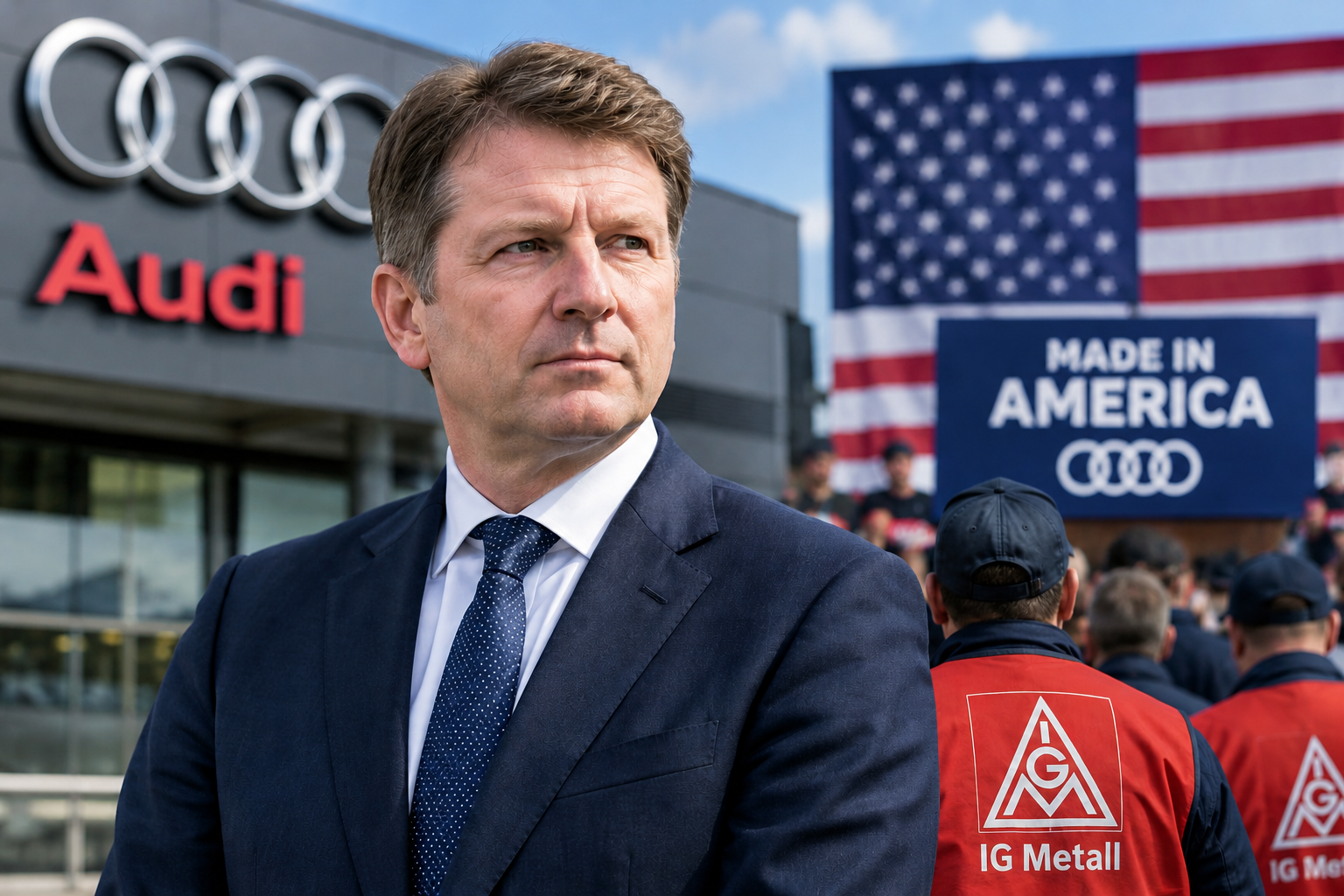
Audi CEO Gernot Döllner is facing criticism from German politicians and labor union leaders after appearing at a U.S. election campaign rally to announce plans for the automaker’s first American factory, a proposed $4 billion investment that has intensified concerns about jobs and political neutrality in Germany.
Döllner joined President Donald Trump on stage at a Republican campaign event in Perry, Georgia, on Oct. 24, where the president announced Audi’s plan to build a manufacturing plant near Macon. The facility is expected to produce 200,000 sport utility vehicles (SUVs) annually and create about 4,500 jobs, according to Audi and published reports.
The appearance drew criticism from Christiane Benner, head of Germany’s IG Metall industrial union and deputy chair of Volkswagen’s supervisory board, who said Döllner had violated the company’s guidelines requiring political neutrality ahead of elections.
“The way in which Gernot Döllner presented himself and Audi in the USA is highly embarrassing, politically unacceptable, and unworthy of the company,” Benner said, according to Agence France-Presse.
The controversy comes as Volkswagen, Audi’s parent company, faces a major restructuring in Germany, including plans to cut jobs and reduce production capacity. Critics have questioned the optics of announcing thousands of new jobs in the United States while German workers face uncertainty over factory operations and employment.
German unions question political neutrality
Audi’s internal guidelines prohibit public appearances with political parties or candidates standing for election during the three months preceding an election, as well as sponsorship of related events.
Benner accused Döllner of breaching those rules. The planned factory announcement took place days before the Nov. 3 U.S. midterm elections, during which Republicans are campaigning to retain control of Congress. Daniela Cavallo, chair of Volkswagen’s works council, also criticized the appearance. In comments reported by Reuters and German media, Cavallo said management had allowed itself to become part of a political spectacle.
Cavallo acknowledged that expanding production in the United States could make business sense, given the importance of the American market. However, she questioned whether a major corporate investment should have been announced at a political campaign rally.
Olaf Lies, premier of the German state of Lower Saxony, which is a major Volkswagen shareholder, also criticized the setting for the announcement. He said a campaign rally was not an appropriate place to unveil an investment of this scale and expressed concern among employees about the potential consequences for German operations. Audi has defended its decision to participate in the event. The company said its delegation traveled to Georgia to advance negotiations over the proposed factory and accepted an invitation to present the project alongside the U.S. president.
The company said the decision was made solely in Audi’s business interests and acknowledged that the appearance had been interpreted as a political signal.
$4 billion factory aims to expand U.S. production
The proposed factory would give Audi a manufacturing base in the United States, a major luxury vehicle market where the German automaker currently lacks its own production facility.
The investment is intended to strengthen Audi’s competitiveness in North America and reduce its exposure to U.S. import tariffs. Reuters reported that tariffs cost Audi approximately 1.2 billion euros, or about $1.3 billion, last year.
READ: Audi to invest $4.2 billion in Georgia factory (October 25, 2026)
The Georgia project is expected to manufacture large SUVs, including models from Audi’s Q-series lineup. Construction is planned to begin in 2027, with production expected to start in the early 2030s, according to German public broadcaster Tagesschau.
The state of Georgia is also expected to provide substantial financial support for the investment. Focus, a German news outlet cited by Reuters, reported that the state could contribute $1.4 billion.
However, the proposed plant has not received final approval from Volkswagen’s supervisory board. The board includes employee representatives, giving labor unions significant influence over major decisions involving production facilities and employment.
Cavallo said employee representatives would need a comprehensive assessment of the project’s impact on Volkswagen’s other locations, particularly in Germany, before supporting the investment.
Volkswagen faces restructuring pressure
The dispute highlights the competing pressures facing Volkswagen as it tries to remain competitive in the global automotive industry.
The group has struggled with weak performance in China, rising competition from Chinese manufacturers, the costly transition to electric vehicles and the impact of U.S. trade tariffs.
READ: Volkswagen expands with Microsoft Copilot as salary freeze for 660,000 workers reportedly looms (October 22, 2026)
Volkswagen has agreed to cut approximately 50,000 jobs in Germany by 2030. Combined with earlier restructuring plans, the company has outlined reductions totaling about 120,000 jobs worldwide, according to AFP.
Audi’s German production facilities have also faced pressure. Its Neckarsulm plant is among the sites affected by discussions over future production capacity and possible closures in the coming decade.
The contrast between potential employment growth in Georgia and workforce reductions in Germany has become a central point of criticism from labor representatives.
Still, some industry analysts have argued that expanding production in the United States could be strategically sensible because it would allow Audi to serve local customers while reducing tariff exposure.
The proposed investment could therefore benefit Audi’s long-term position in the American market, even as it raises difficult questions about how Volkswagen distributes production and employment across countries.
Final decision remains pending
Audi’s planned U.S. factory remains subject to approval by Volkswagen’s supervisory board, where employee representatives have substantial voting power.
The dispute over Döllner’s appearance could complicate discussions, although union leaders have acknowledged that local U.S. production may make economic sense.
For Audi, the challenge is to expand in a major market while maintaining confidence among employees and honoring its stated commitment to political neutrality. The factory’s future will depend not only on its commercial prospects but also on whether Volkswagen’s leadership can address concerns about the consequences for its German workforce.