



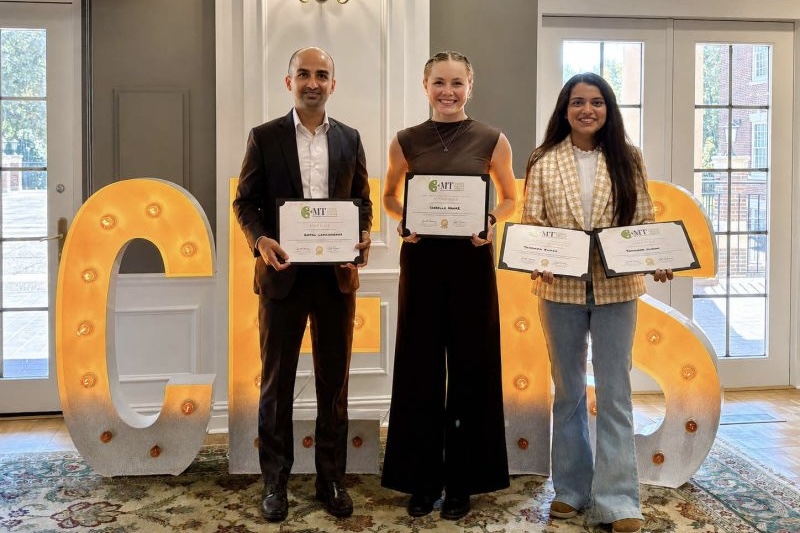
Tamanna Kinha, an Indian doctoral student at Oklahoma State University’ s College of Education and Human Sciences has won twin awards at its Three-Minute Thesis competition for her presentation on Indian immigrant adolescents’ mental health.
Kinha, a PhD student in human development and family science, earned third place with a $100 cash prize and the $300 People’s Choice Award at the Oct. 10 competition to recognize top graduate student researchers in the college.
Her presentation, “The Invisible Paradox: A Tale of Indian Immigrant Adolescents and Their Mental Health,” focused on the mental health of Indian immigrant adolescents.
Kinha said her interest in the topic grew from her background in India and her experience as a science educator for more than six years, in which she worked closely with adolescents. She wanted to better understand how cultural transitions may affect Indian immigrant adolescents as they adapt to life in the United States.
READ: Meera Narasimhan receives South Carolina’s highest civilian honor (September 28, 2026)
“The People’s Choice Award is actually a cherry on the cake,” Kinha said. “I realized that the topic that I presented and the research I’m doing is something which people can actually relate to.”
Kinha said she felt encouraged by the audience’s response and hoped her research would help people recognize the challenges facing Indian immigrant adolescents and work toward solutions.
Kinha earned a Bachelor of Education degree form Lady Irwin College, Delhi and a Master of Arts in Counseling Psychology from Indira Gandhi National Open University (IGNOU), Delhi, before coming to the United States.
Kinha’s research focuses on immigrant families majorly adolescents in the United States examining how cultural orientation and language use, perceived parenting and family support related to internalising and externalising outcomes.
READ: Anish Pyne wins Carnegie Mellon’s People’s Choice Award (April 2, 2026)
Her work centers on risk and resilience in immigrant youth, using survey methods, measure validation, and multivariate analyses to understand how family and cultural contexts shape adolescent development.
Gopal Lamichhane, a Nepali doctoral student in nutritional sciences, earned first place and a $300 prize for his presentation, “Can Curcumin Slow Metabolic Diseases in Aging?”
Isabella Hanks, a master’s student in marriage and family therapy, earned second place and a $200 prize for research on couples’ relationship satisfaction during therapy.
The 3MT competition challenges graduate students to communicate their research to a broad audience in a concise presentation. The competition was founded by the University of Queensland in 2008 and has evolved into a globally recognized challenge.