



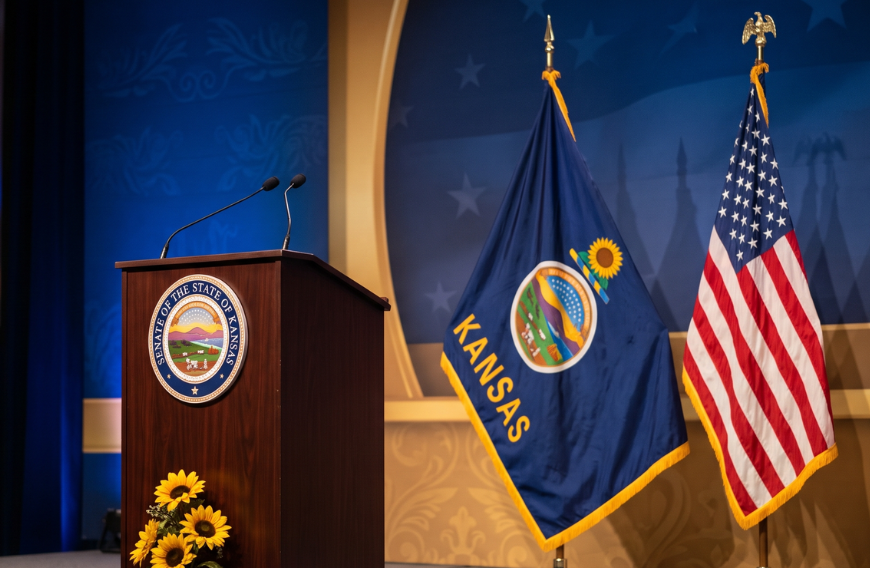
Kansas, a state that has long favored Republicans in Senate elections, is facing an unusually competitive race that could put an end to the Democrats’ 94-year losing streak. On Election Day, Democrat Adam Hamilton is challenging Republican Sen. Roger Marshall in a contest that has drawn national attention as both parties fight for control of the U.S. Senate.
The stakes extend beyond Kansas. The state has not elected a Democrat to the Senate since 1932, when George McGill won reelection. A victory for Hamilton would mark a significant political shift in a state that President Donald Trump carried by 16 percentage points in the 2024 presidential election.
The race has become more competitive than many Republicans initially expected, raising questions about whether voter frustration with the economy and the Trump administration could weaken the party’s hold on traditionally Republican territory.
According to the Associated Press, Democrats entered Election Day hoping Hamilton could capitalize on concerns about inflation, rising fuel costs and the prolonged war with Iran. Higher diesel prices have been particularly significant in Kansas, where agriculture plays a major role in the economy.
Hamilton, a United Methodist pastor who founded the Church of the Resurrection in the Kansas City area, has presented himself as a centrist candidate seeking to appeal to voters beyond the Democratic base. The church has grown into the largest United Methodist congregation in the country, giving Hamilton a prominent public profile and a network of supporters.
READ: US midterms 2026: Election puts Trump’s leadership and Republican majorities to the test (November 3, 2026)
His campaign has focused on affordability, leadership and Marshall’s close alignment with Trump. Hamilton has also criticized the incumbent over his support for the president’s tariffs and questioned whether Marshall has remained sufficiently connected to Kansas after owning a vacation home in Florida. Marshall said he bought the property to spend time with family and sold it in October.
Marshall, a retired obstetrician, has defended his record and argued that Hamilton’s election would strengthen liberal Democrats in Washington. He has also maintained that the economy is performing well and defended the administration’s approach to the war.
The contest has attracted significant campaign spending, reflecting the possibility that Kansas could become a genuine pickup opportunity for Democrats. The Associated Press reported that spending on the race had exceeded $108 million, setting a record for a Kansas election. Democrats committed approximately $64 million to television and digital advertising, compared with about $44 million from Republicans.
Recent polling has also underscored the race’s competitiveness. A CNN/SSRS poll conducted from Oct. 20 to Oct. 26 among 838 likely voters put Hamilton at 49% and Marshall at 45%, with a margin of error of 4.5 percentage points. Other surveys have shown a similarly close contest, although individual polls differ and should not be treated as a prediction of the final result.
The Cook Political Report and other election forecasters have also moved the race into toss-up territory, an unusual development for a state that has consistently elected Republicans to the Senate for decades.
READ: Florida Election Day alert: Polling locations changed in 7 counties after flooding (November 3, 2026)
Republicans have responded by investing heavily in the contest, while Trump returned to the campaign trail ahead of Election Day to rally support in Kansas and other states where the party is defending Senate seats. His involvement highlights the importance of the race to Republican efforts to preserve their majority in Washington.
However, a competitive campaign does not guarantee a Democratic victory. Kansas has a long history of Republican support in federal elections, and Democrats have previously struggled to convert close polling and campaign momentum into statewide wins. The state’s Republican-leaning electorate remains a significant obstacle for Hamilton.
The outcome will help determine whether Democrats can expand their opportunities in traditionally Republican states as they seek to challenge the GOP’s Senate majority. Even if Hamilton falls short, the closeness of the race could offer an indication of how economic concerns and attitudes toward the Trump administration are influencing voters beyond the usual battleground states.
For Kansas Democrats, the election represents a rare opportunity to break a political pattern that has lasted nearly a century. For Republicans, retaining the seat would preserve their longstanding dominance in the state and provide an important defense of their position in the Senate.
With voters heading to the polls today, Kansas has become one of the races to watch in a midterm election that could reshape the balance of power in Washington.