



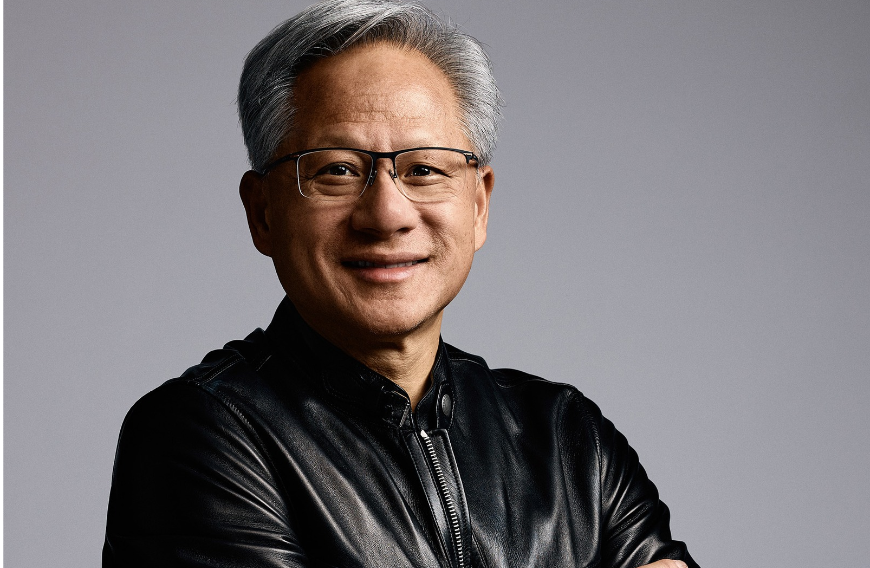
Nvidia shares fell sharply on Monday as the company’s investigation into CEO Jensen Huang’s relationship with a Chinese businesswoman suspected by U.S. intelligence of working for Beijing intensified investor concerns about leadership uncertainty. It also exposed the chipmaker to national security scrutiny.
The shares fell as much as 8% during Monday’s trading, wiping more than $180 billion off Nvidia’s market value, the Financial Times reported. The Associated Press reported that the stock dropped 5% at the opening bell, falling $14.27 to $172.37.
The decline followed Nvidia’s announcement on Sunday that its board had initiated an independent investigation into reports that Huang had been targeted by a foreign intelligence operation. The investigation came after Huang acknowledged in a message to employees that he had been unfaithful to his wife and pledged to cooperate fully with the review.
The company has said it has no reason to believe that U.S. national security or its confidential business information was compromised.
Investors assess Huang’s future at Nvidia
The developments have brought renewed attention to Huang’s position at Nvidia, where he has served as CEO since co-founding the company in 1993 with Chris Malachowsky and Curtis Priem.
Huang, 63, has led Nvidia’s transformation from a graphics-chip manufacturer focused on video games into the world’s leading supplier of processors used in artificial intelligence systems. His central role in the company’s expansion has also made questions about his leadership particularly significant for investors.
READ: Nvidia probes into Jensen Huang’s affair with Chinese businesswoman amid spy claims (November 9, 2026)
Dan Ives, a partner and senior managing director at Yorkville Ives & Co., and his colleagues said in an investor note that they expected Huang to remain CEO in the near term. However, they warned that the investigation could weigh on the company’s shares. “There is clearly a risk that Jensen could be removed as CEO depending on the board investigation,” they wrote.
However, the company has expressed confidence in Huang and its leadership team. Nvidia has also indicated that he remains committed to continuing as CEO without interruption, according to Reuters.
China allegations add to business concerns
The controversy has also drawn attention to Nvidia’s commercial connections in Asia and the broader U.S.-China competition over advanced semiconductor technology. The allegations concern Alice Huang, a former executive associated with Singapore-based Megaspeed International. She is not related to Jensen Huang.
According to reports citing U.S. intelligence assessments, Alice Huang was suspected of having links to China’s Ministry of State Security and gathering information about the Nvidia chief and the semiconductor industry.
The New York Times previously reported on the alleged intelligence operation. The allegations have not been publicly established through the company’s investigation.
READ: Nvidia board probes Jensen Huang China spy allegations (November 8, 2026)
Megaspeed’s website identifies the company as an Nvidia Cloud Partner in the Asia-Pacific region and lists Nvidia’s GB200 NVL72 and HGX H100 products, according to The Times of India. Nvidia’s advanced AI processors have become a central issue in Washington’s efforts to restrict China’s access to sophisticated semiconductor technology.
Fallout reaches Nvidia’s Asian operations
The controversy has also had repercussions for Nvidia’s planned engagements in South Korea. Madison Huang, Jensen Huang’s daughter and an Nvidia executive, cancelled a scheduled visit to Seoul for an Nvidia conference that began Monday, according to companies that had been due to meet her.
South Korean AI startup Rebellions said planned engagements involving Madison Huang had been cancelled because of “unavoidable internal circumstances at Nvidia,” The Times of India reported.
The developments come as Nvidia remains central to the global AI industry, with its processors powering data centers and computing systems used to train and operate AI models.
For investors, the immediate question is how the board’s investigation will affect Huang’s leadership and whether the controversy will bring additional scrutiny to the company’s business relationships involving China.
The board’s findings and any further developments in the investigation are likely to remain important factors for Nvidia’s investors.