



On November 3, Democrats swept the midterm elections, capturing both the House of Representatives and the Senate by margins that exceeded many expectations. They also flipped governorships, gained control of state legislative chambers, and made significant inroads into traditional Republican strongholds.
The scale of the victory was extraordinary.
According to CNN, Democrats will control a majority of state legislative chambers across the country, holding majorities in both chambers in 23 states and gaining more than 500 state legislative seats. With Democratic governors set to lead at least 28 states, roughly three-quarters of Americans will live in states governed by Democrats.
It was one of the most consequential Democratic waves in decades, drawing comparisons to the political upheaval that followed the Watergate scandal.
The reasons for the Republican defeat have been extensively discussed: the unpopular Iran war, rising gasoline prices, persistent inflation, affordability concerns, tariffs and the Trump administration’s aggressive immigration crackdown.
Although a Democratic victory was widely anticipated, the magnitude of Republican losses surprised even seasoned political observers. Particularly striking was the Democratic breakthrough in Texas, where the party captured both the governorship and a U.S. Senate seat after decades of Republican dominance.
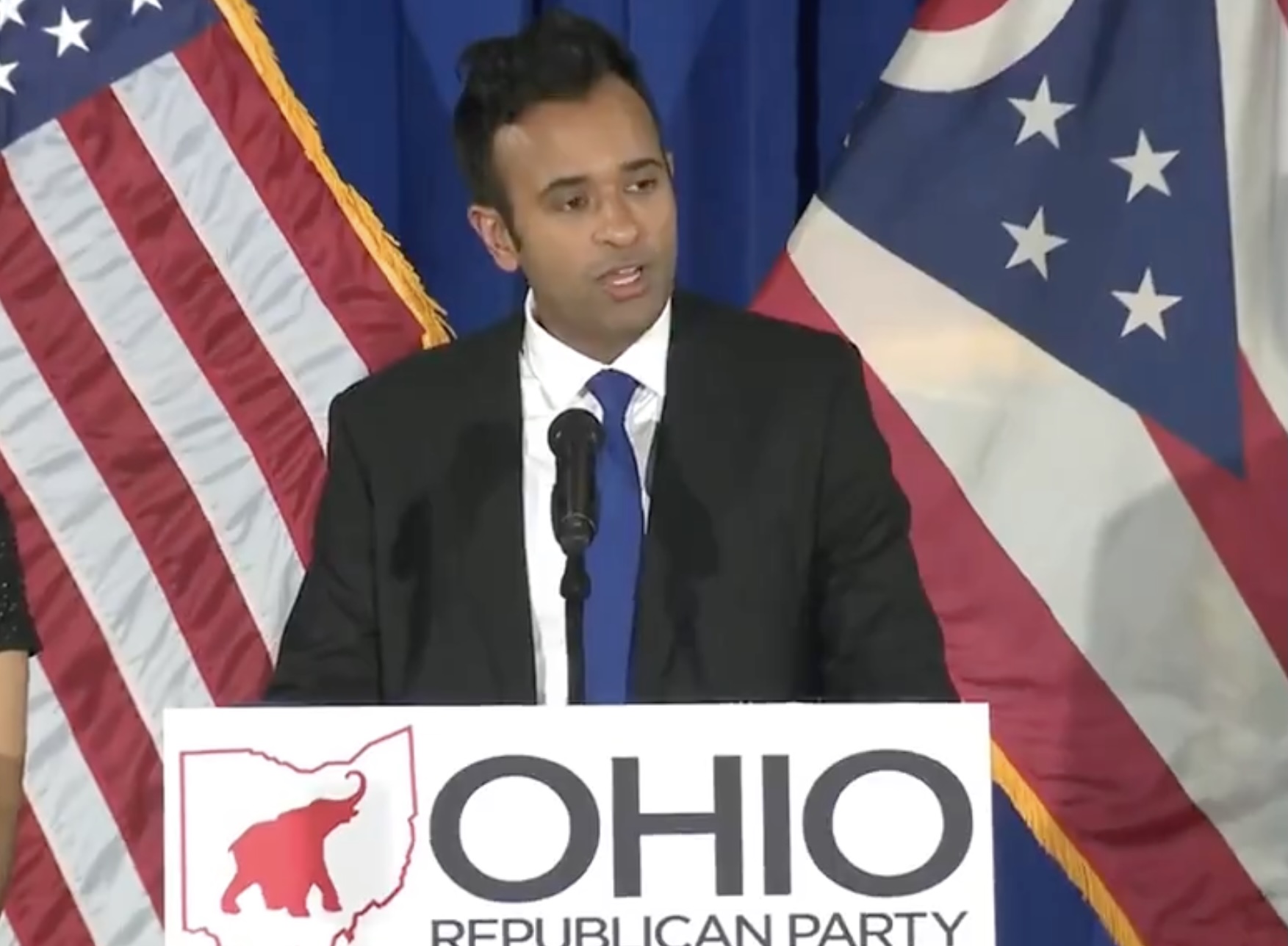
But amid the election-night surprises, one outcome was considerably less unexpected: the defeat of Vivek Ramaswamy in Ohio.
The Indian American billionaire, once celebrated as a rising star of the Republican Party, lost the gubernatorial race to Democrat Amy Acton by nearly eight percentage points.
Acton, a physician and former director of the Ohio Department of Health, received approximately 52.3% of the vote against Ramaswamy’s 44.4%, an almost eight-percentage-point defeat in a state Trump had carried comfortably just two years earlier.
RELATED: Why is Vivek Ramaswamy struggling in red Ohio? (October 4, 2026)
Acton had led in most major polls during the closing weeks of the campaign, although some surveys suggested a much closer contest. Her eventual margin of victory was more decisive than polling averages had indicated.
As Election Day approached, the Ramaswamy campaign turned to a desperate last-minute tactic.
On October 19, a controversial advertisement surfaced featuring Acton’s estranged mother, Donna Arthur, who accused her daughter of dishonesty.
Acton had been estranged from her mother since childhood, after her stepfather was charged with raping her when she was 12. Court records and contemporaneous reporting corroborate key elements of Acton’s account of the abuse and the circumstances surrounding her separation from her mother.
Ramaswamy’s campaign acknowledged producing the advertisement and initially planned to spend millions of dollars promoting it.
The deeply personal attack provoked widespread criticism, including from prominent Republicans such as Ohio Governor Mike DeWine, U.S. Senator Jon Husted — who also lost on Nov. 3 — and Ramaswamy’s former presidential rival Nikki Haley.
To critics, the advertisement appeared to be a desperate gamble by a campaign struggling to reverse its fortunes. Many warned that it could backfire.
Journalist Tej Joshi, who spent several years as a morning-show host in Cincinnati and closely followed the Ohio election, believes that is precisely what happened.
“I think his team [and] he thought maybe that would be the final thing that would get them over the edge,” Joshi said. “And I think, as a lot of political pundits have said, it backfired. It got a lot of earned media — organic media — and it was replayed a lot around the country, helped Amy act with her fundraising. Also, I think it did not show Vivek Ramaswamy in the best light.”
Joshi said Democratic voters he spoke with in Ohio were generally confident that Acton would win. What surprised them was the magnitude of her victory.
The advertisement may have compounded Ramaswamy’s difficulties, but it cannot fully explain his defeat.
After all, he was running in a state Donald Trump had carried comfortably just two years earlier. He enjoyed the president’s endorsement, national name recognition, considerable financial resources and an established following among conservative voters.
Yet he lost decisively.
Was Ramaswamy simply swept away by a national Democratic wave? Or did his defeat reflect deeper political miscalculations, weaknesses as a candidate, and an inability to win over important segments of the very movement that had helped elevate him to national prominence?
A rising Republican star
Just two years earlier, Ramaswamy had been widely regarded as one of the Republican Party’s brightest rising stars.
The brash, charismatic biotech entrepreneur burst onto the national political scene as a self-styled happy warrior, barnstorming Iowa in pursuit of the 2024 Republican presidential nomination.
His campaign generated considerable excitement and attracted extensive media attention. But that enthusiasm failed to translate into votes.
After finishing a distant fourth in the Iowa caucuses, Ramaswamy suspended his campaign in January 2024 and promptly endorsed Trump.
It proved to be a politically astute move.
Unlike Haley, the second Indian American Republican in the race in 2024, Ramaswamy recognized early that Trump remained the dominant force in Republican politics. Continuing to challenge him risked political isolation. Embracing him, on the other hand, offered a path to influence within the party.
Trump reciprocated.
The former president praised Ramaswamy and repeatedly spoke of his political potential, helping elevate the young entrepreneur’s standing within the MAGA movement.
When Trump won the November 2024 presidential election, Ramaswamy appeared poised for an influential role in the new administration.
He was even considered for the Ohio U.S. Senate seat being vacated by his friend and former Yale Law School classmate, JD Vance, who was preparing to become vice president.
Perhaps the clearest indication of Trump’s confidence in Ramaswamy came when he tapped him, alongside billionaire Elon Musk, to lead the newly proposed Department of Government Efficiency, or DOGE, a signature initiative aimed at reducing federal spending and bureaucracy.
But Ramaswamy’s involvement with DOGE ended before the initiative formally got underway. In January 2025, he withdrew from the project to pursue his political ambitions in Ohio.
By then, however, his relationship with the MAGA movement had already encountered its first serious rupture.
The H-1B controversy and MAGA backlash
On December 26, 2024, Ramaswamy posted a lengthy message on X defending the technology industry’s reliance on highly skilled foreign workers.
In doing so, he criticized aspects of American culture that, he argued, celebrated mediocrity over academic excellence and intellectual achievement.
The reason top tech companies often hire foreign-born & first-generation engineers over “native” Americans isn’t because of an innate American IQ deficit (a lazy & wrong explanation). A key part of it comes down to the c-word: culture. Tough questions demand tough answers & if we’re really serious about fixing the problem, we have to confront the TRUTH:
Our American culture has venerated mediocrity over excellence for way too long (at least since the 90s and likely longer). That doesn’t start in college, it starts YOUNG.
A culture that celebrates the prom queen over the math olympiad champ, or the jock over the valedictorian, will not produce the best engineers.
A culture that venerates Cory from “Boy Meets World,” or Zach & Slater over Screech in “Saved by the Bell,” or ‘Stefan’ over Steve Urkel in “Family Matters,” will not produce the best engineers.
(Fact: I know *multiple* sets of immigrant parents in the 90s who actively limited how much their kids could watch those TV shows precisely because they promoted mediocrity…and their kids went on to become wildly successful STEM graduates).
More movies like Whiplash, fewer reruns of “Friends.” More math tutoring, fewer sleepovers. More weekend science competitions, fewer Saturday morning cartoons. More books, less TV. More creating, less “chillin.” More extracurriculars, less “hanging out at the mall.”
Most normal American parents look skeptically at “those kinds of parents.” More normal American kids view such “those kinds of kids” with scorn. If you grow up aspiring to normalcy, normalcy is what you will achieve.
Now close your eyes & visualize which families you knew in the 90s (or even now) who raise their kids according to one model versus the other. Be brutally honest.
“Normalcy” doesn’t cut it in a hyper-competitive global market for technical talent. And if we pretend like it does, we’ll have our asses handed to us by China.
This can be our Sputnik moment. We’ve awaken from slumber before & we can do it again. Trump’s election hopefully marks the beginning of a new golden era in America, but only if our culture fully wakes up. A culture that once again prioritizes achievement over normalcy; excellence over mediocrity; nerdiness over conformity; hard work over laziness.
That’s the work we have cut out for us, rather than wallowing in victimhood & just wishing (or legislating) alternative hiring practices into existence. I’m confident we can do it. 🇺🇸 🇺🇸
— Vivek Ramaswamy (@VivekGRamaswamy) December 26, 2024
The remarks, made amid a fierce debate over the H-1B visa program, triggered an immediate backlash from MAGA activists. (It has so far received 130 million views on X.)
To many immigration hardliners, Ramaswamy’s defense of foreign talent appeared fundamentally at odds with the America First movement’s commitment to prioritizing American workers.
Even some of his supporters believed he had made a serious political mistake.
Vinson Palathingal, a Fort Myers, Florida, resident who campaigned for Ramaswamy in Iowa during the 2024 presidential campaign, said “talking too highly of immigrants” was a mistake.
“That type of talk, he could have easily avoided,” he in an interview conducted before the midterm elections. “It’s a little bit cocky; a little bit, you know, bordering arrogance, that he could have easily avoided.”
Palathingal was critical of Ramaswamy’s handling of the H-1B debate.
“It was a very unintelligent thing to come out of Vivek’s mouth saying that H-1 [visas] are big and we cannot survive without H-1s.”
Ramaswamy’s criticism of American culture only intensified the controversy, with some detractors accusing him of placing foreign interests above those of the United States.
What he may have intended as a defense of meritocracy and economic competitiveness instead exposed a serious political vulnerability.
He appeared to have misread an important constituency within the very movement he hoped would propel his political career.
The episode also highlighted a fundamental tension in Ramaswamy’s political positioning. As a successful entrepreneur whose own career reflected the opportunities available in America’s technology and biotechnology sectors, he championed the value of talent and competition. But a significant faction of Trump’s political base viewed immigration, including skilled immigration, through a very different lens.
The controversy exposed the limits of Ramaswamy’s ability to reconcile those competing priorities.
It also raised an uncomfortable question: Could he count on the support of MAGA voters who embraced Trump but remained skeptical of Ramaswamy himself?
The controversy followed him into his campaign for governor of Ohio, offering an early warning that Trump’s endorsement did not necessarily guarantee the loyalty of Trump’s supporters.
Nevertheless, Trump backed Ramaswamy in the Republican gubernatorial primary, helping clear his path to the nomination.
But the endorsement that proved so valuable in the primary was not enough to carry him through the general election.
The setback was compounded by another Republican loss in Ohio.
Incumbent Husted, whom Gov. Mike DeWine had appointed to replace Vance, was defeated by former Democratic Sen. Sherrod Brown, although by a narrower margin.
For some Republicans, the results raised questions about whether Ramaswamy’s candidacy had also hurt the party’s prospects farther down the ballot.
For Ramaswamy, the defeat marked a dramatic reversal of political fortune.
A politician once celebrated as a potential future leader of the Republican Party had failed to win his first elected office, despite the backing of its most powerful figure.
The result also underscored a critical distinction: winning the approval of Trump and the Republican establishment was not necessarily the same as winning the confidence of Ohio voters.
A campaign dogged by online ridicule
The H-1B controversy was hardly the only source of political trouble for Ramaswamy.
Throughout the election season, he faced a steady stream of negative attention on social media. His campaign appearances, private-jet travel, public persona, and even his Hindu faith became targets of criticism on X and other platforms.
Some attacks came from Democrats. Others originated among conservatives and Republican-aligned commentators, underscoring the divisions that persisted within his own political camp.
Several incidents went viral, often turning relatively minor campaign moments into national talking points.
One occurred on October 3 in Vandalia, Ohio, exactly a month before the election.
During a campaign appearance, Ramaswamy invited a 10-year-old boy onto the stage and attempted to lift him. Video of the moment showed the candidate struggling to hold the child, and the clip quickly spread across social media.
The incident generated widespread online ridicule and was subsequently discussed by late-night television host Jimmy Fallon.
Another controversy involved a campaign video in which Ramaswamy appeared in a batting cage while presenting his “10 Things I’ll Do for Ohio” agenda.
The video attracted considerable mockery online.
CNN senior politics reporter Andrew Kaczynski shared a clip on X that received more than 3 million views, according to an account of the controversy published in September.
Ramaswamy’s campaign subsequently removed the video from Instagram, although it remained available on TikTok at the time.
Individually, such episodes might have amounted to little more than the routine embarrassment that candidates occasionally endure during campaigns.
Taken together, however, they helped sustain an unflattering social-media narrative about Ramaswamy’s campaign style and public image.
More politically damaging were questions about his wealth, lifestyle and ability to relate to ordinary Ohio voters.
Private jets and the politics of affordability
Ramaswamy’s reliance on private aircraft became a recurring source of criticism, particularly as voters grappled with rising living costs and gasoline prices.
An X post circulating on October 6 alleged that he took an 11-minute private flight from Findlay to Toledo rather than making a drive of approximately 42 minutes.
The post claimed the flight consumed $1,500 worth of fuel and accused Ramaswamy of disregarding Ohioans’ concerns about rising fuel costs.
The specific fuel-cost figure and the suggestion that he chose the flight simply to avoid driving could not be independently verified.
But the broader issue of his campaign’s private-aircraft use was documented.
NBC News reported that Ramaswamy’s campaign had spent more than $1 million on private-jet expenses during the governor’s race. The report also found that approximately 40% of his campaign travel had taken place outside Ohio.
The disclosures provided critics with fresh ammunition at a time when affordability had emerged as a defining issue in the election.
Ramaswamy had sought to make lower gasoline prices part of his campaign platform, promoting an Ohio gas-tax holiday as a way to provide relief to families.
That message, however, risked being undermined by images of a wealthy candidate traveling extensively by private aircraft.
The criticism was not confined to Democrats.
Some Republicans in Ohio also questioned whether a billionaire who relied heavily on private jets could convincingly present himself as someone who understood the everyday concerns of working- and middle-class voters.
Democratic groups seized on the issue.
The Ohio Democratic Party highlighted voter complaints about Ramaswamy’s private-jet travel, along with criticism of his positions on data centers.
His campaign also faced online mockery over smaller events. In Tiffin, for example, social-media users ridiculed a change of venue from a university facility capable of accommodating hundreds of people to a much smaller downtown location.
None of these controversies, taken individually, can explain an eight-point electoral defeat.
But collectively, they reinforced questions about Ramaswamy’s political judgment, campaign priorities and ability to connect with voters beyond his most enthusiastic supporters.
Questions of faith and belonging
Perhaps more revealing were attacks that had little to do with Ramaswamy’s policy positions or campaign performance.
His Hindu faith also became a target of criticism from some conservative commentators.
One controversy involved Nalin Haley, the son of Haley, who criticized Ramaswamy on X after a video resurfaced in which the Ohio candidate discussed the relationship between Hinduism and Christianity.
The episode highlighted another challenge confronting Ramaswamy: even as he embraced Trump’s political movement and presented himself as a committed conservative, some figures on the right continued to question aspects of his religious identity.
The criticism illustrated the limits of political alignment in a movement where questions of immigration, religion and national identity have become increasingly prominent.
Ramaswamy’s experience also revealed a paradox.
He had positioned himself as one of Trump’s most enthusiastic defenders, adopting much of the president’s political rhetoric and cultivating close ties with MAGA activists.
Yet some of the hostility directed toward him emerged from within the same political coalition.
That did not necessarily mean such attacks represented the views of most Republican voters. Nor does the existence of online hostility establish how much it affected the election.
But it suggested that Ramaswamy’s acceptance within the movement was less secure than his national prominence and Trump’s endorsement might have implied.
For a candidate seeking to win statewide office, those divisions represented an additional obstacle at an already difficult political moment.
Beyond the Democratic wave
Ramaswamy’s defeat cannot be understood in isolation from the broader political environment.
Republican candidates across the country suffered major losses as voters registered their dissatisfaction with the Trump administration over the economy, immigration, foreign policy and the rising cost of living.
Ohio was not immune to those forces.
The defeat of Husted in the U.S. Senate race demonstrated that Republican difficulties extended beyond Ramaswamy’s candidacy.
But Ramaswamy’s margin of defeat, his history of clashes with MAGA activists and the controversies surrounding his campaign suggest that national conditions were not necessarily the whole story.
His political ascent had been unusually rapid. Within a short period, he went from a relatively unknown biotech entrepreneur to a presidential contender, a prominent Trump ally and a leading candidate for governor of one of America’s most politically important states.
That trajectory brought enormous visibility, but it did not necessarily produce the political organization, local relationships or broad coalition required to win statewide office.
Ramaswamy had demonstrated an ability to attract attention, dominate political conversations and appeal to ideologically committed conservatives.
Winning a general election, however, required something more: persuading voters who were less invested in ideological battles and more concerned about their economic circumstances and everyday lives.
His campaign struggled to overcome the perception that he was a wealthy national political personality rather than a candidate closely connected to the concerns of Ohio residents.
The Democratic wave undoubtedly created a formidable challenge. But the campaign’s miscalculations, repeated controversies and uneasy relationship with parts of the Republican base may have made that challenge even more difficult.
For Ramaswamy, the election was a reminder that celebrity, wealth, political ambition and the backing of a powerful president do not automatically translate into electoral success.
His political future remains uncertain.
What is clear is that the November 3 defeat exposed the distance between his prominence on the national political stage and his ability to build a winning coalition among voters in Ohio.