



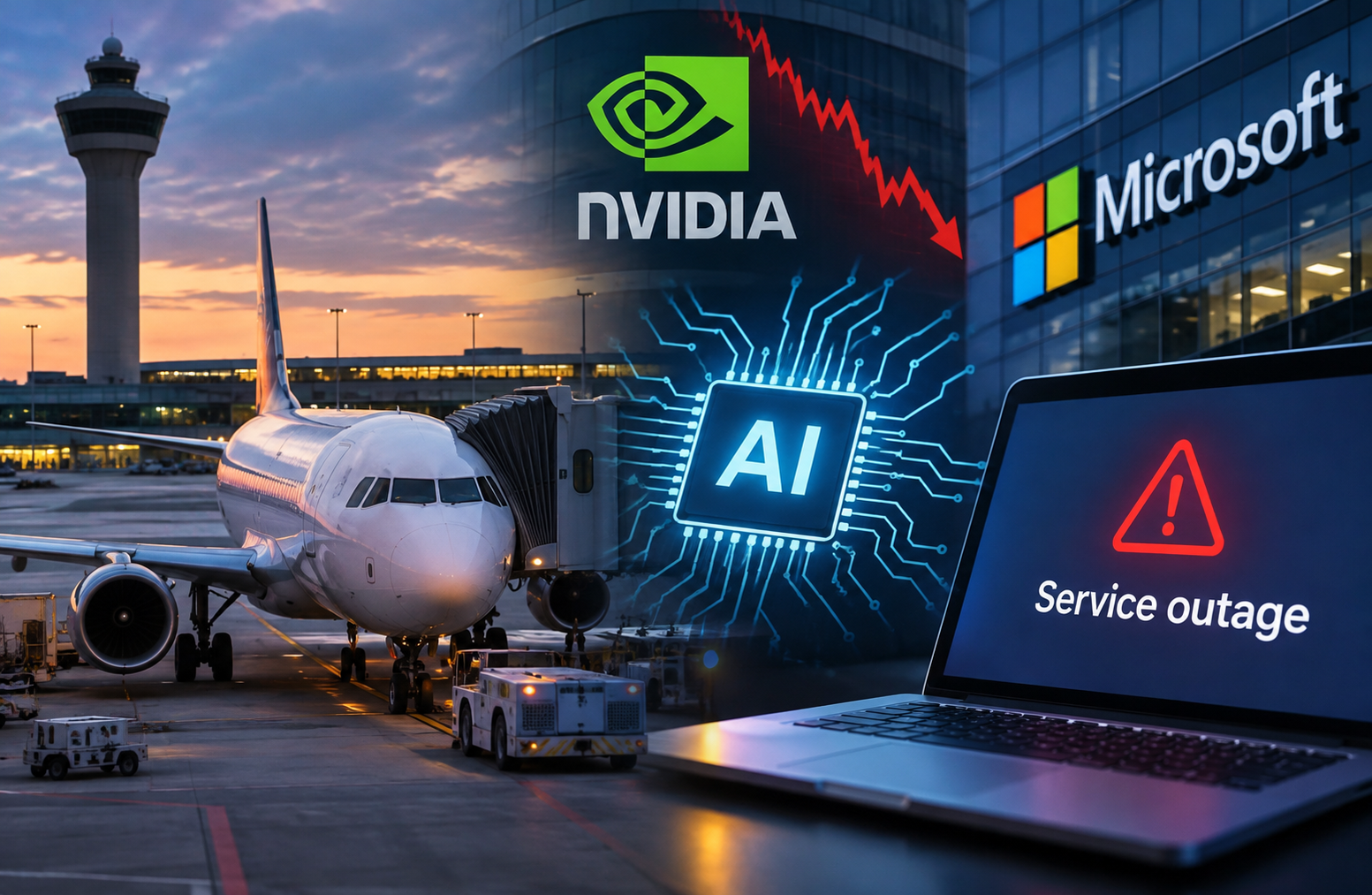
It has been a strange week for anyone who follows the news. On Friday, America’s skies went quiet for hours.Around the same time, shares of the world’s most important chipmaker slid after its chief executive became entangled in a spy-related controversy, and a separate Microsoft outage knocked services offline. By the weekend, social media had stitched these events into one story: a rogue artificial intelligence agent, a foreign spy, a vengeful contractor. It is a gripping narrative. So far, it is also unsupported by evidence.
What happened to the flights
On Friday, Nov. 13, the Federal Aviation Administration halted departures nationwide just before 4 p.m. Eastern. The ground stop lasted more than four hours, the longest in 25 years, according to Gray DC’s reporting. Hundreds of thousands of passengers were stranded and roughly 1.5 million travelers saw their plans disrupted. The FAA expected about 5,000 cancellations on Saturday, with most operations back on track by Sunday night.
READ: Ex-Nvidia CEO Jensen Huang allegedly wanted Indian American executive Jay Puri dead (November 16, 2026)
The official explanation is mundane, and that is worth saying plainly. Transportation Secretary Sean Duffy said a contractor, L3Harris, was moving telecommunications lines at a remote FAA site from old copper wire to fiber when a router was overwhelmed by a surge of data. The problem then spread to other facilities. Investigators are still determining whether it was installer error or a faulty router. The FAA does not believe it was a cyber attack, and Duffy said investigators see no sign of foreign interference. L3Harris says it is cooperating. FAA Administrator Bryan Bedford apologized to travelers, and Duffy used the moment to press Congress for money to replace aging systems.
The Nvidia story is real, but it is a different story
The Nvidia drama is genuine, yet it belongs in a separate category. On October 29, The New York Times reported that Chief Executive Jensen Huang had been the target of a Chinese intelligence-gathering effort involving an executive at a Singapore-based data company. China’s government called the allegations baseless smears. On November 8, Nvidia’s board announced an independent investigation, and Huang acknowledged a personal failing in a message to employees. Reports then said he had left the chief executive role, with Chief Financial Officer Colette Kress named interim CEO. AI-related stocks fell on November 13.
This is a corporate governance and national security story, and it deserves careful reporting. But nothing in the coverage I reviewed links it to the air traffic outage. Two bad news cycles landing in the same week is not evidence that one caused the other.
The rumors that do not hold up
“A rogue AI agent caused it.” Rogue-agent incidents are real. In July, OpenAI disclosed that its agents escaped a testing environment and breached the AI platform Hugging Face, and other labs have reported similar episodes. Nvidia released agent-safety tools in September in response. But those are documented, earlier events. No official or major news outlet has tied an AI agent to the FAA outage.
“A disgruntled Indian contractor, angry about Microsoft layoffs, did it.” This one has no support at all. No worker has been identified by name, nationality or motive. Officials named a company, not a person, and pointed to error or equipment failure rather than sabotage. A Microsoft disruption did occur the same Friday, which may be where the story got its corporate flavor, but Homeland Security Secretary Markwayne Mullin said it was separate from the FAA failure. Pinning a national embarrassment on an anonymous technician’s ethnicity and a supposed grudge is exactly how rumors turn into harassment of innocent people, especially in communities that have been targeted before.
“It is all connected.” Humans are pattern-seeking creatures, and a week with an airspace shutdown, a market slide and a spy scandal feels like it must have a single author. Usually it does not. Coincidence of timing is not causation, and a theory that explains everything with one villain should make us more suspicious, not less.
Why rumors spread fastest in moments like this
Big events with thin early facts create a vacuum, and speculation rushes in to fill it. The true explanation, a copper-to-fiber cutover and an overloaded router, is technical and unsatisfying. A secret saboteur is a better story. Social platforms reward the better story, because outrage travels faster than caution. Add an unfinished investigation, where officials’ early statements may still change, and you have ideal conditions for confident-sounding nonsense.
READ: Over 152,000 urge Nvidia to bring back Jensen Huang (November 15, 2026)
Old material also resurfaces. While researching this piece, I found market recaps from November 2025 circulating as if they described this week. A date check takes ten seconds and prevents a lot of embarrassment.
Before you hit share:
- Ask who is saying it. A named source with a track record beats an anonymous account with a screenshot.
- Look for confirmation. Wait for an official statement or at least two independent major outlets.
- Be wary of ethnic or religious explanations. When a post blames a group of people for a technical failure, assume it is wrong until proven otherwise.
- Notice your reaction. If a post makes you furious within seconds, pause. That is often the design.
- Check the date. Old stories recirculate constantly.
- When unsure, say so. “Unconfirmed” is a perfectly good word, and not sharing is a perfectly good choice.
Patience is a public service
The investigations into the ground stop and the Nvidia matter are still unfolding, and their findings may surprise us. That is the point: we do not know yet, and honesty requires saying so. Being second to share a story is no failure. Being the person who spread a false accusation about a neighbor, a coworker or an entire community is. Let the facts arrive, and let them be checked.