



By Prachi Kapoor
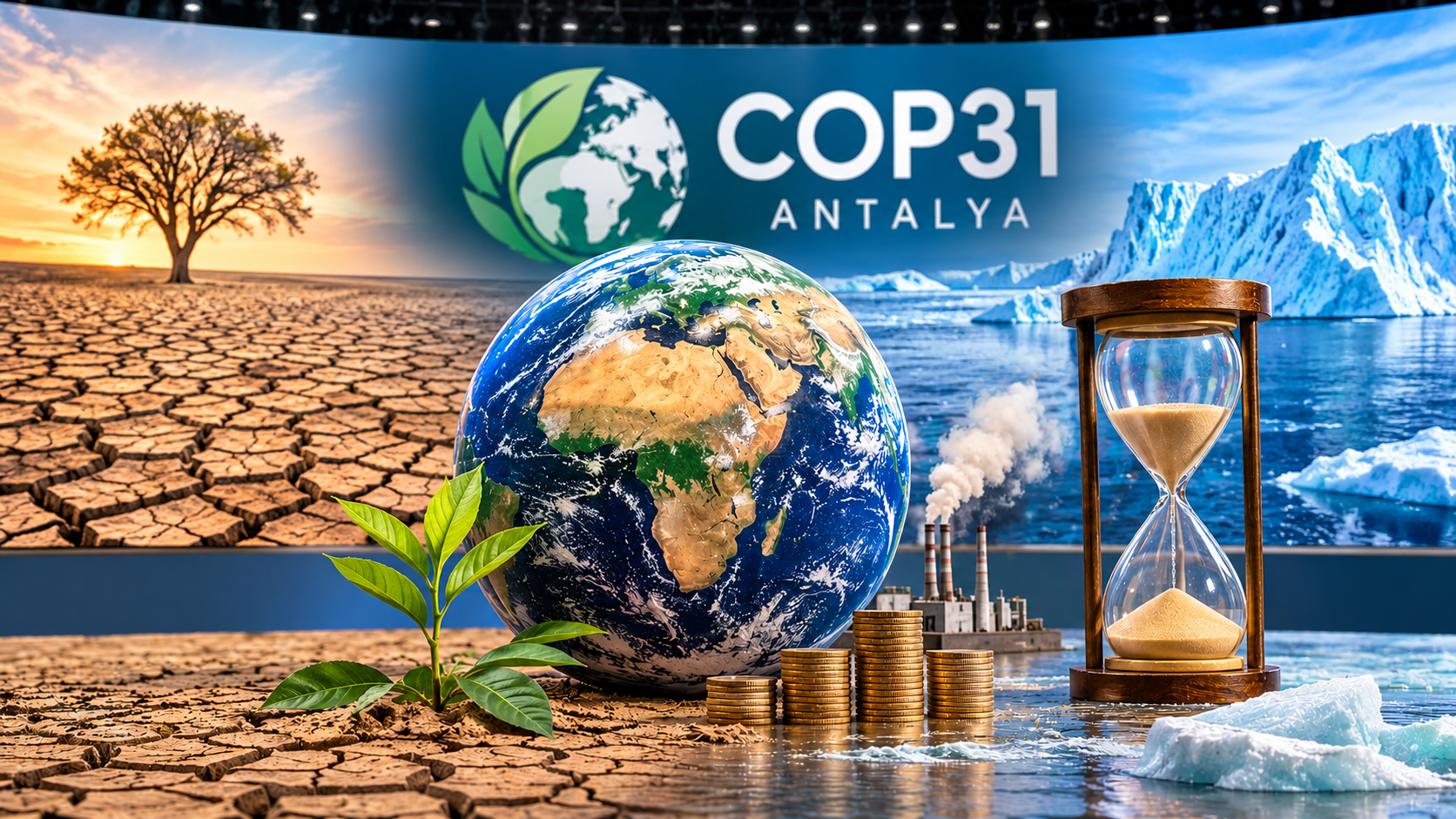
The COP31 deliberations in Antalya expose one of the most fundamental pitfalls in global climate negotiations: while there is growing recognition of the urgency of climate action, countries remain deeply divided over the decades-old debate of who should bear its costs and how the transition should be financed, even in the face of worsening climate disasters. Moreover, the United States, supposedly a “global leader,” was conspicuous by its absence yet again. The failure to reach consensus on the proposed Antalya Pact, particularly on fossil fuels and climate finance, reflects unresolved tensions over climate responsibility, economic interests and development priorities.
One of the most contentious issues was the absence of an explicit commitment to transition away from fossil fuels in the proposed cover text. Several countries, including the European Union and climate-vulnerable island states, argued that the draft weakened commitments made at previous COPs and failed to respond adequately to the scientific urgency of limiting global warming. Others defended the continued role of fossil fuels and technologies such as carbon capture and storage (popularly referred to as “CCS”). Ultimately, the proposed Antalya Pact was not adopted, although delegates reached separate decisions on areas including the *Global Goal on Adaptation* and the *Just Transition Work Programme*.
READ: Americans are turning against data centers: 54% say they hurt the environment (October 7, 2026)
These disagreements bring to mind the argument made by Sial (2025), who theorizes that the green transition involves more than just a shift from fossil fuels to renewable energy. For developing countries, it must also involve transforming the structure of production and reducing dependence on advanced economies. A country may expand its solar or wind capacity while continuing to import the technology, machinery, patents and financing required to operate these industries. In such circumstances, green industrialization risks reproducing existing economic dependence rather than creating domestic productive capabilities.
It can be gleaned from the propositions made in COP31’s cover texts that developing countries are increasingly expected to decarbonize while operating within unequal global economic structures. This overlooks critical constraints such as intellectual property restrictions, high borrowing costs, limited fiscal resources and trade barriers, all of which can prevent them from developing domestic green industries. Sial also highlights the imbalance in global climate governance: developing countries often have limited influence over decisions that directly affect their development pathways. Consequently, climate commitments that do not address these structural constraints risk placing additional obligations on the Global South without providing the means to fulfill them.
As a result, the divisions no longer lie solely between the developed and developing worlds. Even within the latter group, we observe the emergence of the “Like-Minded Developing Countries” (LMDCs), comprising India, China, Saudi Arabia and others, which advocate for the continued, measured use of fossil fuels in their respective countries. These countries were largely in favor of the absence of a reference to fossil fuels in the COP31 decisions, whereas around 130 countries opposed this position. Clearly, this division among developing countries poses a threat to their unified lobbying efforts, which might otherwise have achieved meaningful results based on the principle of common but differentiated responsibilities. According to Ireland’s climate minister, Darragh O’Brien, “This COP, I believe, was hijacked by some oil states,” referring to Saudi Arabia and its alleged disproportionate access to the conference presidency.
The negotiations on adaptation finance and loss and damage reveal a twin problem. Developing countries have repeatedly argued that climate action cannot depend primarily on loans or private investment, particularly when they are already burdened by debt and have contributed relatively little to historical emissions. The proposed increase in adaptation finance at COP31 was criticized by the African Group for lacking a clear baseline and assured delivery. Ultimately, no consensus was reached.
Lavinas (2025) draws attention to the increasing reliance of developing countries on private creditors and capital markets to finance development. However, this often comes at high interest rates and can deepen sovereign debt vulnerabilities. She notes that debt servicing can absorb resources that would otherwise be available for climate investment, health care, education and social protection.
She uses the example of Brazil’s sovereign sustainable bonds. Although these bonds mobilized funds for environmental and social programs, their issuance did not necessarily translate into additional public expenditure. Brazil’s fiscal rules continued to constrain spending, meaning that the proceeds largely financed expenditure within existing budgetary limits. Lavinas therefore questions whether innovative financial instruments can meaningfully advance climate and social development when the underlying fiscal framework remains restrictive.
This raises an important question about the direction of climate finance emerging from COP31: Are developing countries being offered resources that expand their capacity to act, or are they being encouraged to borrow more to meet obligations they cannot independently finance? Sustainable bonds and private investment can certainly play a role, but they cannot substitute for stable public climate finance, concessional lending, debt relief and stronger domestic public financial institutions. Nor should the success of climate finance be measured only by the amount of capital mobilized. Its terms, ownership, allocation and developmental outcomes matter equally.
Drawing on Sial’s and Lavinas’s respective writings, one can conclude that a just transition requires more than ambitious emissions targets and innovative financing mechanisms. It requires policy space for developing countries to pursue their own industrial strategies, build technological capabilities, expand public investment and protect vulnerable communities. For India, the implication is that expanding renewable energy capacity must go hand in hand with domestic manufacturing, technology development, affordable financing and employment generation.
COP31’s limited outcome is disappointing. Climate negotiations cannot simply center on securing commitments while leaving unresolved the inequalities that determine whether countries can implement them. If we are to truly have a chance of honoring the widely recognized commitment to limit global warming to 1.5 degrees Celsius, the next phase of global climate cooperation must move beyond asking developing countries to transition faster. It should address how they will be enabled to do so.
READ: Three Indian Americans in TIME’s 2026 climate leaders list (November 11, 2026)
Without this shift, the green transition may reduce emissions in aggregate while reproducing the very economic dependencies and inequalities that make climate action unjust. World leaders must take cognizance of the fact that, amid these negotiations and disagreements, they have lost precious time and, potentially, opportunities to reach actionable conclusions. This must drive them to pursue more conclusive and productive discussions in the future.
Prachi Kapoor is an undergraduate student researcher pursuing economics at Sri Venkateswara College, University of Delhi. Her research interests include climate finance, green macrofinance and sustainable economics.