



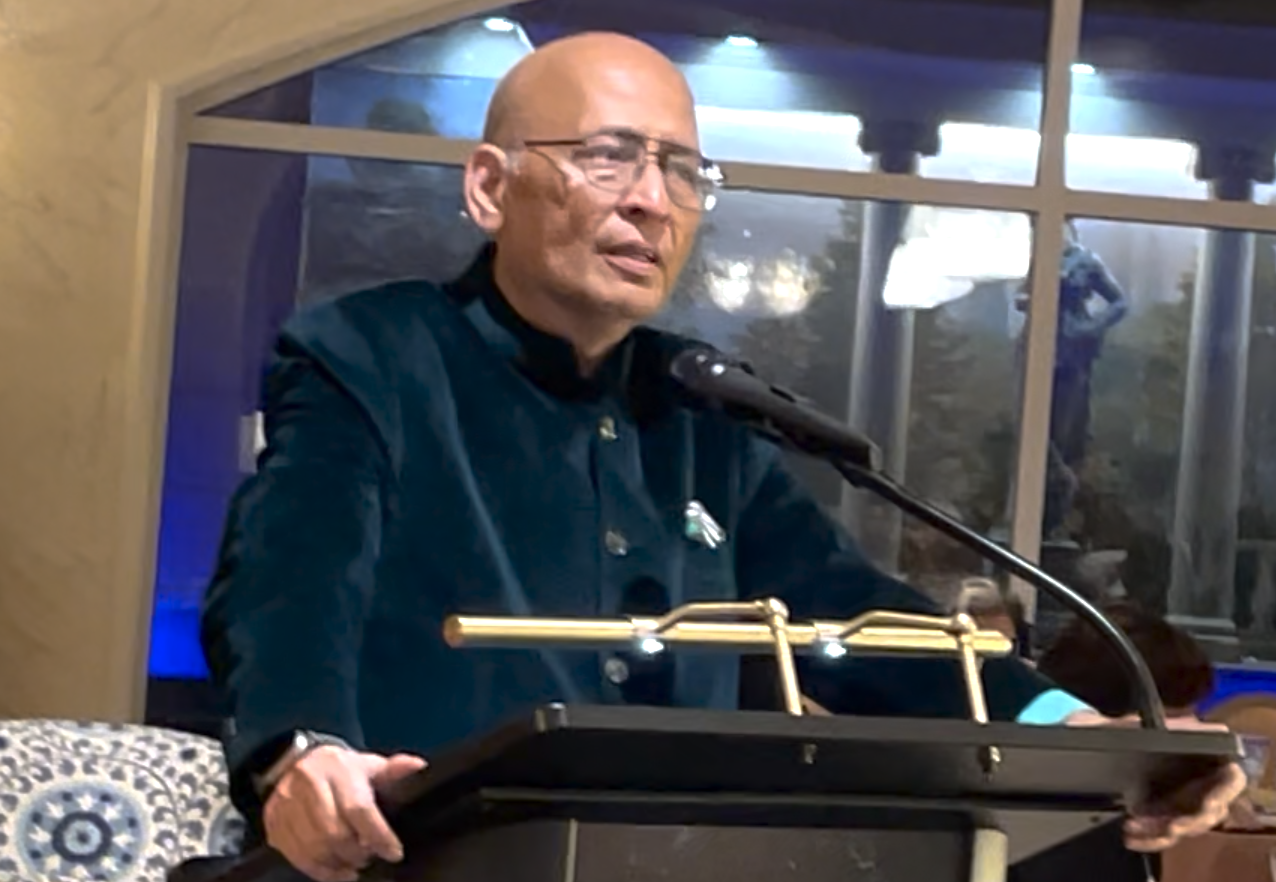
Secularism is a crucial, albeit often misunderstood, pillar of Indian democracy, said Abhishek Singhvi, a leader of India’s opposition Congress party and Member of Parliament.
Delivering a lecture on “India at 75 and beyond: Law, politics and governance in the world’s largest democracy,” at the Potomac, MD, residence of Indian American philanthropist Frank Islam, Singhvi delved into the multifaceted landscape of India’s political, legal, and governance systems.
“Indian democracy is based on several institutional and non-institutional pillars, where obviously the non-institutional ones are even more important than the institutional ones,” said Singhvi, a former Additional Solicitor General of India and well-known lawyer.
“The most important of those non-institutional pillars of Indian democracy is secularism, one of the most abused, debased and devalued terms of our society,” he said.
The Rajya Sabha MP stressed the importance of pluralism and inclusiveness, characteristics embedded in the term secularism.
The lecture, part of a series hosted by the O.P. Jindal Global University across the United States, was attended by a diverse audience, including educators, university administrators, university officials, and prominent members of the Indian American community from Washington, DC, Maryland, and Virginia.
Singhvi, who is also a spokesperson of the Congress party, began with a thought-provoking question to the audience: Why has India, among the countries that emerged from imperialism in the mid-20th century, remained a vibrant democracy unlike any other? Singhvi pondered whether the unique sequencing of leaders like Gandhi and Nehru played a role in shaping India’s democratic journey.
Exploring other pillars of Indian democracy, Singhvi spoke about the relevance of fraternity, the second pillar, echoing the ideals of unity and co-ownership, reinforcing the notion of a shared democracy.
Singhvi underscored the need for individuals, regardless of their place in society, to feel a sense of co-ownership in the democratic process. This inclusiveness, he argued, was essential for a country as diverse as India to thrive.
According to Singhvi, federalism, a captivating chapter in India’s constitutional evolution, is a non-institutional pillar that has grown stronger over the years. He traced the journey from a largely unitary system to an inadvertent and unintended federalism, citing examples of fiscal and linguistic federalism.
The MP touched upon the significant role of institutions like the Parliament, the Army, and the Election Commission in sustaining India’s vibrant democracy. He emphasized the country’s commitment to electoral democracy, highlighting the revolutionary concept of one person, one vote, despite the challenges faced, such as late women’s suffrage.
The foundational principles of the Indian Constitution, including fundamental rights and directed principles of state policy, were explored in depth. Singhvi praised the delicate balance between civil and political rights, enforceable through judicial interpretation, and the unique role of the Supreme Court in upholding the basic structure doctrine.
Singhvi reminisced about the post-emergency phase, describing the Supreme Court’s quest for legitimation. He portrayed the court as a powerful force in judicial review and activism. The current liberal phase, advocating for gender rights and liberal values, was also acknowledged as a crucial aspect of India’s democratic tapestry.
Earlier, the host, Islam, a prominent Democratic party donor, welcomed the guests and introduced C. Raj Kumar, the vice-chancellor of Jindal Global University, who then introduced Singhvi.
Terming the event a ‘renewal’ dinner, held in the United States, the world’s second-largest democracy, soon to celebrate its 250th year, Islam juxtaposed it with the challenges facing democracies worldwide.
Islam highlighted the tumultuous state of democracy in the United States, characterized by congressional chaos and global conflicts in regions such as the Middle East and Ukraine. He described the gathering as an opportunity to revitalize faith in and commitment to the democratic principles that form the foundation of both the United States and India, the world’s two largest democracies.
“We are at a positive ‘turning point for democracy,’ and authoritarians are beatable because of difference-makers like you, guests at this ‘renewal’ dinner tonight,” he said. “Look around this room, and you will see professors, doctors, lawyers, reporters, and other leaders who are already making a difference.”
Among those in attendance were Maryland’s Acting Secretary of Higher Education Sanjay Rai and former Maryland Deputy Secretary of State and Founding Chairman and CEO of Global Alliant Rajan Natarajan.