



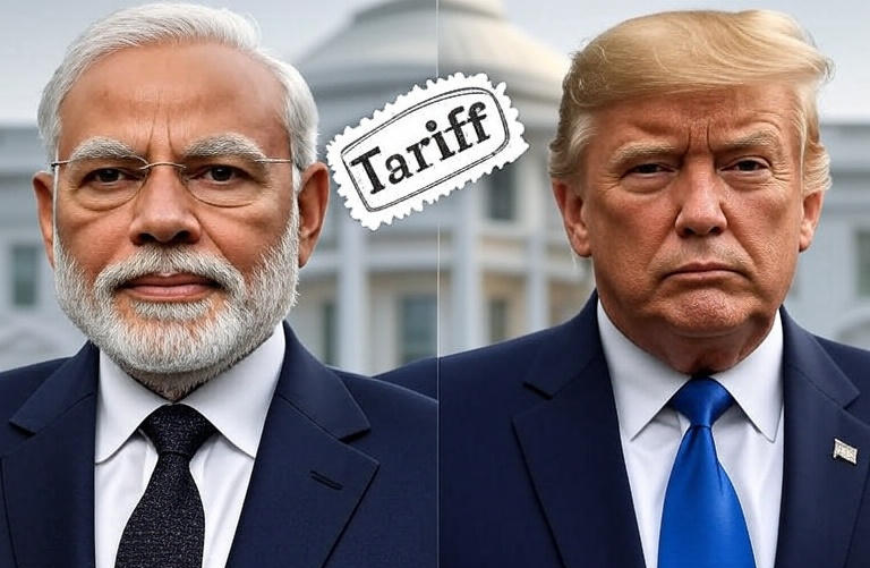
The Trump administration’s latest trade move against India kicked in Wednesday, as a new 25% tariff on Indian imports took effect. The penalty, tied to New Delhi’s continued purchases of Russian oil, doubles the overall duty burden to 50%. White House officials have framed the measure as a national security step, with Vice President JD Vance telling NBC News that President Trump is using “aggressive economic leverage,” including secondary tariffs, to choke off Moscow’s oil revenues.
The move places India who is long seen as a key U.S. partner in the Indo-Pacific, among the countries now facing some of the steepest tariffs anywhere. For New Delhi, the hit comes at a sensitive moment as the U.S. was until recently its top trading partner, and higher duties threaten to squeeze exports and slow momentum in the world’s fifth-largest economy.
In response, Indian Prime Minister Narendra Modi’s government has scrambled to soften the blow. Earlier this month, Modi pledged tax cuts to cushion businesses and doubled down on calls for greater economic self-reliance in India. He framed the announcement as a festive boost, saying a Diwali gift in the form of a “massive tax bonanza” was on the way for country’s ordinary citizens and the millions of small businesses that power India’s $4 trillion economy.
READ: Who lost India? Trump’s tariff approach puts a generation of U.S.-India progress at risk (
From the ramparts of Delhi’s Red Fort on Independence Day, celebrated on Aug. 15 — Modi was draped in a saffron turban before a cheering crowd, urging small shopkeepers to put up signs reading “Swadeshi” or “Made in India.”
“We should become self-reliant—not out of desperation, but out of pride,” he declared. “Economic selfishness is on the rise globally and we mustn’t sit and cry about our difficulties, we must rise above and not allow others to hold us in their clutches.”
The rhetoric, repeated in multiple speeches this week, plays well at home but also signals to Washington, D.C., that India intends to chart a more independent economic course even as the U.S. tightens the screws with new tariffs.
In the Pentagon, Modi’s call for self-reliance is being read as both defiance and pragmatism. U.S. officials argue that India’s export-heavy economy is bound to feel the squeeze from a 50% tariff wall, and some see the “make and spend in India” push as New Delhi bracing its public for tougher times ahead. At the same time, it underscores a widening gap between two governments that still call each other strategic partners but are drifting apart on trade.
READ: India hit with fresh tariff hike; Trump doubles down with 50% (
India’s manufacturing sector has struggled to expand, remaining around 15% of GDP despite years of subsidies and production incentives. Experts say that by cutting taxes and simplifying the GST, the government can inject liquidity directly into the economy, helping businesses and consumers weather the impact of Washington’s steep 50% tariff.
After a $12 billion income tax relief announced earlier this year, Modi is now seeking to overhaul India’s indirect tax structure, signaling a broader strategy to shield export-driven industries and keep the economy resilient amid escalating trade tensions with the U.S.
Modi has now followed through with plans aimed at cushioning the economy, as India’s finance ministry unveiled a proposal for a simplified two-tier GST system. “Combined with the income tax cut in place from April 2025… the GST rate reforms [likely worth $20 billion; £14.7 billion] should together provide a meaningful push to consumption,” analysts at U.S.-based brokerage Jeffries said, highlighting how the measures could help India’s businesses and consumers absorb the shock from Washington’s 50% tariff, as quoted by BBC.
Private consumption drives nearly 60% of India’s GDP, making it a cornerstone of the country’s economic health. Rural spending, buoyed by a bumper harvest, has stayed relatively strong, but urban demand for goods and services has slowed, weighed down by lower wages and job cuts in major sectors like IT following the pandemic.
READ: How U.S. tariffs threaten Indian exports from textiles to jewelry (
Modi’s proposed tax cuts, framed as a “fiscal stimulus,” are expected to help revive consumer spending, according to investment banking firm Morgan Stanley. The reforms should support GDP growth while easing inflationary pressures.
“This is particularly crucial amid headwinds from ongoing global geopolitical tensions and adverse global tariff-related developments that might impair external demand,” Morgan Stanley noted.
The tax breaks are likely to provide the most immediate lift to consumer-facing industries. Everything from scooters and small cars to garments and even cement used in home construction are some sectors that typically see demand surge around Diwali.
READ: China backs India, criticizes US over harsh trade tariffs (
Complementing this fiscal support, the Reserve Bank of India has signaled readiness to deploy additional monetary measures if needed. RBI announced that the organization is prepared to roll out extra policy measures if the country’s economy starts feeling the pinch from the new 50% U.S. tariffs.
“We have provided ample liquidity to the banking sector and whatever else is required to support the growth of the economy and including those of sectors which are impacted more. If it so happens, we will not be found wanting in our job,” Indian Governor Sanjay Malhotra announced on Monday.
Together, these measures like tax cuts, GST reforms, and RBI readiness are designed to keep India’s economy moving, support consumer demand, and help export-driven industries like textiles and automotive components weather the blow from Washington’s steep tariffs. Yet not all sectors are faring equally: the diamond trade(gems and jewelry) has already slowed sharply under the new duties. India’s carpet business too feels threatened and loses market to Bangladesh and Vietnam, where tariffs are lower at 37% and 46%, respectively.
Against this backdrop, tensions between Delhi and Washington have escalated, particularly over India’s continued Russian oil imports, calling off the trade talks that were scheduled to begin earlier this week. The standoff shows how government spending, central bank actions, trade talks, and global politics are all connected, with India trying to protect its economy while handling rising tensions with other countries.
READ: India halts postal services to US; Russian oil deal continues (
While Indian media outlet The Telegraph stated that according to a government source, India is optimistic that Washington may reconsider the additional 25% tariff imposed on its goods over Russian oil purchases. The government is actively consulting with exporters to boost shipments of textiles, leather, gems, and jewelry to alternative markets, and is expected to offer financial support to businesses most affected by the duties.
Indian markets are closed on Wednesday for Hindu festival Ganesh Chaturthi, so there is no immediate reaction to the new tariff. However, on Tuesday, equity indices suffered their worst day in three months after Washington confirmed the extra 25% duty. The Indian rupee also fell for the fifth straight session, hitting a three-week low. Exporters warn that the tariffs could impact roughly 55% of India’s $87 billion in merchandise sales to the U.S., while giving a boost to rivals like Vietnam, Bangladesh, and China.
Both sides released similar statements on Tuesday noting that senior officials from their foreign and defense departments held a virtual meeting on Monday and expressed a strong interest in “eagerness to continue enhancing the breadth and depth of the bilateral relationship.” They also reiterated their commitment to the Quad, the strategic grouping that includes the U.S., India, Australia, and Japan.