



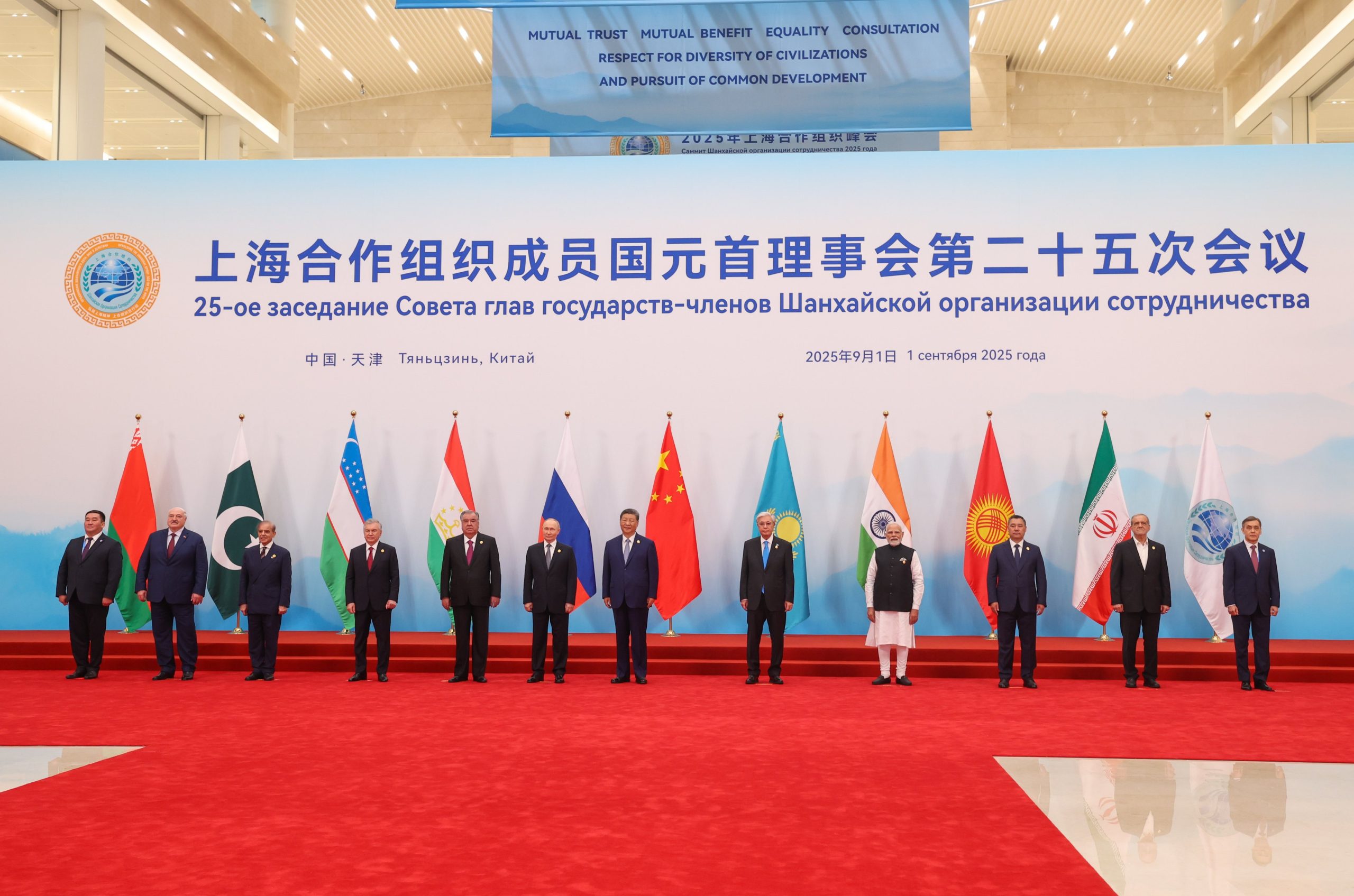
The 25th Shanghai Cooperation Organization (SCO) Summit, the largest in the bloc’s history, concluded in Tianjin on Sept. 1. Hosted by China for the fifth time, the gathering took place at the newly renovated Meijiang Convention & Exhibition Center along the Hai River.
Chinese President Xi Jinping, Russian President Vladimir Putin, and Indian Prime Minister Narendra Modi used the platform to call for a multipolar world order, criticizing Western “power politics” and pledging support for “true multilateralism.” Xi also proposed creating an SCO development bank, pledging $280 million (RMB 2 billion) in grants and $1.4 billion (RMB 10 billion) in loans for member states.
The summit spotlighted rare diplomatic warmth between Beijing, Moscow, and New Delhi, with Modi publicly exchanging handshakes and smiles with Xi and Putin. But Washington dismissed the display. U.S. Treasury Secretary Scott Bessent branded the meeting “largely performative” and accused China and India of being “bad actors” for maintaining trade ties with Russia, underscoring American concerns over deepening Eurasian alliances.
READ: Who lost India? Trump’s tariff approach puts a generation of U.S.-India progress at risk (August 19, 2025)
While Russia and China projected a united front, India’s careful positioning reflected its effort to balance engagement within the SCO against mounting pressure from the United States and its allies.
With the Shanghai Cooperation Organization (SCO) Summit highlighting the camaraderie among Indian, Chinese, and Russian leaders, global trade negotiations appear to be entering a new phase. The meeting underscored how emerging alliances may reshape the balance of power in an already unsettled global economy.
This diplomatic theater unfolded just days after a landmark U.S. court decision. The Federal Court of Appeals ruled against the President’s expansive use of the International Emergency Economic Powers Act (IEEPA) to justify sweeping tariffs. The judges found no basis for invoking emergency powers to impose duties on multiple economies. The ruling upheld an earlier decision by the Court of International Trade in Manhattan, which had deemed the tariffs unlawful. The administration has now appealed to the Supreme Court, dismissing both lower courts as “left wing.”
From day one, the President has pointed to the $1 trillion-plus Chinese trade surplus and America’s corresponding deficit as justification for tariffs. His simple claim: tariffs would force companies to “reshore” investment and prevent the U.S. from “becoming a third-world economy.”
Yet the facts suggest otherwise. Since 2015, the United States has been a net recipient of foreign direct investment (FDI). Far from retreating, global capital continues to flow into U.S. markets. Even before the current administration, President Biden had attracted semiconductor fabs through the CHIPS and Science Act and clean-energy projects via the Inflation Reduction Act (IRA). These programs, which combined targeted subsidies and tax incentives, demonstrated that steady policy—not bombast—could lure high-value industries back to American soil.
Chip wars and compromise
The administration has also been forced into pragmatic concessions. One example: restrictions on the export of advanced Nvidia AI chips. Initially imposed as a way to undercut China’s technological rise, the ban was later eased after Nvidia agreed to share a portion of profits with the U.S. government. Officials also recognized that overly aggressive restrictions risked accelerating Chinese innovation. In response, Beijing softened curbs on rare-earth exports critical to U.S. manufacturers.
These battles echo earlier disputes. A decade ago, the U.S. challenged China’s rare-earth export restrictions at the WTO and prevailed. Today, history risks repeating itself—only with higher stakes as AI, semiconductors, and clean technologies become central to economic security.
The reality of global value chains
Trade’s share of world GDP has grown from about 5% in the 19th century to roughly 25% today. In this era of deep global value chains, the U.S. and Europe still dominate high-value activities like design, R&D, and branding, while lower-value assembly is dispersed across Asia and the developing world. Tariffs, however politically appealing, do little to alter this structural reality.
Moreover, the President’s narrative of capital flight does not hold up. The stock of foreign investment in the U.S. exceeds American investment abroad, a reflection of America’s unique role as a safe haven. Much of this capital targets the “Magnificent Seven” tech giants, with Nvidia—now valued at over $4 trillion—leading the charge. Investors are not irrational; they will not build industries in locations where costs make them uncompetitive, regardless of how generous subsidies may be.
Risks of subsidy overreach
The administration’s conviction that ever-larger subsidies can guarantee reindustrialization risks deadweight losses to the U.S. economy. America’s agricultural sector offers a cautionary tale: decades of subsidies have distorted production while entrenching inefficiency. Replicating this model in advanced manufacturing could backfire, leaving taxpayers with ballooning costs and little durable advantage.
The bigger picture
Rather than escalating legal appeals and clinging to tariffs, the U.S. should use this moment to reassert international leadership. It remains the world’s largest economy, accounting for roughly one-quarter of global output, and boasts the highest per capita GDP of any nation over 10 million people. It dominates global services trade, accounting for nearly one-eighth of the $8 trillion worldwide total.
Instead of lamenting trade deficits, Washington should embrace its role as the market of choice for the world. Failure to do so risks driving emerging economies toward alternative frameworks like BRICS, which already represents a substantial share of global population and output.
The choice before Washington is stark. It can double down on tariffs, subsidies, and litigation—policies that risk isolating the U.S. from an increasingly multipolar world. Or it can lean into its enduring strengths: innovation, services, and global leadership.
For a country that has long defined itself as the engine of the world economy, the latter path is not only wiser but essential.