




As Americans’ faith in capitalism hits a record low, two-thirds of Democrats now view socialism positively.
Though Americans still support free enterprise by an overwhelming margin, with inflation straining the middle class and wealth increasingly concentrated among billionaires, their confidence in capitalism has fallen to the lowest level Gallup has ever recorded.
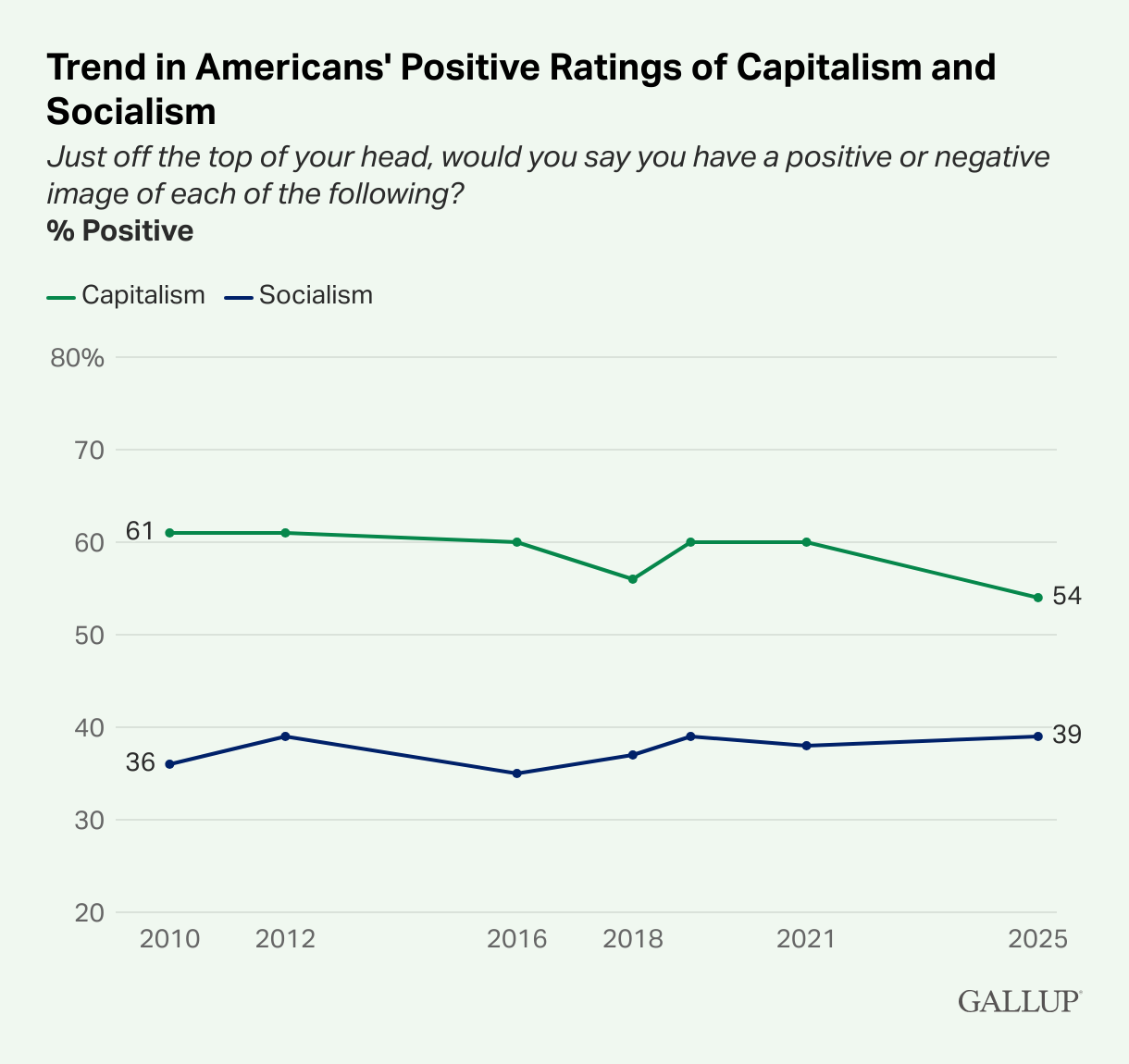
Only 54% of Americans view capitalism favorably, down six points from 2021 and the lowest in more than a decade of polling. Nearly two in five (39%) now view socialism positively, a figure that has remained relatively stable over time.
Gallup first began tracking attitudes toward economic systems in 2010 and has repeated the survey six times since, most recently between August 1–20. Until this year, Americans’ views of capitalism had remained largely steady near 60%.
The growing disillusionment with capitalism comes against a backdrop of stagnant wages, rising living costs, and widening inequality. While corporate profits and stock markets have surged in recent years, many households continue to struggle with the burden of inflation, soaring housing prices, and medical debt.
Federal Reserve data shows the top 0.1% of Americans now control more than five times the wealth of the bottom half of the population. By the end of the first quarter, the top 0.1% of Americans held $22.2 trillion in wealth, according to the Federal Reserve’s Distributional Financial Accounts, while the bottom 50% held a combined $4 trillion.
For many, this concentration of prosperity at the very top reinforces the perception that the economic system works better for billionaires than for ordinary workers.
The decline in support for capitalism is being driven by Democrats and independents, both of whom registered eight-point drops since 2021. For the first time, fewer than half of Democrats (42%) now view capitalism positively. By contrast, two-thirds of Democrats (66%) express positive views of socialism, making them the only partisan group to prefer socialism over capitalism.
The surge in support for socialism among Democrats is hardly surprising, given the rising influence of progressives within the party. For decades, one of the most prominent figures on the left has been Vermont Sen. Bernie Sanders, a self-described democratic socialist who helped mainstream the term in American politics. In recent years, New York Rep. Alexandria Ocasio-Cortez, a left-wing populist, has emerged as one of the most influential voices in the House.
That progressive shift is also reshaping local politics. Earlier this summer, Democratic Socialist Zohran Kwame Mamdani made history by defeating Gov. Andrew Cuomo to become the Democratic nominee for mayor of New York City — the nation’s largest and wealthiest metropolis.
Independents remain slightly more favorable toward capitalism (51%) than socialism (38%), while Republicans’ views are largely unchanged, with 74% holding a positive view of capitalism and only 14% viewing socialism positively.
Over time, Democrats’ embrace of socialism has grown — from 50% in 2010 to roughly two-thirds since 2019 — while Republican support has fallen, keeping overall national attitudes toward socialism relatively stable.
Free enterprise and small business still popular
Despite the erosion in support for capitalism, Americans remain overwhelmingly positive about two of its components: 95% have a favorable view of small business, and 81% view free enterprise positively. Both figures are consistent with past readings.
Attitudes toward big business, however, have soured sharply. Just 37% of Americans now view big business positively, down from 52% in 2019 and a high of 58% in 2012. Views are especially negative among Democrats (17%) and independents (36%), both new lows, while 60% of Republicans remain positive.
Part of the souring on big business reflects the gap between corporate success and workers’ realities. Tech giants and other multinationals have grown into trillion-dollar enterprises, posting record profits and rewarding shareholders, even as they announce sweeping layoffs. At the same time, wages for many workers have remained stagnant, benefits have eroded, and job security feels increasingly uncertain. This contrast — booming balance sheets at the top, economic anxiety on the ground — has fueled public skepticism toward corporate America.
Gallup concludes that while Americans continue to broadly support the U.S. economic system, capitalism’s image has dimmed at a time of high inflation, economic inequality, and growing political polarization.