



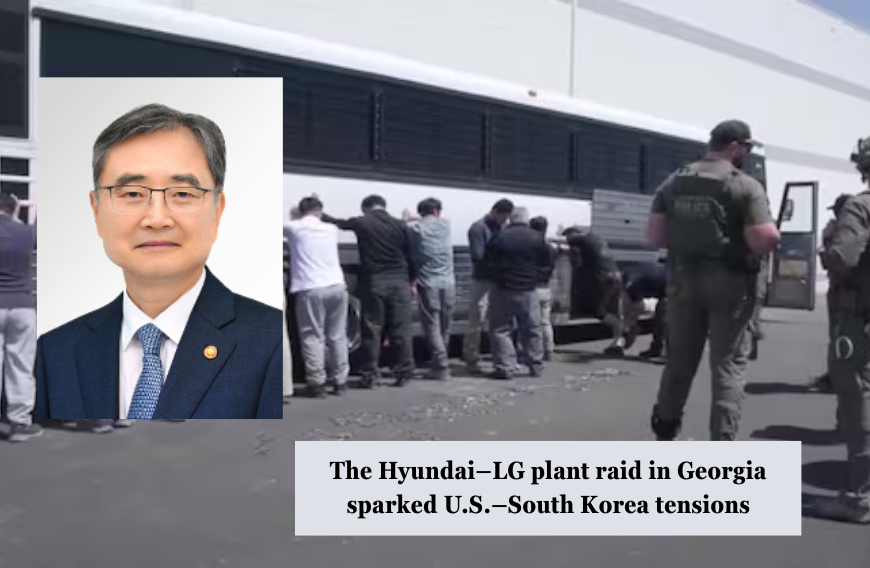
South Korea has voiced displeasure with the United States after being informed of a raid at a Hyundai warehouse. More than 300 South Korean workers detained in a massive immigration raid at a Hyundai plant in Georgia will be released and repatriated, the South Korean government announced Sunday.
On September 4, 2025, U.S. immigration authorities carried out the largest single-site immigration raid in American history at the Hyundai–LG electric vehicle battery plant under construction in Ellabell, Georgia. The operation, dubbed “Operation Low Voltage,” led to the detention of 475 workers, the majority of whom were South Korean nationals employed through subcontractors. Authorities alleged visa violations, including misuse of visitor or training visas for labor. The raid was the result of a months-long federal investigation involving multiple agencies such as ICE, HSI, and the FBI. Although no criminal charges were filed, the operation drew immediate international attention and sparked diplomatic tensions.
In response, the South Korean government expressed deep concern over the detentions and moved quickly to resolve the situation. Within days, a bilateral agreement was reached: over 300 South Korean workers would be voluntarily repatriated without formal deportation, using a chartered flight arranged in coordination with U.S. authorities. South Korea’s Foreign Minister, Cho Hyun, personally traveled to Washington to finalize the deal. Meanwhile, President Trump defended the raid as a necessary enforcement of immigration laws, urging foreign companies to prioritize hiring and training American workers. He signaled willingness to allow foreign specialists into the U.S., provided they follow legal procedures. The incident has raised concerns about future foreign investment and labor practices in the U.S., particularly for major international projects relying heavily on subcontracted foreign labor.
READ: ICE detains South Korean student, sparks outcry in community (
South Korean presidential chief of staff Kang Hoon-sik said Sunday that negotiators were finalizing talks with U.S. officials to secure the release of the workers arrested in the crackdown at the Hyundai–LG plant. “The South Korean government will remain on guard and stay on the situation with responsibility until our citizens have safely returned home,” Kang said at a meeting with senior legislators and Cabinet officials.
While the U.S. government justified the operation as a necessary step to uphold immigration laws, the scale and diplomatic fallout highlighted the risks involved when major international projects rely on foreign labor through subcontracting networks. For South Korea, a key U.S. ally and a major investor in American manufacturing, the incident came as a shock, especially in light of recent economic and strategic agreements between the two nations.
The timing further intensified the reaction. In July, South Korea agreed to purchase $100 billion in U.S. energy and invest $350 billion in the U.S. in exchange for lower American tariff rates. About two weeks ago, U.S. President Donald Trump and Lee held their first meeting in Washington.
The swift diplomatic response, including the voluntary repatriation of over 300 South Korean workers, demonstrated both countries’ desire to contain tensions. However, the raid has already had a chilling effect on foreign companies considering U.S. expansion, particularly in high-tech manufacturing sectors like EVs and semiconductors. Moving forward, 2025 may serve as a turning point for how the U.S. balances economic openness with immigration control, forcing companies and governments alike to reconsider how global labor forces are managed within legal and diplomatic boundaries.
READ: US limitations on chipmaking hit top South Korean chip manufacturers (
President Trump suggested that an arrangement could be reached allowing South Korean specialists to train American workers in advanced industries. “If you don’t have people in this country right now that know about batteries, maybe we should help them along and let some people come in and train our people,” Trump said Sunday night at Andrews Air Force Base. He added: “The way you train people is bring people in that know what they’re doing, let them stay for a little while and help.”
The Hyundai raid has ignited global concern over how foreign labor is managed in large-scale industrial projects, particularly in the fast-growing electric vehicle sector. The heavy use of subcontractors, often operating in legal gray areas, has raised alarms about oversight failures in even the most high-profile international ventures. In the aftermath, both U.S. and South Korean officials have called for tighter regulatory controls and clearer visa protocols to prevent future diplomatic and legal fallout. For multinational firms, the 2025 incident is more than a legal issue, it’s a strategic warning that compliance, labor transparency, and cross-border governance are now non-negotiable pillars of global investment.