



A move critics call an “economic wrecking ball” could devastate the tech workforce, with Indian professionals hardest hit.
(Editor’s note: This story has been updated.)
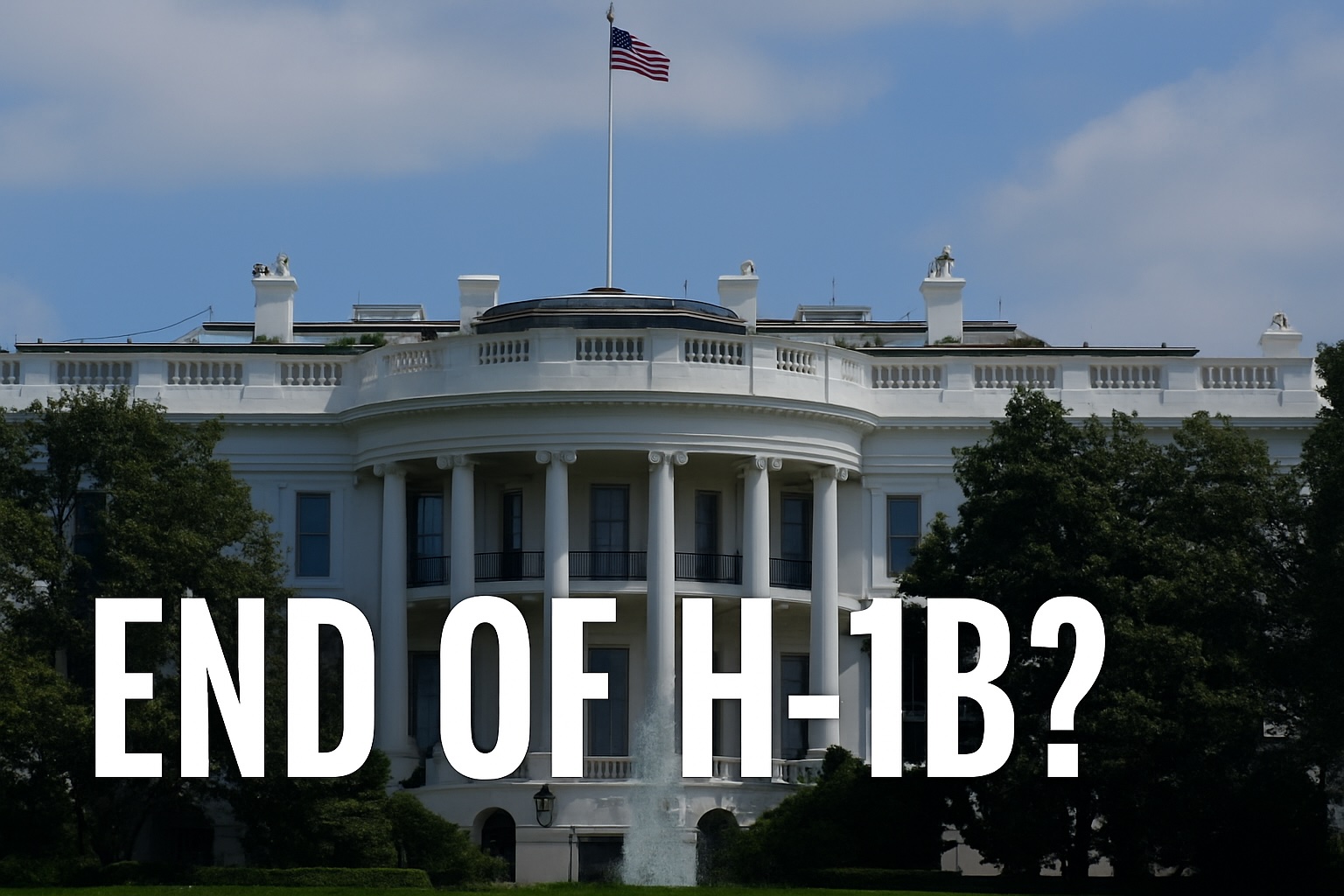
It’s the Big Daddy of all crackdowns — a move so seismic that, if implemented, it threatens to flatten an entire workforce that has powered America’s tech backbone for decades. President Trump on Friday issued a proclamation imposing a jaw-dropping $100,000 fee on every H-1B visa application. The shocking development was first reported Friday morning by Bloomberg, sending everyone from H-1B hopefuls to tech industry insiders to immigration attorneys into a tizzy. The news was later confirmed by a White House official to the New York Post.
“The high numbers of relatively low-wage workers in the H-1B program undercut the integrity of the program and are detrimental to American workers’ wages and labor opportunities, especially at the entry level, in industries where such low-paid H-1B workers are concentrated,” the executive order states. “These abuses also prevent American employers in other industries from utilizing the H-1B program in the manner in which it was intended: to fill jobs for which highly skilled and educated American workers are unavailable.”
As per the executive order, entry into the U.S. on an H-1B visa is restricted unless the petition is accompanied by a $100,000 payment. Employers must obtain and retain documentation proving the $100,000 payment before filing petitions, and the Department of State must verify payment during visa petition review and approve only petitions with verified payment.
Restriction begins 12:01 a.m. EDT on September 21, 2025 and lasts for 12 months, unless extended.
The Department of Homeland Security (DHS) may waive restrictions for individuals, companies, or industries if hiring H-1B workers is deemed in the national interest and poses no threat to U.S. security or welfare.
The Department of State must issue guidance to prevent misuse of B visas by H-1B beneficiaries with start dates before October 1, 2026.
The H-1B program, created through the Immigration Act of 1990, has long served as the pipeline feeding Silicon Valley its engineers, coders, and innovators. If this measure becomes law, it could effectively wipe out a major segment of America’s tech workforce overnight — the majority of whom are Indian nationals.
The executive order, however, pointed out that the number of foreign STEM workers in the country “has more than doubled between 2000 and 2019, increasing from 1.2 million to almost 2.5 million, while overall STEM employment has only increased 44.5 percent during that time.” It added that, among computer and math occupations, the foreign share of the workforce grew from 17.7 percent in 2000 to 26.1 percent in 2019. And the key facilitator for this influx of foreign STEM labor has been the abuse of the H-1B visa.”
Information technology (IT) firms have been among the most aggressive users of the H-1B program, a trend that critics say has harmed American workers in computer-related fields, the proclamation noted, adding that the share of IT workers in the H-1B pool rose from 32 percent in Fiscal Year (FY) 2003 to more than 65 percent on average over the past five years.
It said, “In addition, some of the most prolific H-1B employers are now consistently IT outsourcing companies. Using these H 1B-reliant IT outsourcing companies provides significant savings for employers: one study of tech workers showed a 36 percent discount for H-1B “entry-level” positions as compared to full-time, traditional workers. To take advantage of artificially low labor costs incentivized by the program, companies close their IT divisions, fire their American staff, and outsource IT jobs to lower-paid foreign workers.”
The proclamation said domestic law enforcement agencies have investigated outsourcing firms heavily reliant on H-1B workers for alleged visa fraud, money laundering, racketeering, and other illicit activities designed to bring foreign workers into the United States.
“It is therefore necessary to impose higher costs on companies seeking to use the H-1B program in order to address the abuse of that program while still permitting companies to hire the best of the best temporary foreign workers,” the president stated.
The Trump administration frames the executive order as “reform.” Critics see it as something else entirely, calling it an economic wrecking ball that targets not only foreign workers but also the U.S. industries and universities that rely on them. As soon as the news broke, it sent shockwaves across the immigration world.
READ: Stephen Miller links H-1B to trade battle with India, escalating bilateral tensions (August 4, 2025)
New York-based Roman Zelichenko, a former immigration attorney and now CEO and co-founder of LaborLess, an H-1B visa compliance technology company, says, “I don’t believe that anybody saw this coming. President Trump recently had top tech CEOs from companies, like Google, Microsoft, Meta, and others invited to the White House. He also had a few of them accompany him to London a few days ago. These companies are some of the absolute biggest filers of H1B visa applications, by the many thousands per year, and so if this was actually a fee of $100,000 per application, I think it would make the H1B visa effectively impossible to maintain even for multi-billion-dollar corporations.”
Reform or End of a Road?
The looming question now is what happens next for the H-1B program. In the past, H-1B reforms have focused on guardrails such as mandating minimum wage levels and curbing the perception that foreign workers displace Americans at lower salaries. But this proposed six-figure fee looks more like an economic tripwire. Nandini Nair, who specializes in immigration and compliance matters and is a partner at A.Y. Strauss, LLC, says, “That’s a big if, if it even happens at all, it would virtually end the program. Almost no one would participate in the program out of financial stress and the net result is that the program would rarely, if at all, be utilized. And that may be a win for the administration.” She adds, “The administration believes that once H1B employees leave or are no longer available, these jobs will go to US workers. It feeds into the narrative that foreigners are taking away jobs from US workers.”
Indians, worst affected?
For the past several years, Indians have consistently been the largest recipients of H-1B visas. In 2022–23, a striking 72% of all H-1B visas went to Indian nationals. A fee this high would disproportionately impact the program’s largest participants. Zelichenko says, “It’s not unreasonable to think that Indian nationals would be the most affected simply because there are so many Indians that apply for the H1B visa over the course of each year. There are many applicants from China as well that file for H-1B visas and so they would certainly be affected too. But we also have to think about the industries and types of companies that would be impacted. Many small to midsize businesses who hire critical H-1B visas would definitely not be able to afford this fee, so it would hurt them and therefore non-corporate businesses quite a bit in the US.”
Litigation Ahead
While immigrant social media groups are abuzz with the implications, Zelichenko warns against alarm.
“This is a proclamation by the President, but we don’t know yet what it really entails or how they will attempt to implement it.” He adds, “Of course, if the government does try to make this somehow enforceable, there will be incredible amounts of lawsuits immediately filed to stop this. There are way too many large companies that are not going to be spending billions of extra dollars just to be able to file H1B visas each year.” Nair adds, “Immediate litigation is the only way to fight this.” And the good news is, “The administration,” says Nair, “has not been a winner in most immigration litigations.”
Influential MAGA figures have long railed against the H-1B program, portraying it as a threat to American job security. Chief among them are former Fox News anchor Tucker Carlson and Trump advisor Stephen Miller, who have consistently argued that foreign workers displace U.S. citizens in key industries.
Commerce Secretary Howard Lutnick has added fuel to the debate, saying both the H-1B visa program and the green card system are slated for an overhaul. In a recent interview with Fox News host Laura Ingraham, Lutnick revealed that the administration is working on a new “gold card” program aimed at attracting “the best people.” While pitched as a merit-based alternative, details remain scarce, and no clear timeline has been provided, leaving immigration attorneys and employers uncertain about how such a policy would be implemented — or whether it would replace or further restrict existing visa pathways.