



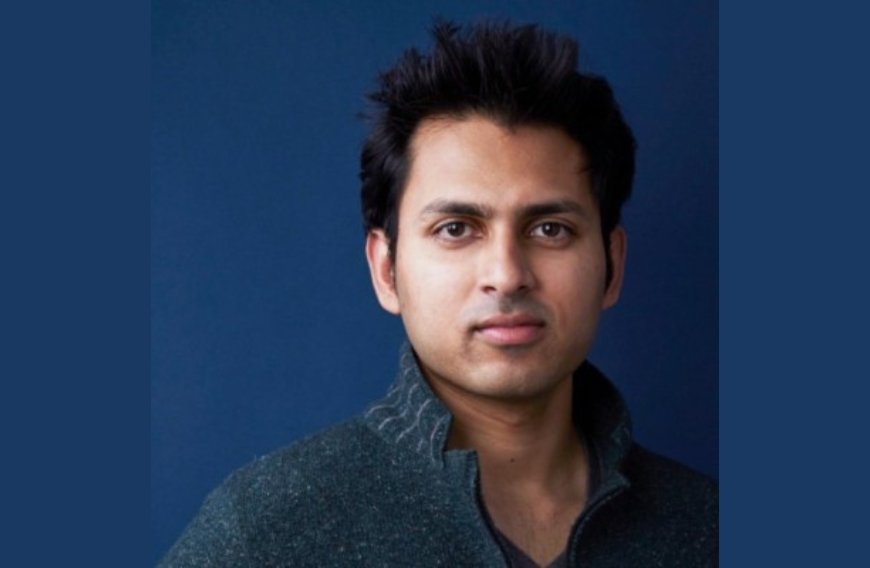
Indian American AI pioneer Soumith Chintala is leaving Meta on Monday after leading PyTorch, the software layer powering the entire AI industry, for nearly eight years.
“Didn’t want to be doing PyTorch forever,” wrote the creator of the ML framework powering 90% of AI—from ChatGPT to Claude to virtually every major foundation mode, announcing his departure from Meta after 11 years, on LinkedIn.
PyTorch’s reach is near-total: 90% adoption in AI research and production, from OpenAI’s models to Meta’s recommendation systems to classrooms from MIT to rural India.
“Eleven years at Meta. Nearly all my professional life. Making many friends for life. Almost eight years leading PyTorch, taking it from nothing to 90%+ adoption in AI,” Chintala wrote.
“Walking away from this was one of the hardest things I’ve ever done. But I’m leaving with a full heart,” he wrote to do “Something small. Something new. Something I don’t fully understand yet. Something uncomfortable.”
“PyTorch handles exascale training now. It powers foundation models that are redefining intelligence. It’s in production at virtually every major AI company,” Chintala noted.
READ: Meta’s Arun Srinivas joins USISPF India leadership board (
“It’s taught in classrooms from MIT to rural India. The tools I dreamed about making accessible? They are. The barrier to entry I wanted to lower? It’s almost gone.”
“I could have moved to something else inside Meta,” he wrote. “But I needed to know what’s out there. I needed to do something small again. I couldn’t live with the counterfactual regret of never trying something outside Meta.”
“It’s very hard to leave,” wrote Chintala noting, “I probably have one of the AI industry’s most leveraged seats, I lead the software layer that powers the entire AI industry.”
“Every major AI company and hardware vendor are on a speed dial. This kind of power is really hard to give up,” he wrote. “But curiosity ultimately won out in my head.”
Chintala, who grew up in Hyderabad and studied at Hyderabad Public School, has never shied away from admitting that he struggled with mathematics as a teenager, according to India Today.
After completing his schooling, he joined Vellore Institute of Technology, Vellore to pursue bachelor’s degree in technology — not an IIT or a top-tier institute, but a tier-2 engineering college.
READ: Mark Zuckerberg’s Meta making a fortune through fraud (
Chintala was planning to pursue master’s in the United States, but despite scoring 1420 on the GRE, he was rejected by all 12 universities he applied to.
Instead of giving up, he came to the U.S. on a J-1 visa without a clear plan and applied again to 15 more universities. Finally he got admission into USC and NYU, with NYU offering a late entry in 2010. He joined NYU.
Even after his master’s, the road wasn’t smooth for Chintala. He was rejected from almost every job he applied for, including at Google DeepMind — not once, but three times.
His first real break was a test engineer role at Amazon, far from the research-driven jobs he wanted. Later, a PhD mentor helped him secure a role at a small startup, MuseAmi.
Between 2011 and 2012, he built one of the fastest AI inference engines for mobile devices, showing his technical capability. Yet, even with that accomplishment, DeepMind rejected him again.
A turning point came when his open-source work connected him with Yann LeCun, now chief scientist of Meta, and one who is also rumoured to be leaving the company.