



By Soumoshree Mukherjee
Editor’s note: This article is based on insights from a podcast series. The views expressed in the podcast reflect the speakers’ perspectives and do not necessarily represent those of this publication. Readers are encouraged to explore the full podcast for additional context.
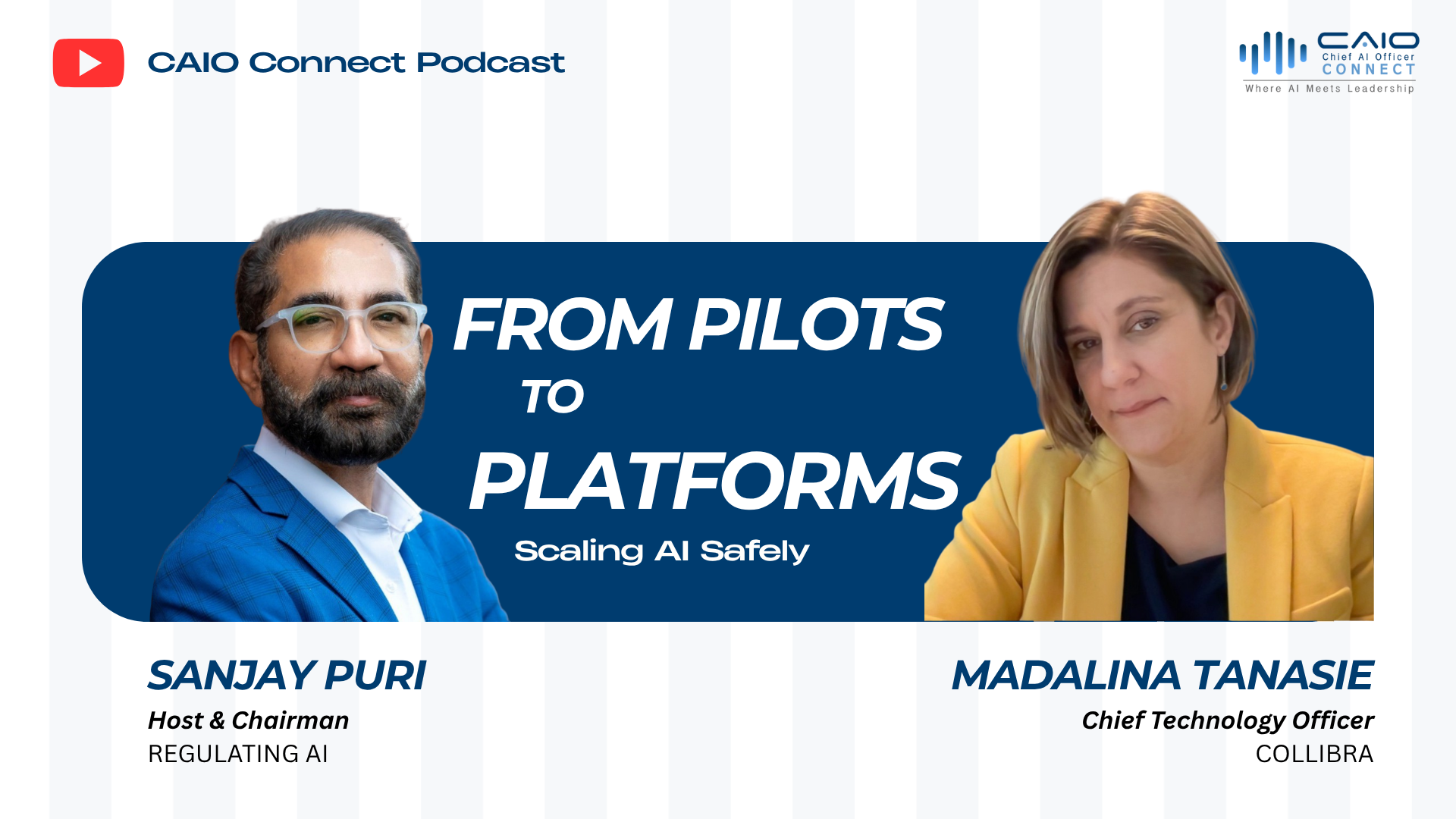
In a recent episode of the “CAIO Podcast,” host Sanjay Puri sat down with Madalina Tanasie, chief technology officer at Collibra, for a conversation that offered rare clarity on how modern enterprises are navigating the promises and pitfalls of AI.
Tanasie, who has spent over five years at Collibra after more than a decade in the highly regulated life sciences sector, described the company as “a data and AI governance solution” that has witnessed a renewed urgency around governance. “We’ve been around for 15 years, we’ve started in data governance and of course, with all things AI, it feels like data governance is having a new comeback,” she said.
Her experience at Medidata Solutions shaped her understanding of operating at scale with precision and compliance. “…got the full appreciation of the importance of data, but also of safety and rigor,” she noted, recalling how Collibra, when she joined in 2019, was transitioning from being “startup-y and very pirate-y… going towards being enterprise and being a lot more focused on structure and safety and scale.”
Tanasie explained that this evolution mirrors the changing tone in boardrooms. “A lot of the board conversation in the last few years has been around the potential of AI,” she said, “it feels like recently the conversation has shifted from outcomes and potential to doing it safely, doing it responsibly.”
Boards want innovation, but they also want assurances. As she put it, “if you are too focused on safety and testing, you’re missing the boat… but you also can’t just go and use it without thinking about the consequences.”
On the question of selecting the right use cases, Tanasie’s advice was simple: start internally. “If someone is early on the AI journey, they should start with internal use cases, because you’re going to make mistakes,” she said. Elaborating, she said that mistakes are inevitable, and early experimentation should happen in environments where risk is contained.
She pointed to code generation, operational automation, and especially knowledge management as fruitful areas. As every company has accumulated a lot of information, she said, “we found that assistance for knowledge management is actually pretty good.”
But when enterprises turn to external, customer-facing AI, caution becomes essential. “I personally find a lot of these chatbots… that I’m using quite frustrating,” she admitted. “If you’re going to do it, do it right, do it better.”
Tanasie also urged leaders to rethink their assumptions about ROI. She explained that they used to be cheap and fast, referring to early access to large language models. “But now everybody’s thinking about how to monetize AI solutions.” That shift requires companies to be “very intentional about what is the value that you’re going to get and be realistic about what’s the outcome and the efficiency that you have there.”
She believes the strongest advantage lies in what only a company possesses. “If you have data that is unique to you, it could be a strategic differentiator,” she said.
Ultimately, Tanasie’s perspective is one of tempered optimism. AI offers enormous potential for transformation across industries, but only when deployed thoughtfully, safely and with full awareness of long-term implications. The enterprises that win in the coming years will be those that treat AI not as a toy or a trend, but as an engineering discipline, one that requires rigor, governance, clear guardrails and a deep respect for the trust their customers place in them.
In an era defined by acceleration, her insight underscored the ethos of modern AI leadership: “There’s always this mix of move fast and move safe.”