



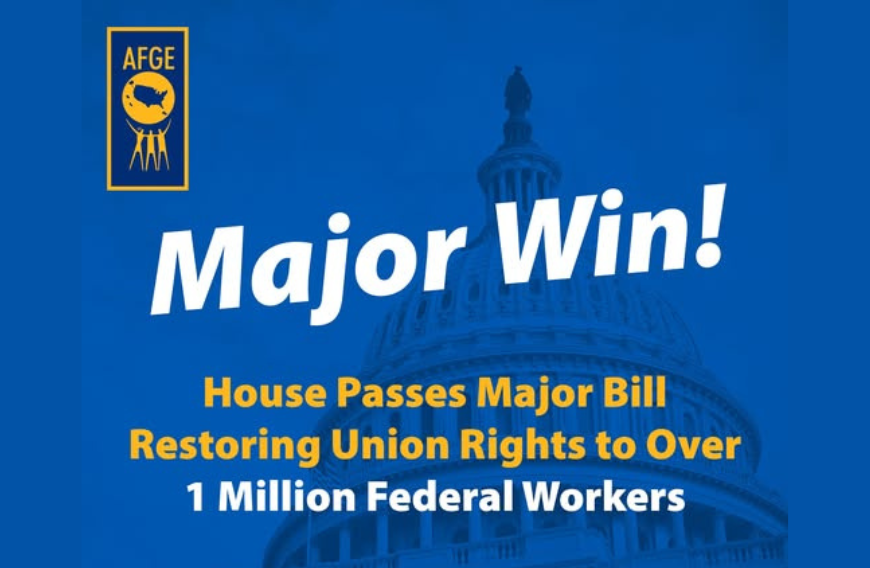
House Republicans rebuked President Donald Trump on Thursday, voting to reinstate collective bargaining rights for federal workers — a move that would restore labor union protections for nearly one million federal employees.
“This is solidarity in action. I’m proud of the bipartisan coalition who passed this bill,” Reps. Jared Golden of Maine, a Democrat, wrote Thursday on X.
The rare bipartisan vote, 231-195, marks the first time the House has voted to nullify an executive order from President Donald Trump this term.
This move seems to be a direct response to executive orders issued by President Trump in 2025 that restricted collective bargaining protections for many federal workers on national security grounds. Those orders affected hundreds of thousands of employees and triggered lawsuits from unions such as the American Federation of Government Employees (AFGE), which argued the actions overstepped executive authority.
READ: House of Representatives returns from break to end shutdown (
Trump signed an executive order this year terminating collective bargaining with federal agencies tied to national security, citing authority under the Civil Service Reform Act of 1978, that law makes exceptions to organizing and collective bargaining for “agencies or units within an agency which has as a primary function intelligence, investigative, or national security work.”
“As we turn to the Senate—where the bill already has bipartisan support—working people are calling on the politicians we elected to stand with us, even if it means standing up to the union-busting boss in the White House,” Liz Shuler, the president of the AFL-CIO, which represents nearly 15 million workers said in a statement on Thursday.
The House’s bipartisan vote to restore collective bargaining rights for federal workers represents a significant moment in the broader national debate over labor rights, executive power, and the independence of Congress. By voting to overturn a sitting president’s executive order—especially one issued on national security grounds—lawmakers signaled a willingness to reassert congressional authority and challenge decisions they believe overreach or undermine long-standing worker protections.
READ: Jay Vaingankar raises $126,000 in 24 hours for Congressional race in New Jersey (
The fact that a notable bloc of Republicans joined Democrats underscores a growing discomfort within parts of the president’s own party over policies perceived as too disruptive to the federal workforce or too aggressive in limiting union activity.
The vote highlights a renewed recognition of the role unions play in safeguarding workplace rights, even within the federal government. For nearly a million public employees, the House’s action represents not only a symbolic victory but also a reaffirmation that collective bargaining remains a critical tool for ensuring fairness, stability, and due process in government workplaces. It also reflects a wider trend of increasing bipartisan support for certain labor protections, especially where issues of fairness and job security intersect with concerns about executive overreach.
As the measure heads to the Senate, the outcome remains uncertain, and it is not yet clear whether bipartisan momentum in the House will carry over into the upper chamber. The bill’s supporters emphasize the significance of this moment, but its path forward may depend on how senators navigate pressures from both labor groups and the White House. Regardless of what happens next, the House’s action marks an important moment in the ongoing struggle to balance national security concerns with the fundamental rights of workers.