



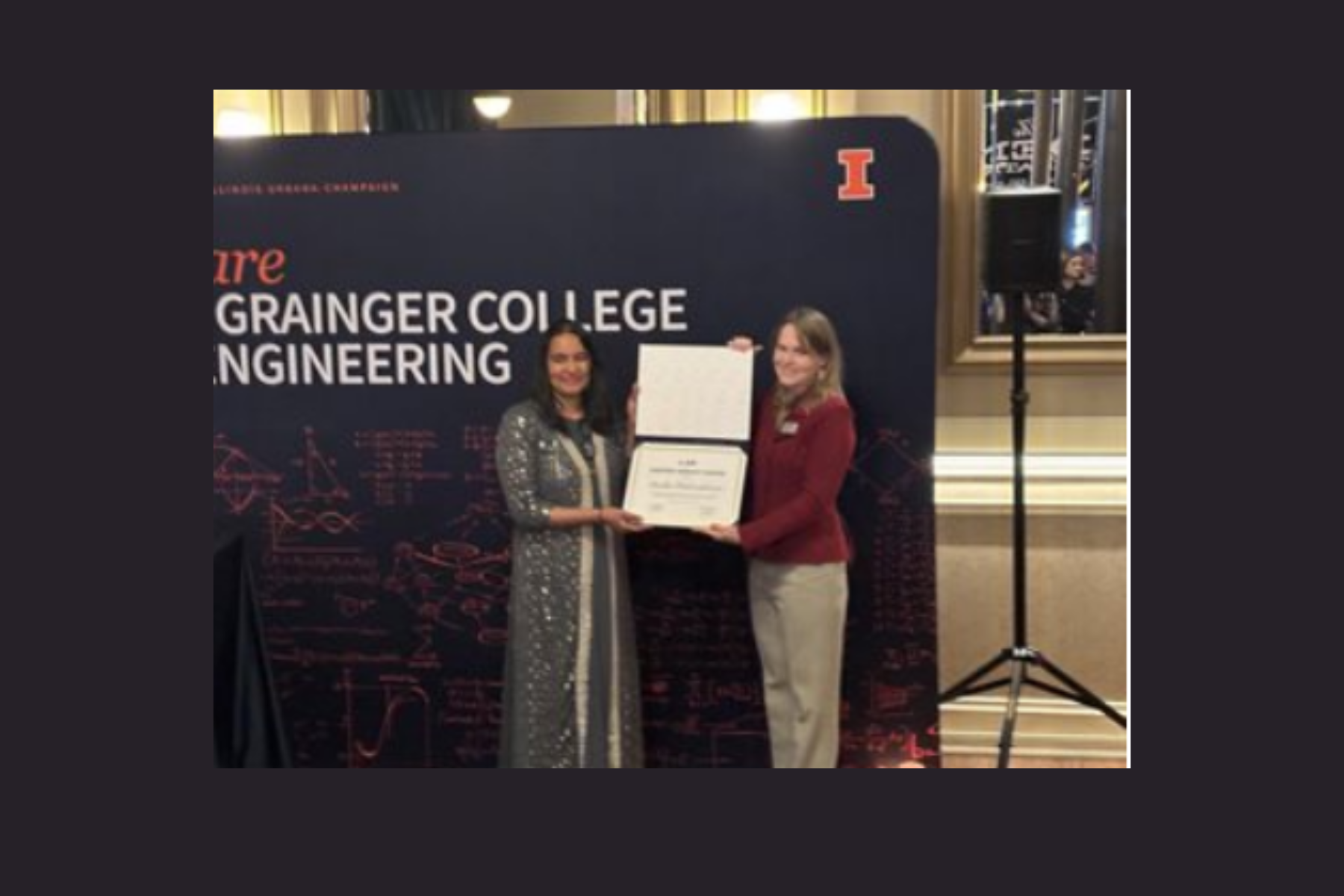
For Smitha Vishveshwara, the complex movements of subatomic particles are not just mathematical equations, they are the choreography of the universe. The Indian-born theoretical physicist at the University of Illinois Urbana-Champaign is being celebrated for her unique ability to translate the abstract world of quantum mechanics into human experiences.
Vishveshwara has achieved a rare “triple crown” of recognition, earning major awards from the American Institute of Physics (AIP), the American Physical Society (APS), and the University of Illinois. The honors recognize her dual life as a world-class researcher and a pioneer of “quantum theater.”
Her journey in science is deeply rooted in her heritage. Born in India, she is the daughter of the late C.V. Vishveshwara, a legendary astrophysicist known as the “black hole man of India” for his early work on gravitational waves.
Before his passing, the father-daughter duo collaborated on the book Two Revolutions, Relativity and Quantum Physics, a project that bridged their respective specialties. Her mother, a molecular biophysicist, has also been a close collaborator, working with Smitha to apply physics to protein networks and the coronavirus spike protein.
Read: Indian American author Megha Majumdar wins NYPL Cullman Center fellowship
In Chicago last month, the AIP presented Vishveshwara with the Andrew Gemant Award, an honor previously given to science icons like Stephen Hawking.
The award highlights her work with CASCaDe (Center for the Physics of Living Cells Art-Science Collective), where she co-created performance pieces like Quantum Voyages and Quantum Illuminations. These productions use dance, music, and narration to bring the subatomic world to life on stage.
While she is celebrated for her outreach, her peers also recognize her rigorous scientific contributions. In December, she was the guest of honor at Rutgers University’s Statistical Mechanics Conference, where she was cited for her groundbreaking theoretical work on anyons, strange quasiparticles that exist in two-dimensional systems.
The American Physical Society further honored her with the “Five Sigma Physicist” award for her advocacy work, particularly her leadership of “QuantumFest.”
On May 20, the University of Illinois will present her with the Excellence in Public Engagement Award. For Vishveshwara, these accolades reflect a lifelong mission to show that science is not a solitary pursuit, but a shared cultural story that belongs to everyone.