



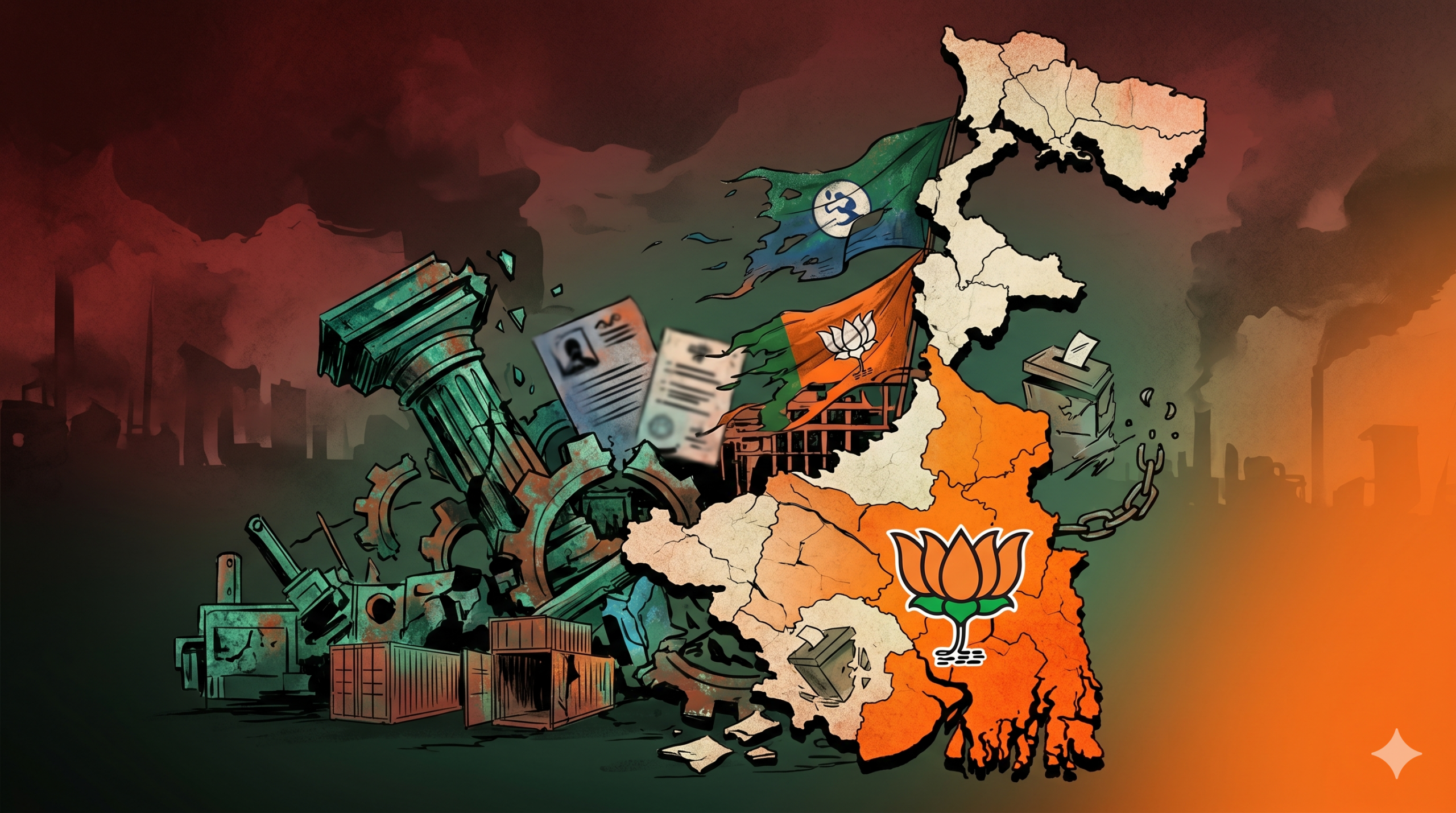
The fall of Mamata Banerjee in the 2026 West Bengal election will be debated for years not simply because a government lost power, but because Indians remain divided over what, exactly, happened. One side sees a democratic transfer of power after fifteen years of fatigue, corruption allegations, economic drift, and political arrogance.

The other sees something darker: an election fought with overwhelming asymmetry of money, media, institutional leverage, voter-roll controversies, paramilitary presence, and relentless polarization — a victory achieved not merely through persuasion but through domination.
That divide may become one of the defining political arguments of contemporary India.
The broad contours of the defeat are already clear. Even commentators who had once admired Banerjee’s political instincts — analysts such as Pratap Bhanu Mehta, Ashutosh Varshney, Shekhar Gupta, Ramachandra Guha, and Jawhar Sircar in different ways over the years, had pointed to a slow institutional decay in Bengal: shrinking administrative credibility, politicized local governance, cadre dominance, corruption scandals, intimidation culture, and a growing intolerance toward criticism.
Banerjee had come to power in 2011 as the destroyer of a tired empire. Her first victory was moral before it was electoral. She defeated a Left Front that had ruled Bengal for more than three decades and had become synonymous with exhaustion. She promised restoration: dignity, accessibility, Bengali pride, and relief from ideological bureaucracy. For millions, she represented motion after paralysis.
But revolutions often become mirrors of the systems they replace.
Over time, the Trinamool Congress evolved from insurgency into machine. Local party structures increasingly resembled protection networks. Critics described parts of Bengal’s district governance as a patronage order dependent on fear, loyalty, and access. Allegations of cut-money politics, recruitment scams, and municipal corruption multiplied. The language of resistance hardened into the language of entitlement.
What had once been a movement slowly acquired the texture of permanence.
READ: Satish Jha | The Steadier Wrecker: On Democratic decline & its varieties (April 23, 2026)
Analysts across ideological camps had observed another shift: welfare politics became the central pillar of Banerjee’s legitimacy. Her government retained considerable support among women and poorer voters through cash-transfer and social schemes. For years, this insulated her from anti-incumbency.
The second major mandate came substantially on the strength of welfare delivery. The third victory, in 2021, was different again: it became a referendum against aggressive Hindutva expansion and against what many Bengalis perceived as cultural intrusion by the Bharatiya Janata Party.
That election made Banerjee appear nearly indestructible.
Yet the deeper economic story of Bengal remained unresolved.
Once among India’s richest and most intellectually dynamic regions, West Bengal had spent decades in relative decline. Its share of India’s industrial economy shrank steadily after the 1960s and 1970s. Capital flight, labor militancy, policy stagnation, weak industrial regeneration, and political over-centralization across successive regimes produced a state that increasingly survived on memory. Per capita income rankings slipped. Large-scale manufacturing never recovered meaningfully. The state that had once imagined itself as India’s modern intellectual frontier began looking anxiously backward.
The tragedy is historical before it is partisan.
The fall of the Congress fifty years earlier had inaugurated one long cycle of ideological dominance followed by institutional fatigue. The Left inherited decline and deepened parts of it. Banerjee inherited exhaustion and personalized it. Bengal increasingly became a place where political energies were consumed by contest rather than reconstruction.
The BJP understood this vacuum.
Its rise in Bengal was not built primarily on governance success elsewhere. Even critics of Banerjee concede that the BJP displayed extraordinary organizational discipline, narrative cohesion, and strategic patience. But supporters of the Trinamool — and many independent observers — argue that the scale of asymmetry in the 2026 election transformed the contest itself.
The controversy over voter-roll revisions became central. Allegations surrounding the Special Intensive Revision (SIR) process dominated the campaign. Critics claimed millions of deletions disproportionately affected minorities and vulnerable communities. The BJP defended the exercise as electoral cleansing and administrative correction.
READ: Satish Jha | The quiet reckoning: Governing India in an age of unmet expectations (April 13, 2026)
Banerjee herself called the election a “murder of democracy,” alleging that more than one hundred seats had effectively been stolen through institutional manipulation, voter deletions, and intimidation.
The BJP denied the accusations and argued that the verdict reflected accumulated public anger against corruption, unemployment, identity politics, and administrative decay. Multiple analyses pointed to fragmentation of minority votes, erosion among women voters, and anti-incumbency after fifteen years in office.
But the moral argument surrounding the election extends beyond statistics.
For many critics of the BJP, the question is not whether Banerjee deserved defeat. Many openly concede that she had become vulnerable through her own errors. Their concern is different: whether elections in India are becoming contests where overwhelming financial power, media dominance, central institutional influence, and social polarization can structurally predetermine outcomes long before ballots are cast.
In this reading, Bengal becomes a warning.
Not because Banerjee lost, but because the methods normalize themselves.
The phrase increasingly heard in political discussions — “money, media, and muscle” — captures this fear. One analysis explicitly described the three Ms, alongside paramilitary deployment, as central force multipliers in the election.
For supporters of the BJP, this criticism sounds selective and hypocritical. They point out that Bengal itself had long witnessed violence, cadre intimidation, and political patronage under both Left and Trinamool regimes. They argue that the BJP merely learned to fight in the terrain that already existed. In their narrative, Banerjee’s defeat represents the collapse of a corrupt regional order unable to withstand democratic accountability.
This is why the Bengal verdict has produced two parallel truths.
In one truth, democracy functioned. A tired government lost after years of accumulated resentment. Voters chose change. A dominant regional leader was defeated through electoral mobilization.
In the other truth, democracy formally survived while the conditions of democratic equality deteriorated. The election may have had ballots, observers, and counting centers — yet still felt to critics like a managed spectacle where the imbalance of power itself shaped the result.
India’s future may depend on whether these two truths can still speak to each other.
Because Bengal’s story is not merely about Banerjee or the BJP. It is about the degeneration of political culture across parties. Banerjee’s own rise had relied on anger against arrogance, violence, and stagnation.
Over time, her government reproduced versions of the same pathologies. The BJP, meanwhile, has mastered electoral expansion without yet convincingly demonstrating a universally admired governance model capable of transcending polarization. Its greatest strength has often been narrative discipline and ideological mobilization rather than transformative statecraft.
Critics argue that in several states the pattern has become familiar: strong packaging, relentless messaging, centralization of power, and communal polarization accompanied by persistent corruption allegations and weakening institutional trust.
That does not automatically invalidate electoral victories. But it deepens anxiety about the nature of political competition itself.
Bengal now stands at a difficult threshold.
READ: Satish Jha | Neighbors’ moment, our mirror (April 12, 2026)
If the BJP governs effectively, restores investor confidence, reduces political violence, improves institutions, and revives economic dynamism, its victory will gradually acquire retrospective legitimacy even among skeptics. If, however, Bengal merely exchanges one patronage structure for another — one culture of intimidation for another, one ideological rigidity for another — then the election will be remembered less as liberation than as transfer.
The deeper lesson may be harshest for regional parties across India.
Personal charisma, welfare politics, identity appeals, and emotional mobilization can sustain power for years. But once institutions weaken, cadre culture hardens, corruption spreads, and criticism becomes intolerable, governments slowly lose moral legitimacy even before they lose elections.
The lesson for opposition parties is equally severe.
A democracy cannot survive indefinitely if political competition itself becomes dependent on overwhelming asymmetries of finance, institutional reach, media ecosystems, and social division. When citizens begin arguing not merely over who won but over whether the contest itself remained substantively fair, democratic trust begins to erode from within.
West Bengal has long been India’s laboratory of political imagination — from the Renaissance to nationalism, from Marxism to populism, from intellectual radicalism to street mobilization. Today it has become a laboratory of something more unsettling: the transformation of elections into battles over the meaning of democracy itself.
The tragedy is that Bengal, once one of India’s richest and most intellectually confident societies, still seems unable to escape its long argument with decline.
And perhaps that is the final irony of this election.
Everyone claims to have defeated someone.
But Bengal itself still waits to win.