



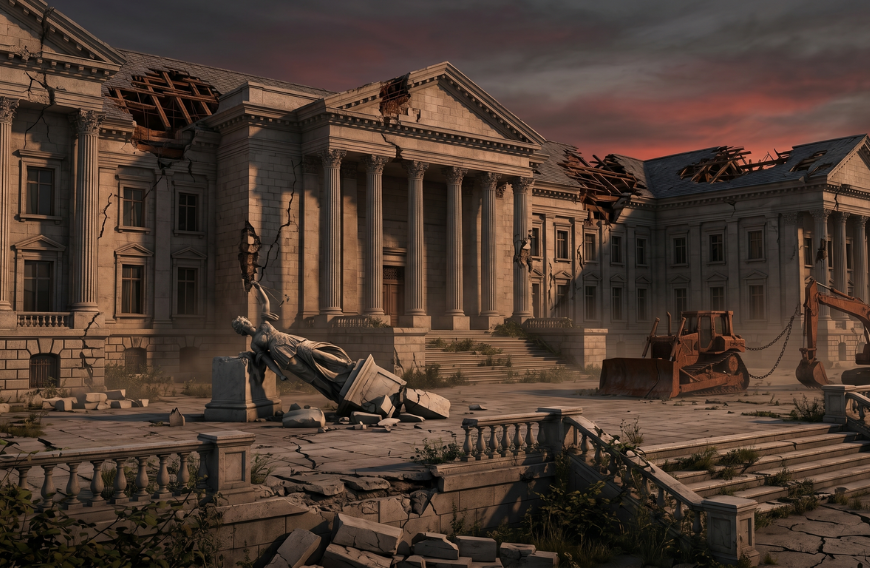
“Institutions need to be reformed, not destroyed; governing well requires skill and careful attention to detail rather than leaders acting on impulse and ignorance; and character and mental stability matter perhaps most of all.” — Jonathan Rauch & Peter Wehner, The New York Times, April 10, 2026
When commentators in the West reach for comparisons to make sense of what is happening in Washington — the chaos, the institutional vandalism, the leader unmoored from consequence — they occasionally gesture eastward. They mean it as a warning: this is where you end up. But in doing so they almost always get the comparison slightly wrong. Because the most instructive parallel to the current American moment is not a cautionary tale about what democratic backsliding looks like when it is uncontrolled and unhinged. It is a cautionary tale about what it looks like when it is controlled, and planned, and carried out by someone who is genuinely disciplined.
That man is Narendra Modi. And the lesson he offers the world is more unsettling than the one the American commentariat usually draws from him — because the lesson is not about disorder. It is about what a patient, strategic, emotionally composed operator can do to a republic over twelve quiet years, while the receipts accumulate out of sight.
THE STRATEGY IS REAL
Let us be precise about what Modi is. He is not a blunderer. He is not a man who tweets his id at 3 a.m. or attacks the Pope or posts AI renderings of himself in divine light. Jamelle Bouie’s portrait of a man “in far over his head,” struggling with the consequences of his own actions, raging because “for all its firepower” the machinery of state will not bend to his will — this is simply not Narendra Modi. The strategy is real. The discipline is real. The tactical intelligence is formidable.
He is not chaos. He is method. And method, it turns out, can hollow a republic more thoroughly than chaos ever could.
He came to power in 2014 having spent thirteen years as Chief Minister of Gujarat, learning the machinery of Indian federalism from the inside. He understood bureaucratic incentive structures. He understood how to move civil servants without provoking them. He understood that the Election Commission, the Central Bureau of Investigation, the Enforcement Directorate, and the Income Tax department were instruments — and that instruments, wielded with patience, could accomplish things that frontal assault never could.
This is what distinguishes him from the portrait Rauch and Wehner paint of an administration that “lacks a consistent attachment to reality and the ability to organize its thinking coherently.” Modi’s administration organises its thinking very coherently indeed. The question that goes unasked — because the government’s PR apparatus is among the most sophisticated in the world — is what exactly that thinking is organised around.
READ: Satish Jha | The quiet reckoning: Governing India in an age of unmet expectations (April 13, 2026)
The answer, available to anyone who looks at the evidence rather than the press releases, is this: it is organised around the perpetuation and expansion of political power. Governance is the instrument. Power is the purpose.
THE TACTIC THAT DARE NOT SPEAK ITS NAME
Every election in India since 2014 has been, for the BJP, a total campaign — total in the military sense, meaning that every arm of the state available to the governing party has been put to use. The Enforcement Directorate, whose cases against opposition leaders accelerated dramatically after 2014, became what critics across the political spectrum — including the Supreme Court — described as selectively deployed. The pattern was consistent enough to have a name in Indian political journalism: “washing machine politics.” Enter the BJP; your corruption cases vanish. Oppose it; they multiply.
Demonetisation did not primarily destroy black money. It destroyed the cash-dependent opposition’s election machinery in five states going to the polls in early 2017.
Demonetisation deserves particular attention, because it is the signature example of a policy that was presented as economic reform and served, primarily, as political warfare. The government’s own data — buried in the RBI’s annual report — showed that 99.3 percent of demonetised currency was returned to the banking system. The black money, the stated target, was largely unaffected. What was affected, precisely and devastatingly, was the cash-dependent infrastructure of political parties that had not had years to build digital alternatives — and five crucial state elections that followed within months. The chaos was real. So was the targeting. The two were not incidental.
“The issue is that the administration as a whole lacks a consistent attachment to reality and the ability to organize its thinking coherently,” according to Jonathan Rauch and Peter Wehner in The New York Times on April 10.
This is the inverted image of Modi’s problem. His administration is coherently attached to a particular reality — the reality of electoral dominance — and organises everything else around it. The confusion between governance and campaigning is not accidental. It is architectural.
THE INHERITED HOUSE, AND WHO GETS THE CREDIT
The infrastructure narrative — the roads, the rural electrification, the digital payments layer — requires honesty about origins. The National Highway Development Programme began under Vajpayee. The groundwork for Jan Dhan financial inclusion was laid by earlier UPA financial inclusion drives. The UPI payments system was built on the NPCI architecture commissioned under Raghuram Rajan as RBI Governor — the same Rajan who was effectively hounded out of his position after publicly disagreeing with government economic policy. Aadhaar, the biometric identity system Modi’s government uses as the spine of its welfare delivery, was designed and built under Manmohan Singh’s UPA government and survived early BJP opposition.
A government that inherits a foundation and builds on it is doing less than it claims. A government that inherits a foundation, takes credit for it, and then fires the architect — that is doing something specific.
None of this makes the subsequent execution irrelevant. Scale matters. Delivery matters. Some things did improve. But the habit of the Modi government — perfected to an art — has been to claim founding credit for things it inherited, to personalise credit for things it extended, and to decimate the institutional memory of those who built what it now presents as its own legacy. The economist Arvind Subramanian, who served as Chief Economic Adviser to the Modi government, has since published detailed critiques of how GDP data was revised in ways that systematically overstated growth in the Modi years. He did this after leaving government. The pattern — institutional independence exercised only from the outside — is the pattern.
THE CORRUPTION THAT DOESN’T LOOK LIKE CORRUPTION
The corruption of the Modi years is not the suitcase-of-cash variety that Indian politics had long normalised. It is of a different, more modern, and in some ways more damaging kind — the corruption of market structure, of regulatory capture, of the distance between crony and policy that has effectively collapsed.
The electoral bonds scheme — struck down by the Supreme Court of India in February 2024 as unconstitutional — allowed corporations to purchase anonymous bonds redeemable only to political parties, with no public disclosure. Data released after the court order revealed that companies that had received government contracts, regulatory approvals, or had active CBI investigations against them purchased bonds overwhelmingly favouring the BJP. The correlation between regulatory outcomes and bond purchases was, in several documented cases, essentially one-to-one.
The consolidation of Indian media ownership into the hands of a small number of industrialists with active government-dependent business interests produced what the Reporters Without Borders Press Freedom Index recorded as a collapse in India’s ranking — from 140th in 2014 to 159th by 2023, among the steepest sustained declines of any democracy in the world.
The telecom sector was restructured in ways that produced, within a decade, a market dominated by one private operator — Reliance Jio — whose founding backer’s relationship with the ruling party is perhaps the most discussed and least officially examined business-political relationship in modern India.
READ: Satish Jha | Neighbors’ moment, our mirror (April 12, 2026)
These are not allegations made by opposition politicians. They are findings of India’s own Supreme Court, data from India’s own government disclosures, and rankings compiled by organisations with no particular animus toward New Delhi. They describe not a government that cannot organise its thinking, but a government that has organised its thinking very deliberately around the extraction of advantage from the institutions it controls.
THE INSTITUTIONS, ONE BY ONE
Rauch and Wehner observed that pathology becomes dangerous when it is “institutionalized” — when the disorder of a leader cascades into the system until the system itself cannot function. In Washington, this happened loudly, visibly, through firings and rages and reversals that made the front page daily.
In New Delhi, it happened quietly. Appointment by appointment. Transfer by transfer.
The Central Bureau of Investigation — India’s premier investigative agency — became known in judicial proceedings and among senior advocates as an instrument so thoroughly politicised that High Courts took to describing it as a “caged parrot” speaking its master’s voice. The Election Commission, whose independence is the constitutional hinge of Indian democracy, saw appointments that opposition parties challenged in the Supreme Court; the court found sufficient cause for concern to mandate a new selection process. The Reserve Bank of India — one of the most respected central banks in the developing world — lost two successive governors, one of whom, Urjit Patel, resigned mid-term in circumstances that have never been fully explained but are widely understood to involve government pressure on monetary policy and the handling of demonetisation’s aftermath.
When institutions are weakened noisily, the noise is the evidence. When they are weakened quietly, you only see it when you need them and they are not there.
The judiciary has been more resistant than most. But the collegium system for judicial appointments has been a sustained battleground, and the government’s refusal to process certain collegium recommendations for months and years — a slow strangulation by procedural delay — has been documented and decried by sitting and retired judges. The result is not a broken judiciary. It is a judiciary that knows the cost of certain judgements and must weigh it. That is not the same as independence.
THE CITIZEN’S VIEW FROM BELOW
Michelle Goldberg wrote about a leader with no idea how to clean up his own mess. The ordinary Indian’s experience of the Modi years is different but not unrelated. It is the experience of messes that were genuinely created — and then not cleaned up, but rebranded.
Demonetisation killed small businesses by the tens of thousands; RBI data and CMIE employment surveys documented the damage. The hasty implementation of GST — a good idea, delivered without adequate transition time or infrastructure — pushed millions of small traders and manufacturers into compliance costs they could not bear. The MSME sector, the spine of Indian employment, has never fully recovered to pre-2016 levels when measured by enterprise count rather than turnover.
The farm laws of 2020 — which may well have been sound policy in design — were rammed through Parliament without committee review, without state consultation, without meaningful engagement with the communities they would most affect. They produced the largest sustained protest in recorded human history: hundreds of thousands of farmers camped on Delhi’s borders for over a year, in winter, through a pandemic. The government held firm, dismissed them as “andolanjeevi” — professional protesters, a term coined by the Prime Minister himself — and then, on the eve of crucial Punjab elections, repealed the laws entirely, offering no acknowledgement of error. The farmers got the repeal. They got no apology. They got no explanation. The laws were simultaneously right enough to impose and wrong enough to abandon. The only consistent variable was the election calendar.
Every major policy reversal under Modi has coincided, within weeks, with an election. This is not governance responding to reality. It is campaigning dressed in the clothes of governance.
Those who lived through the COVID lockdown of March 2020 — announced with four hours’ notice, the shortest in the world for a nation of 1.4 billion — watched millions of migrant workers walk hundreds of kilometres home because there was no plan for them. Not a contingency plan. Not a delayed plan. No plan. The images of those walking feet belong in any honest accounting of what the Modi government built and what it neglected. They were never acknowledged. They were never mourned officially. The Prime Minister lit a candle. He banged a thali. The walkers walked.
THE COMPARISON THAT ACTUALLY HOLDS
Here, finally, is where the parallel to the American moment becomes precise — and more damning for being precise.
Bouie writes of a man “not in control of himself.” Modi is, by all evidence, very much in control of himself. The composure is genuine. The strategic patience is genuine. He does not post messianic self-portraits. He does not attack the Pope. He meditates, publicly and photographically, in a cave in Kedarnath before elections. The optics are managed with a sophistication that would make any political communications director weep with envy.
But this is exactly the point that those who have suffered his governance would make, and that the Western commentariat — charmed by the contrast with Washington — consistently misses: self-control in the service of institutional capture is not a virtue. It is the more dangerous tool.
“As the Trump era winds down, the country may relearn something that never should have been forgotten… character and mental stability matter perhaps most of all,” according to Rauch and Wehner in NYT.
Character is the word that wants examination here. Stability of temperament is not the same as character. A man can be emotionally disciplined and institutionally predatory. He can be personally austere — Modi’s ascetic image, the no-family, no-property presentation — and preside over one of the largest systems of crony-state capitalism in democratic history. He can be calm and be the author of a media landscape so thoroughly defanged that opposition voices reach their audience primarily through WhatsApp forwards. The absence of rage is not the presence of integrity.
The citizens who live under Modi’s governance — the farmer who walked home in March 2020, the Muslim businessman who finds bank loans mysteriously unavailable, the journalist who has learned which stories carry professional consequences, the small manufacturer crushed between GST compliance costs and Jio’s zero-price data plans that killed his internet café — these citizens do not experience their government as restrained. They experience it as a system organised, at every level, for the benefit of those inside it and the management of those outside it.
READ: Satish Jha | The Thali was full. The nation was not hungry enough (April 3, 2026)
Their experience, stripped of its geography and translated to a different vernacular, is not so different from what the American voter who trusted in institutions is now discovering. The institutions were there. They looked solid. And then, when needed, they were not.
THE REAL LESSON
The genuine parallel the NYT columnists are groping toward — without knowing it, because they are not looking east — is this: democratic backsliding has two speeds. The American version is fast and loud and generates daily coverage and protest movements and a free press screaming from the rooftops. The Indian version has been slow, methodical, and largely silent in the places that produced the silence deliberately.
Both arrive at the same destination.
A republic where the institutions are formally intact but functionally subordinate. Where elections occur but their fairness is structurally compromised. Where the press exists but knows its limits. Where the courts rule but certain rulings take years to arrive, when the moment has passed. Where citizens vote, but the choice is shaped long before they enter the booth.
The fast wrecker is easier to stop. You can see him coming. The slow one has already arrived by the time you notice the damage.
Modi has not destroyed Indian democracy. He has tilted it — so gradually, so consistently, and with such careful maintenance of its outward forms that any individual act of resistance addresses only the surface. Journalists write about individual cases of CBI overreach. Lawyers challenge individual appointments. Farmers protest individual laws. Each battle is fought and sometimes won. The aggregate direction does not change, because the aggregate direction is the strategy, and the individual cases are merely its tactics.
This is what Rauch and Wehner mean when they warn that damage can take “a generation to repair.” Not the damage of a single dramatic rupture, but the compounded damage of twelve years of appointments, of regulatory decisions, of media ownership patterns, of judiciary management, of electoral system engineering — all of it still standing, still formally legal, still wearing the clothes of republican governance.
The man in Washington is a fire. Everyone can see the smoke.
The man in New Delhi is a slow subsidence — the ground sinking by millimetres, the building still upright, the cracks appearing only when you look closely, and by then the foundation has shifted in ways that no single repair can address.
Both men, in the end, have the same relationship with democratic institutions: they are useful until they aren’t, legitimate until they become inconvenient, and worth preserving only insofar as they can be made to serve the project.
The difference is not of intent. It is of style. And style, in the judgment of history, is not a moral category.