


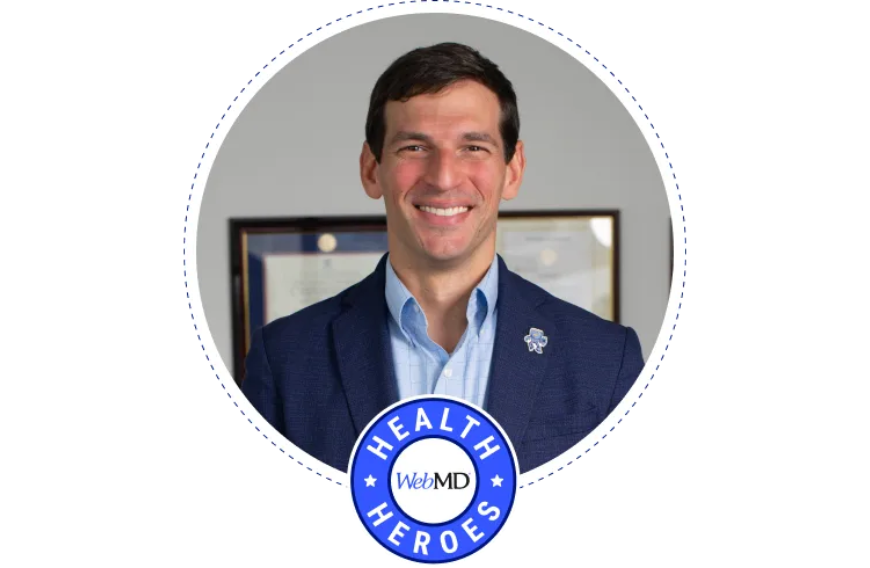
Almost a decade ago, Dr. David Fajgenbaum cold called me and requested a lunch meeting. Marinating in my own narcissism, I believed he was seeking my counsel, my wisdom, perhaps my connections. I was prepared to dispense advice, ready to help this young physician-scientist navigate whatever challenge he faced.
Only after lunch did I realize that David was recruiting me. David wasn’t looking for a mentor. He was assembling a team of elves to help him create miracles, and he—this quietly determined dreamer who had almost died and come back five times—was Santa Claus determined to discover life-saving cures for humanity. If you know David, you understand what’s possible when someone refuses to accept the world’s limitations.

Over the years, friends like David have convinced me that there’s a cure for every disease. I have dedicated my own life to fund scientists who are searching for cures. As civilians, we have watched a loved one suffer from an untreatable disease. But most of us probably don’t know that there are roughly 18,000 known human diseases and approximately 14,000 diseases lack even a single approved drug therapy.
Finding cures
The need to end or limit human suffering from untreatable diseases continues to be urgent. In 2024, Every Cure, David’s nonprofit, deployed an AI-powered platform to analyze over 4,000 drugs against 18,000 diseases, revealing approximately 75 million possible drug-disease pairings. No human could evaluate that many possibilities in a lifetime. But with artificial intelligence and someone with David’s determination, that seemingly impossible task becomes both possible and practical.
Take my word for it, David doesn’t accept “impossible” as an answer. When most people face insurmountable odds, they adjust their expectations. David adjusts the system. That difference, that refusal to accept limitations that kill people, is what makes him a champion innovator.
Easy Guarantee: David and his elves will discover cures.
David’s story
David’s journey began in the most harrowing way imaginable. As a third-year medical student at Penn in 2010, this former Georgetown quarterback, handsome, strong and invincible, was struck down by Castleman disease, a rare and deadly condition that pushed him to death’s door five times. He even received his last rites in a hospital bed.
But David clawed his way back. He discovered that sirolimus, a 25-year-old drug originally approved as an immunosuppressant after kidney transplants, could save his life. It had never been used for Castleman disease. His salvation was hiding in plain sight.
That experience fundamentally changed how David understood medicine, and how he understood his purpose. If one repurposed drug could save his life, how many other life-saving treatments were sitting on pharmacy shelves, their potential unrealized simply because no one had bothered to look?
The Review by Ajay Raju: Are you prepared to live a longer and healthier life? (September 29, 2025)
A pragmatist like me would have advised him to be grateful for his remission and move on with his life. The incrementalists would have told him to tackle one disease at a time, build slowly, don’t bite off more than he can chew.
But David saw 75 million possible drug-disease pairings and asked: “Why aren’t we looking at all of them?”
A broken system
Our pharmaceutical system has a massive blind spot. Of over 7,000 rare diseases worldwide, only 5 to 7 percent have FDA-approved drugs. Why? Because there’s no financial incentive for pharmaceutical companies to investigate generic, off-patent medications for new uses. A cheap drug that works brilliantly for an unexpected disease represents a market failure in our current system, not a commercial opportunity.
Every Cure exists to address this market blind spot. Already, it has advanced or identified 14 repurposed treatments across five rare diseases, reuniting families and restoring health in ways that were previously unimaginable.
The stories are extraordinary. In February 2025, Every Cure’s AI model identified adalimumab as a potential treatment for Castleman disease, putting a terminally ill patient into remission, a finding published in the New England Journal of Medicine. In another instance, leucovorin helped restore speech in children with specific folate-pathway abnormalities, a subtype of autism.
When David sends regular progress updates to me, I am filled with hope – convinced that he and other scientists like him will bring cures to us in the not-so-distant future. David and his elves aren’t just discovering medicine, they are proving resurrection is possible.
Every Cure
In February 2024, David’s Every Cure received transformative validation: a three-year, $48.3 million contract from ARPA-H, announced at a White House event. This funding supports MATRIX (ML/AI-enabled Therapeutic Repurposing In eXtended uses), a platform that represents a fundamentally different approach to drug discovery.
Traditional drug repurposing begins with one disease or one drug and seeks matches, a needle-in-haystack approach depending on serendipity and physician intuition. Every Cure looks across all drugs and all diseases simultaneously, then quantifies the strength of those connections. It’s the difference between throwing a bullet or shooting it; hoping to stumble upon a cure or systematically mapping every possible therapeutic relationship.
Then in October 2024, Every Cure received a five-year $60 million commitment through TED’s Audacious Project, bringing total funding to approximately $110 million. This year, David was named to the TIME100 Health list, recognizing the world’s most influential people in health.
I’ve watched David’s journey, from making good on a hospital bed epiphany to building a powerhouse organization that WILL transform global health.
Every Cure is David’s most recent epiphany. The concept is fairly simple. Most drugs don’t just do one thing. Drugs interact with dozens of proteins in the body, creating multiple potential therapeutic pathways. Many seemingly different diseases share common underlying mechanisms. Recent research identified drug candidates from nearly 8,000 medicines for 17,080 diseases, including conditions with no available treatments.
More than 30 million people in the U.S. suffer from rare diseases, with the majority still lacking effective treatments. Collectively, rare diseases affect some 300 million people worldwide. The human suffering represented by these numbers is incomprehensible. But, there’s hope for these patients. A treatment already exists for their diseases. It’s just not labeled for their condition. The cure could be sitting on a pharmacy shelf being used for another condition. That is David’s simple epiphany: repurpose existing drugs.
The Review by Ajay Raju: When Penn Medicine wins, humanity wins (
Dreamers
Without market incentives, finding cures by repurposing drugs will most likely remain a dream. But, David Fajgenbaum is a dreamer who stays awake to make his dreams come true. The best dreamers like David don’t just imagine different futures, they make us realize those futures were possible all along. They have a vision and they ask us to stand next to them to see the vision for ourselves. That’s the power of leaders who are propelled by a purpose larger than themselves. David’s grit and resilience aren’t just about surviving, they’re about systematically dismantling the barriers that keep others from surviving. He turned his own desperation into determination, his own survival into a blueprint, his own second chance at life into a fighting chance for countless others.
The nonprofit structure of Every Cure was deliberate. It allows Every Cure to pursue treatments that lack commercial appeal but could save countless lives. Rather than the one-step-at-a-time drug discovery process, AI creates an opportunity to rapidly understand how already-approved drugs could be effective against other diseases.
Again, what makes David’s vision so powerful is its elegant simplicity. He’s not waiting for breakthrough technologies or billion-dollar research programs to develop entirely new molecules. He knows that the solutions are already here, sitting in pharmacies, with established safety profiles and known mechanisms of action. Drug repurposing uses medicines that are often affordable, widely accessible generics.
If Every Cure reaches its goals, it will launch 15 to 25 validated repurposing projects by 2030, shift clinical guidelines, and offer new hope to patients overlooked by the pharmaceutical industry. These are audacious goals. But if anyone has earned the right to set seemingly impossible targets, it’s someone who saved his own life by refusing to accept that there were “no more options.”
Last word
Looking back on that lunch meeting nearly a decade ago, I’m embarrassed by my initial misunderstanding. I thought David needed my help navigating the world. Instead, he was declaring a war against human suffering and he was enlisting soldiers, Fast forward to today and the war rages on, powered by artificial intelligence, sustained by nonprofit mission, and driven by someone who knows exactly what it feels like to need a cure that exists but hasn’t been discovered yet.
There are 14,000 diseases without approved treatments. There are 75 million possible drug-disease pairings to evaluate. And there’s a team led by David, armed with artificial intelligence and refusing to accept that “impossible” means anything other than “not yet done.”
That’s what true leaders do. They don’t ask permission to change the world. They recruit you to help them do it, one repurposed drug, one saved life, one impossible-made-possible at a time.
My New Year’s wish for you is this: be part of something that matters. Be a hero or help a hero.