



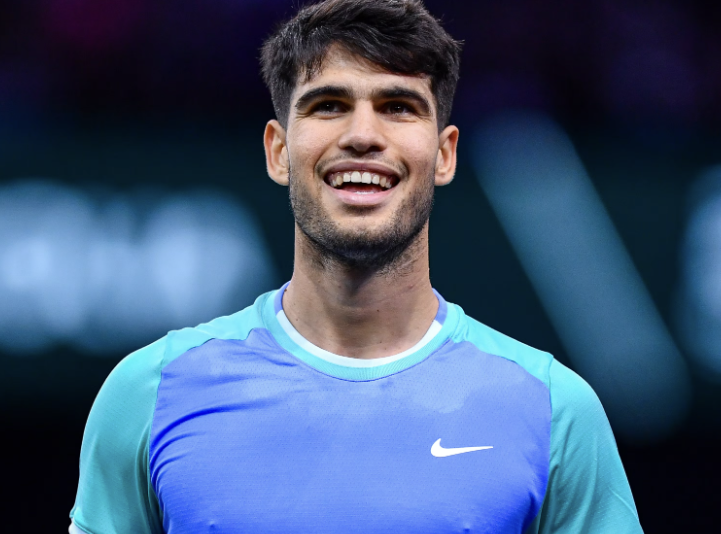
Carlos Alcaraz has just become the youngest player to complete a career Grand Slam, and while history will celebrate the records and trophies, what feels far more compelling is how he arrives at these moments. Watching him play, it becomes clear that his greatest advantage is not power or speed, but vision—how he sees the court, how he reads situations, and how he understands himself when everything is on the line.
When Alcaraz is faced with adversity, when the match turns and momentum slips, he does something many of us struggle to do. He looks inward. Not in doubt or panic, but in reflection. He reaches for an inner belief that has been built quietly through preparation and experience, and he trusts it enough to let it guide his next move. This is not optimism in abstract. It is belief grounded in knowing what he has practiced, what he has endured, and what he can summon when circumstances demand more than comfort allows.
READ: What’s the point? Lessons from Scottie Scheffler and Carlos Alcaraz on what really matters (July 23, 2025)
At the same time, his vision expands outward. He sees the bigger picture unfolding around him, reading every nuance of the situation—the opponent’s posture, the shifting rhythm of the rally, the subtle change in pace or intention. Nothing feels static. Everything is information. And because he sees the whole rather than fixating on a single point, he adapts. He adjusts without hesitation, without resistance, allowing change to become an ally rather than a threat.
What is striking is how naturally he reframes difficulty. Challenges do not register as obstacles to be feared, but as openings to be explored. Pressure sharpens his attention rather than narrowing it. Moments that would paralyze others seem to invite creativity from him, as if uncertainty itself is a space where possibility lives. He does not wait for ideal conditions. He creates them.
That way of seeing extends beyond competition. There is an openness in how he engages with people, an ability to notice the best in others, whether it is the joy of a child in the crowd or the effort of an opponent across the net. His smile is not incidental. It reflects a generosity of perception, a willingness to recognize humanity even while competing at the highest level.
And then there is the magic, the part that defies easy explanation. He does not just visualize what his body can do with the ball. He sees it first with his mind. The shot exists before it is struck, formed through intellect, imagination, and intention, and then carried out through movement that feels inevitable rather than forced. Mind and body align, not as separate systems, but as a single expression of vision in motion.
The Alcaraz Principles are not techniques to copy or habits to mimic. They are a way of seeing. Looking inward for belief when challenged. Expanding outward to grasp the full context of a situation. Reframing difficulty as opportunity. Choosing to see the best in others. And aligning thought, imagination, and action so that what once seemed impossible becomes visible, and therefore achievable.
Alcaraz shows us that to change outcomes, we often have to change perception first. To see differently is not a luxury. It is a discipline. And in watching him, we are reminded that the world reveals more to those who learn how to look.
The Alcaraz Principles
- When faced with a challenge, look inward first.
Alcaraz consistently shows that the foundation of elite performance is an inner belief that is not dependent on circumstances, rankings, or external validation; he does not search outward for answers, but inward for conviction. - Let adversity refine you, not define you.
Losses, injuries, and pressure moments are not treated as limitation, but as feedback; Alcaraz absorbs difficulty as part of the developmental process rather than a threat to identity. - Stay present, especially when the stakes are highest.
One of his most striking traits is emotional regulation under pressure; he plays the point in front of him, not the expectations attached to the moment. - Pair joy with discipline.
Alcaraz competes with visible joy, creativity, and freedom, but beneath that lightness is extraordinary structure, preparation, and work ethic - Trust the long arc of growth.
Becoming the youngest to achieve a career Grand Slam did not come from chasing milestones, but from committing to daily improvement; the results arrived as a byproduct of patience, belief, and relentless consistency.