



Few years ago, my dear friend, Lisa Roberts, one of the quiet architects of the Germination Project’s fellowship selection process, posed a question to a room of aspiring civic leaders. If you were dispatched as an ambassador of Earth to a civilization that had never encountered our planet, never read our history, never tasted our food or heard our music, what would you bring with you to describe who we are?
The answers ranged from the philosophical to the physical: a flower, a seed, a Beethoven sonata, a photograph of a mother holding her child, the Bible, the iPhone. The question, Lisa understood, was never really about the object, but was about the hierarchy of values hiding inside each choice.

I thought of Lisa’s question the moment I saw the passenger manifest of Air Force One departing for Beijing on May 13, 2026.
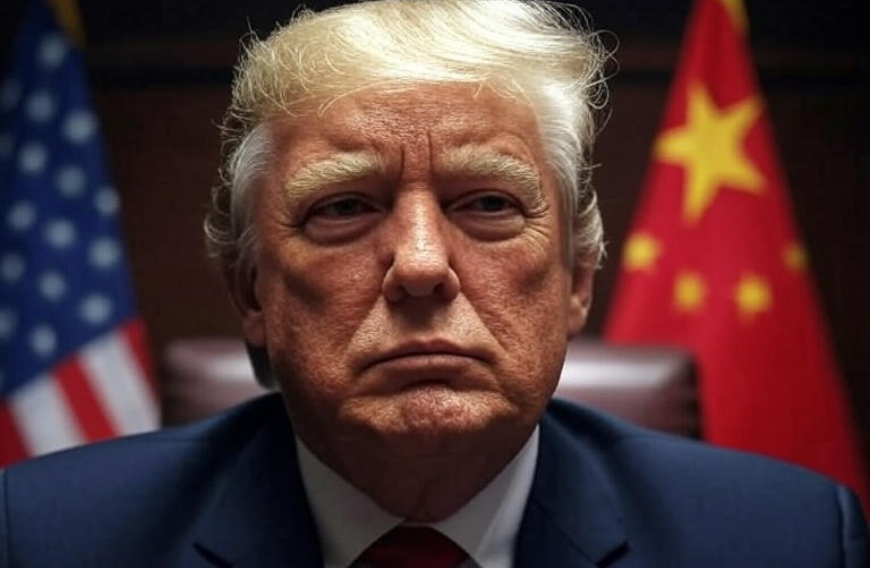
President Donald Trump’s two-day summit with Chinese President Xi Jinping, the first American presidential state visit to mainland China in nearly a decade, carried its geopolitical weight in many registers. Trade balances. Taiwan. The shadow of a war in Iran darkening the Strait of Hormuz. But the most eloquent statement the trip made was in the guest list.
Traveling with the President aboard Air Force One were seventeen executives representing the commanding heights of the American economy. Elon Musk of Tesla, SpaceX, xAI, etc. Tim Cook of Apple, in what was his final major diplomatic act before handing the keys to John Ternus on September 1st. Jensen Huang of Nvidia, who joined the delegation at the last minute in a move that sent investors into a quiet frenzy. Larry Fink of BlackRock, steward of $14 trillion in assets. Stephen Schwarzman of Blackstone. David Solomon of Goldman Sachs. Jane Fraser of Citigroup. Michael Miebach of Mastercard. Ryan McInerney of Visa. Sanjay Mehrotra of Micron. Cristiano Amon of Qualcomm. Dina Powell McCormick of Meta. Kelly Ortberg of Boeing. Larry Culp of GE Aerospace.
Consider what this roster represents when you apply Lisa’s exercise. If this delegation were your answer to the alien ambassador question, if this were America’s self-portrait, its curated exhibition to the universe, what story would it tell?
It would tell a story not about democracy, not about the Constitution, not about jazz or the Grand Canyon or the first line of the Declaration of Independence. It would tell the story of an America whose highest expression, at this moment, is the capacity to build intelligent machines, move capital at the speed of light, and ensure the world conducts its commerce in dollars.
The Review by Ajay Raju: Philadelphia is hosting an Open House in 2026 (May 18, 2026)
The Manifest as Message
Diplomatic delegations have always been semiotic events, carefully staged performances communicating priorities through presence and absence alike. When Richard Nixon landed in Beijing in February 1972, he brought Henry Kissinger, the choreographer of détente. When Trump visited China in November 2017, his business delegation leaned on manufacturing and consumer goods. The comparison is revealing. A Chinese expert cited by the Global Times noted directly that the 2026 roster, heavier in advanced technology and finance than any previous American delegation, signals that the United States attaches paramount importance to cooperation in high-tech and financial sectors.
This was not a trade mission. This was a product launch.
The three pillars of the American offer were hard to miss. First: artificial intelligence and semiconductor dominance, embodied by Jensen Huang and the contested question of Nvidia’s H200 chips. Second: the infrastructure of global capital, BlackRock’s tokenized financial instruments, Mastercard and Visa’s stablecoin settlement rails, Goldman’s deal architecture, Citigroup’s cross-border machinery. Third: the physical substrate of technology itself, Micron’s memory chips, Qualcomm’s wireless silicon, Boeing’s aircraft, GE’s aerospace engines. Rare earth access, the fuel for all of it, sat in the background of every conversation.
America declared in Beijing that we are the operating system of the modern world and asked China and the world watching if they want to run on us, or build a competing stack.
The Nvidia Gambit
No figure in the delegation carried more symbolic weight than Jensen Huang. His late addition to the passenger manifest, reversing earlier reports that he would not attend, was itself a statement. Wedbush Securities’ Dan Ives captured the market’s read, noting the presence of Huang alongside Musk and Cook “signals that technology and commerce are among the top US priorities going into the meetings.”
At the summit’s heart was the H200 question. The Nvidia H200, part of the older Hopper architecture, first released in 2023, and notably not the company’s most advanced chip, had been the subject of a remarkable policy arc. The Trump administration had banned even the downgraded H200 chip as recently as April 2025. Trump’s administration, on December 8, 2025, reversed that posture, signaling willingness to allow H200 sales to China under a revenue-sharing framework: approved Chinese firms could purchase H200s provided Nvidia remits 25 percent of revenues to the U.S. government. The January 13, 2026 Commerce Department regulation formalized the structure.
The summit’s most concrete technological development came from a Reuters exclusive published May 14: Washington had cleared approximately ten major Chinese technology firms, including Alibaba, Tencent, ByteDance, JD.com, and Lenovo, to each purchase up to 75,000 H200 chips under an export-licensing framework. While the administration issued licenses for 750,000 H200 chips, representing approximately twice China’s current annual AI computing production capacity, Xi told reporters that China wants to make its own chips.
Nvidia’s $130 billion annual revenue guidance had assumed zero recovery in China, a market representing roughly 13 percent of the company’s business and home to approximately half of all global AI developers. The strategic paradox, as one pre-summit analysis noted, is that China’s frontier AI labs, DeepSeek, Kimi, MiniMax, and others, have demonstrated the ability to build competitive models without H200 access. America is selling intelligence, but the buyer is already studying the blueprint.
What is clear is that the Trump administration has made a deliberate choice: to use technology access as a diplomatic lubricant, betting that commercial entanglement creates dependence that serves American interests better than embargo.
The Mineral Trap
Beneath every conversation at the Great Hall of the People lurked rare earths. China dominates approximately 85 percent of rare earth processing and more than 90 percent of global magnet production. These are the physical foundation of the entire technology stack the American delegation was offering to sell.
Beijing had already demonstrated its willingness to weaponize this leverage. In April 2025, following Trump’s “Liberation Day” tariffs, China imposed rare earth export restrictions on gallium, germanium, antimony, and graphite, the materials essential for compound semiconductors used in RF components, power electronics, and photonics. Chinese customs data going into the summit showed that exports of several critical resources remained roughly 50 percent below pre-restriction levels, even after a trade truce had nominally been agreed.
The truce itself, which reduced U.S. tariffs from 145 percent to 30 percent and Chinese tariffs from 125 percent to 10 percent, announced May 12, 2026, contained a provision that Beijing would “effectively eliminate” its rare earth export controls. In practice, those controls remain partially in force. U.S. Trade Representative Jamieson Greer acknowledged the situation and noted: “There’s certainly a willingness on both sides… to make sure we’re getting rare earths,” adding that flows had improved to “better levels, sometimes it’s slow.”
The Trump administration has responded on multiple fronts: a $12 billion initiative to stockpile critical materials announced in February 2026, executive orders to streamline domestic mining permits, and the USA Rare Earth company’s announced acquisition of Brazil’s Serra Verde Group, one of the few mines outside China with significant reserves of heavy rare earths. Analysts at CSIS credited these signals with attracting private investment. But as the Atlantic Council noted, building mines and processing facilities takes years regardless of political will and we cannot out-mine, out-process or outspend China quickly enough to rebuild resilience in the near term.
America’s negotiating position in Beijing was therefore structurally asymmetric. It arrived as a seller of software, intelligence, and financial architecture, and a buyer of the earth itself.
The Review by Ajay Raju: A Letter to the 2026 Graduating Class (May 11, 2026)
The Dollar’s New Architecture
The presence of Larry Fink, David Solomon, Jane Fraser, Michael Miebach, and Ryan McInerney in Beijing was not simply about existing relationships, but a specific vision of the financial future, one that the U.S. financial establishment is actively constructing, and in which the dollar plays a role never before imagined.
The global fiat-backed stablecoin supply exceeded $273 billion in March 2026, growing 40 times from $6.8 billion in March 2020. Of that total, 99.6 percent is dollar-linked. In 2025, adjusted stablecoin transaction volumes grew 91 percent to $10.9 trillion, approaching Visa’s $14.2 trillion of annual payments volume. Real-world stablecoin payments doubled in 2025 to $400 billion, with 60 percent estimated to be B2B transactions. The tokenized real-world assets market has surged approximately 410 percent since early 2025 to exceed $31 billion.
BlackRock, which manages $14 trillion in assets, is not watching this transformation from a distance. In the week before the Beijing summit, the firm filed with the SEC to launch the BlackRock Daily Reinvestment Stablecoin Reserve Vehicle and a digital share class of its $6.1 billion Treasury-backed liquidity fund, both designed for investors who hold their wealth in stablecoins and crypto wallets rather than traditional brokerage accounts. The tokenized securities will trade on the Ethereum blockchain with round-the-clock settlement. The message embedded in the filings was clear: the world’s largest asset manager is building infrastructure for a 24/7 financial system that never sleeps.
Mastercard, meanwhile, completed its acquisition of UK-based stablecoin infrastructure firm BVNK in March 2026, establishing the deposit rails enabling banks and fintechs to accept stablecoin payments. Visa is piloting stablecoin settlement programs. The New York Stock Exchange has announced a partnership with Securitize to build a blockchain-powered platform for tokenized stocks and ETFs. In mid-March, the SEC approved Nasdaq’s proposal to allow certain stocks to be traded and settled in tokenized form. The tokenized U.S. Treasuries market has grown 13 times since April 2024, from $1 billion to nearly $13 billion. The tokenized equities market, which effectively did not exist two years ago, has more than doubled to $945 million.
As stablecoins proliferate globally, providing hard-currency stability to populations in emerging markets facing inflation, capital controls, or currency devaluation, each stablecoin minted in dollars requires a dollar-denominated reserve. Each reserve requires U.S. Treasury securities. Each Treasury security funds U.S. government operations and sustains demand for American debt. The U.S. dollar, through the alchemy of blockchain, becomes the native currency of a parallel financial system that operates 24 hours a day, seven days a week, in every jurisdiction on earth.
By the way, this is not accidental. The GENIUS Act, the federal regulatory framework for payment stablecoins signed into law in 2025, defined dollar-linked stablecoins as payment instruments rather than securities, clearing the regulatory path for U.S. banks to issue them. JPMorgan Chase has JPM Coin. Citigroup, represented in Beijing by Jane Fraser, has Citi Token Services. The dollar’s supremacy is being re-encoded at the protocol layer of global finance.
The BIS general manager Pablo Hernández de Cos warned in April 2026 of the risks this poses to emerging market monetary sovereignty, noting that dollar stablecoins threaten to “increas[e] the dollarisation of emerging market economies and undermine their control of money flows.” From Washington’s perspective, that is THE feature and not a bug.
The Deeper Signal: Selling Civilization
Back to Lisa’s question.
The Trump delegation to Beijing was, in the most literal sense, the answer America chose to give. America sent its chip designers, its asset managers, its payment network architects, its autonomous vehicle builders, its smartphone manufacturers. We sent the instruments of economic infrastructure and technological dominance.
A civilization reveals its self-conception through its ambassadors. When the Greeks sent philosophers and poets to other city-states, they were announcing that Athens understood itself as a place where the life of the mind was sovereign. When the British Empire dispatched its administrative class, it was announcing that it understood itself as a civilizational project of order and extraction. When America sent its tech and finance elite to Beijing, it announced something specific: that it understands itself as the provider of the world’s digital infrastructure, and that it intends to keep that position.
The three vectors of ambition on display in Beijing converge toward a single thesis. Dominate the intelligence layer: Nvidia’s chips powering the AI models that increasingly govern commerce, medicine, logistics, and military strategy. Control the energy and material inputs: rare earth access as both geopolitical lever and manufacturing prerequisite. Own the financial operating system: a dollar-denominated, blockchain-settled, 24/7 market in which capital flows through American-built rails, held in American-designed instruments, subject to American regulatory architecture.
Xi Jinping offered a response that was simultaneously welcoming and declarative: China’s door “will only open wider,” he told the assembled executives. And yet in the same breath, he noted China’s intention to build its own chips. China has demonstrated, through the DeepSeek moment and the subsequent wave of frontier-competitive domestic models, that the gap in AI capability is narrower than America’s export control architecture assumed. It has demonstrated, through rare earth leverage, that the physical substrate of American technological dominance runs through Chinese geology. Xi’s message was the mirror image of Trump’s: we are a willing partner, and we are also building the alternative.
The summit concluded, in the assessment of most analysts, heavy on symbolism and lighter on substance. Not a single H200 chip had shipped to any approved Chinese buyer by the time Air Force One returned to Washington. Rare earth exports remained roughly 50 percent below pre-restriction levels. No bilateral AI governance framework was signed. Trump told reporters that “a lot of different problems were settled,” but the CFR and other analysts were more restrained.
Predicting the Future From the Guest List
What does the Beijing meeting tell us about the decade ahead?
First: artificial intelligence will be the central axis of geopolitical competition for the foreseeable future. The decision to bring Jensen Huang to Beijing, even at the last minute, signals that AI chip access has become as diplomatically significant as oil was in the mid-twentieth century. Every major economy is now positioning its AI strategy in relationship to Nvidia’s silicon, seeking access, building alternatives, or both. The H200 licensing framework, whatever its specific contours, represents the beginning of a long negotiation over the terms on which the world’s most consequential technology gets distributed.
Second: the rare earth question will not be resolved by summitry. It will be resolved, over years, by geology, capital, and political will. America is making the right bets, Project Vault, the Serra Verde acquisition, domestic permitting reform. But Chinese processing dominance is not a problem that diplomatic cordiality can dissolve. The United States must simultaneously engage China and build around it. That contradiction will define supply chain strategy for at least a generation.
Third: the dollar’s future is being written on blockchains, not in central bank vaults. The presence of Fink, Solomon, Fraser, Miebach, and McInerney in Beijing was an announcement that American financial institutions intend to be the architects of the next monetary infrastructure. The stablecoin market’s explosive growth, 99.6 percent dollar-denominated, approaching Visa’s annual transaction volume, suggests they are succeeding. The GENIUS Act, the NYSE-Securitize partnership, the BlackRock tokenized fund filings: these are not experiments. They are the foundation of the 24/7 global capital market that American finance is building. The dollar’s hegemony is being re-encoded not through interest rate differentials but through protocol design.
Fourth: the CEO delegation model signals a structural shift in how American statecraft operates. When the executive branch travels with the CEOs of technology and finance, it is not merely providing diplomatic cover for commercial deals, but announcing a theory of national power in which corporate capability and sovereign interest are fused. The lines between statecraft and market strategy, between national security and competitive advantage, are dissolving. This may be the most consequential long-term implication of the Beijing trip, more consequential, in the end, than any specific chip deal or tariff concession.
Last Word
I think of Lisa’s question again and wonder what a different president would have brought to describe us to China?
Trump brought semiconductors, a stablecoin, and a term sheet and explained that intelligence is now synthetic and tradeable, that money is now programmable and borderless and that the earth’s rarest elements flow through the decisions of a few sovereign actors.
A question that remains unanswered is whether the infrastructure we are building is also capable of sustaining the civilization it was meant to serve. Technology without wisdom is leverage without direction. Capital without conscience is acceleration without a destination. The men and women on that plane are, by any measure, among the most consequential builders of our era. The world they are building will arrive whether we are ready for it or not.
My friend Lisa would tell you the real question was never about the object, but about who you are when you choose it.