



By Shalin Shah
The views and opinions of this article are the author’s own*
In my last column, I introduced the concept of Livable Longevity — the idea that the best longevity strategy is one you can actually sustain. I laid out the Longevity Pyramid, from foundational habits like nutrition and sleep to advanced interventions like peptides and regenerative medicine.
The second layer of that pyramid — hormone optimization — deserves its own conversation. Because if your hormones are declining and nobody’s paying attention, everything else you’re doing is fighting uphill.
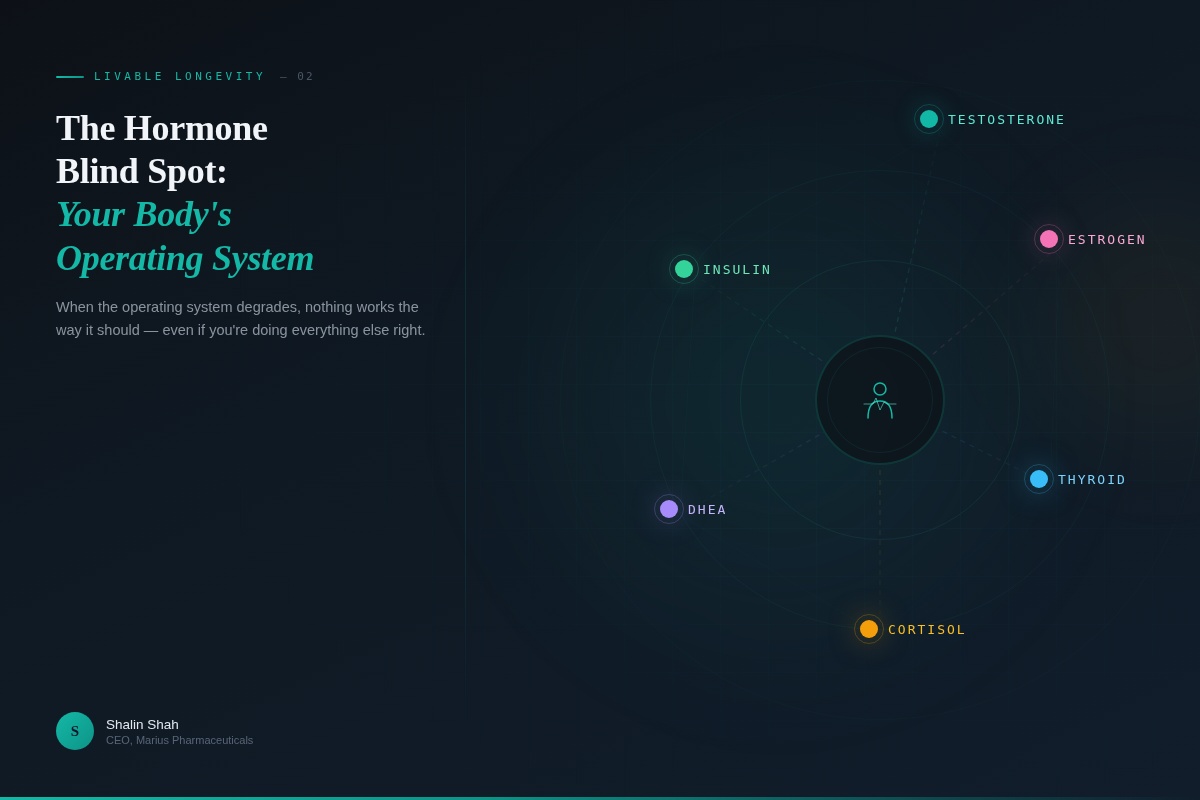
Think of hormones as your body’s operating system. They don’t just govern reproduction — that’s the outdated textbook version. Hormones regulate how you metabolize food, how well you sleep, how clearly you think, how efficiently you build or lose muscle, how your heart functions, and how resilient your mood is under stress.
When the operating system is running well, everything hums. When it degrades, nothing works the way it should — even if you’re doing everything else right.
More than ‘sex hormones’
Most people hear the word “hormone” and think testosterone or estrogen. But the endocrine system is an orchestra, not a solo act. Testosterone, in both men and women, supports lean muscle, bone density, cognitive sharpness, cardiovascular health, and drive.
Estrogen and progesterone, far beyond their reproductive roles, protect the brain, regulate inflammation, and maintain vascular elasticity. Thyroid hormones set your metabolic rate — they determine whether your engine runs hot and efficient or cold and sluggish.
DHEA, often called the “mother hormone,” serves as a precursor to both testosterone and estrogen. Cortisol, when properly regulated, manages energy and immune response; when chronically elevated, it dismantles the very systems it’s meant to protect.
And insulin — arguably the most metabolically consequential hormone of all — dictates how your body stores or burns fuel.
These hormones don’t operate in isolation. They’re in constant conversation. When one drifts out of range, others compensate, and over time the entire system recalibrates — often in the wrong direction. This is why a single lab value rarely tells the whole story. You need to see the network.
The decline is real: Starting earlier than you think
Hormone decline is a biological certainty. In men, testosterone drops roughly one to two percent per year after thirty. Women experience a more dramatic shift through perimenopause and menopause, with estrogen and progesterone fluctuating and eventually falling sharply.
Thyroid function slows. DHEA declines steadily from its peak in the mid-twenties. These are natural trajectories — but “natural” doesn’t mean optimal, and it certainly doesn’t mean you have to accept the symptoms silently.
What’s more concerning is that the decline appears to be accelerating. Environmental endocrine disruptors — microplastics, pesticides, BPA, phthalates — are measurably interfering with hormone production and signaling. Chronic stress elevates cortisol, which in turn suppresses testosterone and thyroid function. Sleep deprivation, now practically normalized, directly impairs growth hormone secretion and testosterone production. We are not just aging hormonally — we are being aged by our environment.
The blind spot: When treatment creates a new problem
Here is where modern medicine has a genuine blind spot — and it’s one worth naming directly.
Cholesterol is the raw material your body uses to manufacture steroid hormones — testosterone, estrogen, progesterone, cortisol, and DHEA all originate from cholesterol.
It is the biochemical starting line. Statins, the most widely prescribed class of drugs in the world, work by aggressively lowering LDL cholesterol. For patients with documented cardiovascular risk, this can be appropriate. But for millions of others, the approach amounts to carpet-bombing a number on a lab report without asking what else that number supports.
When you drive cholesterol to very low levels, you reduce the substrate available for hormone synthesis. There is a growing body of clinical observation — and emerging research — linking aggressive statin therapy to lower testosterone levels, reduced libido, fatigue, cognitive fog, and mood changes. These are symptoms patients report frequently, and they are too often dismissed or attributed to “just getting older.”
This is not an anti-statin argument. Statins save lives in the right context. But it is a call for nuance. Medicine should not optimize one biomarker while inadvertently degrading an entire hormonal system. The question should never be simply “Is your LDL low enough?” It should be “Is your LDL low enough and are your hormones still functioning well?” Treating the whole patient means looking at the whole picture.
Lifestyle first: Earning your hormonal health
Before any prescription enters the conversation, there is real hormonal ground to be gained through behavior. This mirrors the Livable Longevity philosophy: the base of the pyramid supports everything above it.
Resistance training is the single most reliable natural stimulus for testosterone and growth hormone. Adequate protein intake fuels the raw materials for hormone production and muscle preservation.
Sleep — seven to nine hours, consistently — is when the endocrine system does its deepest repair work; growth hormone pulses during deep sleep, and testosterone peaks in the early morning only if sleep architecture is intact.
Managing chronic stress lowers cortisol, which in turn unblocks suppressed testosterone and thyroid output. And reducing exposure to endocrine disruptors — filtering water, choosing cleaner food sources, avoiding heated plastics — removes interference at the receptor level.
These interventions are free, available to everyone, and compounding. They are the foundation. But for many people, especially those over forty, lifestyle alone cannot fully restore what time and environment have taken. That’s where the next step comes in — and it’s where unnecessary fear has held too many people back.
Replacement, Not Manipulation
There is a persistent stigma around hormone replacement therapy, rooted partly in the controversial Women’s Health Initiative study from 2002 and partly in the cultural association of testosterone with performance-enhancing abuse. Both narratives have created fear that is disproportionate to the actual evidence — and that fear has cost people years of vitality.
Here is the reframe that matters: hormone replacement therapy, when done properly, is not introducing a foreign substance into your body. It is restoring a molecule your body has produced its entire life and has now stopped producing in adequate amounts. You are not manipulating your biology. You are returning it to a place it already knows. Bioidentical hormones — structurally identical to what your body makes — are the standard in modern practice. The goal is not to push levels to the top of the range or beyond. It is to find the individual’s physiologic sweet spot: the level at which energy, cognition, metabolism, mood, and physical function are all optimized.
READ: What longevity really means, and why it has to be livable (
For men, testosterone replacement has evolved significantly. What once required injections or messy topical gels now includes convenient oral options that offer stable absorption without the peaks and troughs of older delivery methods. For women, bioidentical estrogen and progesterone — delivered through patches, creams, or oral formulations — can address the cascade of symptoms that accompany menopause, from hot flashes and sleep disruption to bone loss and cognitive changes.
In both cases, the therapy should be supervised by a clinician who understands endocrinology, monitors labs regularly, and adjusts based on symptoms and data — not just numbers on a page.
This is precision medicine, not reckless experimentation. And when layered on top of strong lifestyle habits, it becomes one of the most powerful tools in the longevity arsenal.
Hormones are not vanity: They are vitality
The conversation around hormones has been clouded by stigma, oversimplification, and a medical system that too often treats symptoms in isolation rather than systems in concert.
But the science is clear: hormonal health is foundational to living longer and living well. It affects your heart, your brain, your bones, your body composition, your energy, and your resilience. Ignoring it is not conservative medicine — it is incomplete medicine.
The Livable Longevity approach is the same here as it is everywhere else: start with the foundation, optimize what you can through behavior, and then — when indicated — use the best available tools to restore what biology has lost. Hormones are not about chasing youth. They are about preserving function. And function is what makes a long life worth living.
In my next column, we’ll go deeper into one of the most misunderstood and promising frontiers of longevity science: peptides — what they are, what the data actually shows, and how they fit into a sustainable protocol.
References
- Hall JE. Guyton and Hall Textbook of Medical Physiology. 14th ed. Elsevier; 2020.
- Snyder PJ, Bhasin S, Cunningham GR, et al. Lessons from the Testosterone Trials. Endocr Rev. 2018;39(3):369-386.
- Davis SR, Baber R, Panay N, et al. Global Consensus Position Statement on the Use of Testosterone Therapy for Women. J Clin Endocrinol Metab. 2019;104(10):4660-4666.
- Mendelsohn ME, Karas RH. The Protective Effects of Estrogen on the Cardiovascular System. N Engl J Med. 1999;340(23):1801-1811.
- Mosconi L, Jett S, Nerattini M, et al. Systematic review and meta-analysis of the effects of menopause hormone therapy on cognition. Front Endocrinol. 2024;15:1350318.
- Harman SM, Metter EJ, Tobin JD, Pearson J, Blackman MR. Longitudinal effects of aging on serum total and free testosterone levels in healthy men. J Clin Endocrinol Metab. 2001;86(2):724-731.
- Handelsman DJ, Sikaris K, Ly LP. Estimating age-specific trends in circulating testosterone and sex hormone-binding globulin in males and females across the lifespan. Ann Clin Biochem. 2016;53(3):377-384.
- Davison SL, Bell R, Donath S, Montalto JG, Davis SR. Androgen levels in adult females: changes with age, menopause, and oophorectomy. J Clin Endocrinol Metab. 2005;90(7):3847-3853.
- Davis SR, Bell RJ, Robinson PJ, et al. Testosterone and estrone increase from the age of 70 years: findings from the Sex Hormones in Older Women study. J Clin Endocrinol Metab. 2019;104(12):6291-6300.
- Gore AC, Chappell VA, Fenton SE, et al. EDC-2: The Endocrine Society’s Second Scientific Statement on Endocrine-Disrupting Chemicals. Endocr Rev. 2015;36(6):E1-E150.
- Levine H, Jørgensen N, Martino-Andrade A, et al. Temporal trends in sperm count: a systematic review and meta-regression analysis. Hum Reprod Update. 2017;23(6):646-659.
- Leproult R, Van Cauter E. Effect of 1 week of sleep restriction on testosterone levels in young healthy men. JAMA. 2011;305(21):2173-2174.
- Van Cauter E, Leproult R, Plat L. Age-related changes in slow wave sleep and REM sleep and relationship with growth hormone and cortisol levels in healthy men. JAMA. 2000;284(7):861-868.
- Schooling CM, Au Yeung SL, Freeman G, Cowling BJ. The effect of statins on testosterone in men and women, a systematic review and meta-analysis of randomized controlled trials. BMC Med. 2013;11:57.
- Shawish MI, Bagheri B, Musini VM, Adams SP, Wright JM. Effect of atorvastatin on testosterone levels. Cochrane Database Syst Rev. 2021;1:CD013211.
- Morselli LL, Claflin KE, Grinspoon SK. Association between statin use and sex hormones in the Multi-Ethnic Study of Atherosclerosis cohort. J Clin Endocrinol Metab. 2019;104(10):4600-4608.
- Labrie F. All sex steroids are made intracellularly in peripheral tissues by the mechanisms of intracrinology after menopause. J Steroid Biochem Mol Biol. 2015;145:133-138.
- Hernández-Pérez JG, Lopez DS, et al. Association of sleep duration and quality with serum testosterone concentrations among men and women: NHANES 2011–2016. Andrology. 2023;11(8):1576-1587.
- Lincoff AM, Bhasin S, Flevaris P, et al. Cardiovascular safety of testosterone-replacement therapy. N Engl J Med. 2023;389(2):107-117.
(Shalin Shah is the CEO of Marius Pharmaceuticals, a Raleigh, NC–based company that developed Kyzatrex, an FDA-approved treatment for testosterone deficiency.) The views and opinions of this article are the author’s own*