



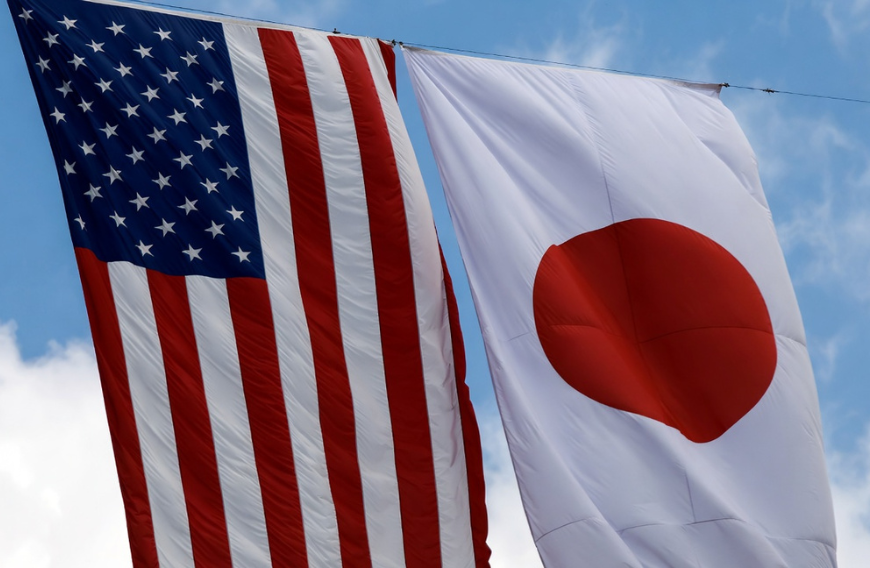
President Donald Trump and Japan seem to be making a very lucrative investment together.
Trump has welcomed Japan’s pledge to invest nearly $36 billion in oil, gas and critical mineral projects in Texas, Ohio and Georgia.
“Our MASSIVE Trade Deal with Japan has just launched!” Trump said Tuesday in a social media post.
“The scale of these projects are so large, and could not be done without one very special word, TARIFFS,” he added.
The commitment represents the first tranche of investments by Japan following a landmark trade deal between the two countries, one in which Tokyo pledged to invest $550 billion in American-based projects and Trump cut tariffs on most Japanese imports to 15%.
“We believe these initiatives truly embody the purpose of this Strategic Investment Initiative, namely the promotion of mutual benefit between Japan and the United States, the enhancement of economic security, and the promotion of economic growth,” Japanese Prime Minister Sanae Takaichi said in a post on X, according to a Google translation.
READ: UAE firm acquires $500 million stake in Trump’s cryptocurrency company (
Takaichi said the projects strengthen the Japan-U.S. alliance and were expected to bring increased sales and business expansion for Japanese companies.
The reported projects span three states: Texas, Ohio, and Georgia. In Texas, the investment supports a deep-water crude oil export terminal. In Ohio, funding is directed toward a large natural gas–fired power plant near Portsmouth. In Georgia, the focus is on a synthetic industrial diamond facility connected to critical minerals and advanced manufacturing.
The White House said Japan would also finance a $2.1 billion deepwater crude oil export facility off the Texas coast, at full capacity, the Texas GulfLink project is expected to generate up to $30 billion in annual U.S. crude exports. Dallas-based energy infrastructure group Sentinel Midstream is developing the project.
Beyond the financial figures, the initiative reflects a broader strategy aimed at strengthening economic security, technological capacity, and infrastructure resilience in both countries. By fostering collaboration on energy production, critical minerals, and advanced manufacturing, the partnership demonstrates how targeted investments can align national interests with global supply chain stability.
READ: Americans, not foreign countries, are paying the price for Trump’s tariffs (
This development also underscores the strategic importance of trade policy in facilitating cross-border investment. Reductions in tariffs and other regulatory adjustments may have played a role in creating conditions that encourage large-scale commitments from international partners, while reinforcing mutual economic benefit.
From a geopolitical perspective, these investments contribute to the deepening of bilateral ties and strengthen the economic and diplomatic relationship between the United States and Japan.
Such initiatives may serve as a model for future cooperation, showing how countries can jointly pursue industrial innovation while addressing energy security and sustainability challenges. The economic impact is expected to extend beyond the immediate sectors, potentially stimulating job creation, technology transfer, and regional economic development in host communities.
In sum, the agreement represents more than a financial transaction; it embodies a strategic vision in which trade, industry, and international collaboration intersect. It highlights the potential of large-scale investment initiatives to support national growth objectives, reinforce alliances, and drive long-term economic resilience in an increasingly interconnected global economy.