



Previously, this column argued that Trump’s Iran war was a pre-planned strategy — designed before the oath was taken — to explain inflation, generate Gulf capital flows into American markets, and create the October peace dividend that would carry Republicans through the November midterms.
A reader’s observation today forces a critical addition to that analysis. And it changes everything.
Before the Iran war began. Before the Strait of Hormuz was closed. Before oil hit $115 per barrel. Before the Gulf sovereign wealth funds began deploying $26 billion per quarter into American markets — Trump seized Venezuela.
READ: Venezuelan President Maduro captured, fueling uncertainty in global oil markets (January 3, 2026)
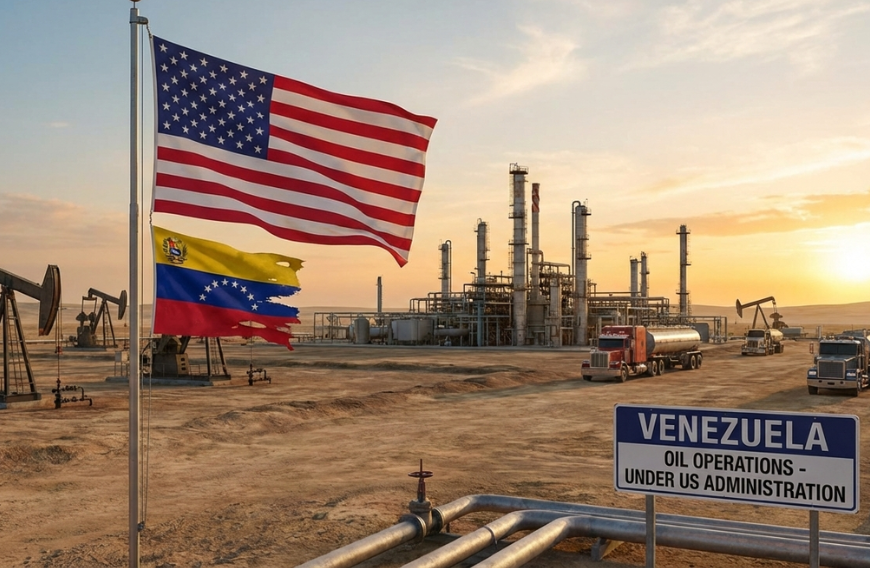
In January 2025 — nine days after his inauguration — US military operations resulted in the ouster and arrest of Nicolás Maduro. Trump announced that the United States would effectively “run” Venezuela and sell its oil. Payments from Venezuelan oil sales would go not to the Venezuelan government but to a special US-controlled account. America would control the cash flow from the world’s largest proven oil reserves.
This was not a coincidence. This was Phase 1.
The Iran war was Phase 2.
And the Iran deal — when it finally arrives — is Phase 3 of a unified oil control strategy that began before most people were paying attention.
Venezuela first. Then Iran. The sequence was never accidental.
Venezuela sits atop the world’s largest proven oil reserves. Mismanagement and sanctions had collapsed production from 3.5 million barrels per day in 1999 to less than 400,000 barrels per day by 2020. The oil was there. The infrastructure was broken. American investment could rebuild it — within 24 to 36 months — to 2-3 million barrels per day.
Trump’s team knew this before January 20. They knew that seizing Venezuela — routing its oil revenues through US-controlled accounts, excluding Russia and China and Iran from all transactions — gave America a second global oil lever that it had never previously controlled.
Maduro was removed in January. The Iran war started February 28.
That sequence is not coincidental. It is architectural.
Without Venezuela, starting the Iran war and closing the Strait would make America hostage to OPEC+ for global oil price management after the deal. When the Strait reopens and Iranian oil returns — OPEC sets the price, Russia influences it, America watches.
With Venezuela under American control — when the Strait reopens and Iranian oil returns — America opens the Venezuelan tap to manage the global price floor. Too high before November — open Venezuela. Too low — close it. The revenue flows to a US-controlled account. America does not just participate in global oil markets after the Iran deal. America manages them.
Trump did not start the Iran war and then look for replacement oil. He secured the replacement oil first. Then started the war. Venezuela before Iran is the only sequence that makes strategic sense. And it is precisely the sequence that happened.
The capital flow that powered the bull market
Once Venezuela was secured and the Iran war began — the strategy executed as designed.
The Strait closure spiked oil to $115 per barrel. Gulf sovereign revenues accumulated at historic speed. Regional instability made Gulf real estate, Gulf infrastructure, Gulf business all temporarily uninvestable. The capital had nowhere to go except the safe haven — America. Specifically American technology, American AI infrastructure, American private equity.
READ: Deal number 39: And what India pays for it (
The five largest Gulf sovereign wealth funds — Saudi Arabia’s PIF, Abu Dhabi’s ADIA, Mubadala, L’imad, and Qatar Investment Authority — deployed almost $26 billion in just three months. Most of it into developed market assets. Most of that into America. The UAE’s total sovereign assets reached $3.08 trillion. The UAE Ambassador to Washington wrote publicly — our $1.4 trillion commitment to the United States is firm.
This capital flow — invisible to most market observers, unreported as a unified phenomenon by mainstream financial press — was the hidden engine of the American bull market in 2026. The S&P 500 did not reach record highs only because of AI earnings. It reached record highs because $26 billion per quarter of Gulf sovereign capital was flowing into American equities while global alternatives were made uninvestable by the war America started.
The SpaceX IPO priced at $1.75 trillion into this Gulf-powered bull market. Deal Number 39 was announced the night before. The Dow surged 930 points. Musk’s personal wealth increased by amounts that would require multiple lifetimes to accumulate through ordinary means. Kushner’s Gulf-funded private equity firm benefited. Witkoff’s crypto company — partially owned by UAE royal investment — benefited.
The system ran exactly as designed.
The fatal paradox — the peace that could cost November
Now, the peace is coming. Oil is already at $84 — down 16.56 percent in one month on deal expectations. An 80 percent probability of a deal has been officially announced. The Strait is expected to begin reopening in the third quarter.
And here is the paradox that Trump’s team designed brilliantly around Iran and Venezuela but may not have fully solved around the capital markets.
When the Strait reopens — the three conditions that drove Gulf capital into American markets disappear simultaneously.
Gulf oil revenues drop as prices fall from $115 to $80-75. The accumulation rate that powered the $26 billion quarterly investment pace slows dramatically. Less oil revenue means less capital available to deploy.
Regional investment becomes viable again. Gulf real estate. Saudi Vision 2030 projects. UAE infrastructure. Qatar’s next decade of development. These compete with American equities for the same sovereign capital. When the neighborhood is safe — capital stays home.
And American valuations become the problem. The S&P 500 at current levels prices in perfection. When Gulf capital stops flowing in at war-emergency pace — and European equities are cheaper after ECB rate hikes compressed prices, and South Korean AI chip exporters are growing at 139 percent — the valuation argument for America weakens dramatically.
READ: Why the US-Venezuela crisis matters to India’s energy and global strategy? (January 6, 2026)
Investors have choices when the war ends. When investors have choices they diversify. When they diversify — American markets lose the concentrated Gulf capital inflow that has been the hidden engine of the current bull run.
The mechanics of the potential sell-off follow a precise sequence.
The Strait reopens. Oil falls to $75. Gulf quarterly SWF deployment slows from $26 billion to $15-18 billion. European and Asian markets — cheaper, recovering, newly safe — begin attracting capital rotation. Foreign institutional investors sell American equities to buy cheaper alternatives with better risk-adjusted returns. American retail investors see prices falling and begin selling. The nobody-is-selling euphoria that we wrote about reverses. Everyone sells simultaneously. The S&P 500 corrects 15-20 percent from peak. The Nasdaq corrects 20-25 percent.
American households open their October 401(k) statements and see losses not records.
November arrives with a falling market.
Republicans lose the House.
The investigations begin.
The strategy that was designed to win November destroys itself in the execution of its final phase.
Venezuela as the solution — and its limits
This is where Venezuela becomes critical to understanding whether Trump’s team solved this problem or not.
As Iranian oil returns to global markets and the Strait reopens — Venezuelan oil simultaneously ramps up under American control. Production rebuilding from 400,000 barrels per day toward 2-3 million barrels per day over 24-36 months. Revenue flowing to US-controlled accounts. Russia, Iran, China explicitly excluded from all transactions.
America now holds a global oil supply lever that no previous administration possessed. It can open or close the Venezuelan tap to manage the global price floor. If oil falls too fast after the Iran deal — threatening the inflation narrative before it fully feeds through — America slows Venezuelan supply increases to support the price. If oil stays too high — threatening the rate cut narrative — America accelerates Venezuelan production to bring the price down.
This is not OPEC membership. This is OPEC management. America managing the global oil price from outside the cartel using an asset it controls directly.
The strategic genius of this — if it works — is that Trump arrives at November with falling oil prices, falling inflation, a Warsh rate cut, recovering markets after the initial sell-off — and Venezuelan oil revenues flowing into US-controlled accounts rather than to Maduro or Russia or China.
America becomes the swing producer of global oil markets. Not Saudi Arabia. America.
But there is a limit to what Venezuelan oil can do in the immediate term. The Atlantic Council expert noted that dramatic changes in Venezuelan output require 12 to 18 months of sustained investment. The Maduro ouster happened in January 2025. The investment began flowing in March 2026 after sanctions were eased. The math suggests meaningful Venezuelan production increases arrive in mid to late 2027 — after the November midterms.
Which means the capital flow problem — the sell-off that follows the Gulf’s reduced investment pace — arrives before the Venezuelan solution is fully operational.
The timing window that determines everything
There is one path through this — and it is narrow.
The deal must be signed in late July or early August. Not June. Not September.
Oil falls immediately on the signing. Inflation data shows the drop in September and October. Warsh cuts rates in September or October on the falling inflation data. The rate cut provides a new domestic engine for American markets — lower rates push equity valuations higher even as Gulf capital inflows slow.
The market absorbs the Gulf capital rotation sell-off in August — the historically low-volume month when institutional investors are on holiday and sell-offs are less catastrophic. By September the rate cut narrative takes over. October 401(k) statements show recovery from the August correction — not the peak, but recovery.
The political narrative for November — Trump managed the crisis, brought peace, cut rates, markets corrected and recovered — is actually more compelling than an uninterrupted bull run that feels fragile. A market that fell and recovered tells the voter that Trump navigated a genuine crisis. An unbroken bull run feels like luck.
But this requires the deal in July-August. The 80 percent probability announced today did not specify a date. Soon is not a strategy. Soon is a hope.
The entire November architecture depends on whether soon means July or September.
The global economy that will not reassemble
One final observation that belongs in this column because it will shape the world India and every other nation operates in for the next decade.
The global economy that existed before February 28, 2026 is not coming back.
Three separate economic worlds are forming from the fractures of the Iran war.
America — with its AI boom, its Gulf capital inflows, its Venezuelan oil lever, its Warsh Fed — is operating in a different economic reality from the rest of the world. Record stock market. Elevated inflation. No rate cut yet. But enormous structural advantages from the capital concentration the war created.
Europe — hiking rates as the ECB responds to energy-driven inflation. Growth contracting. Energy costs elevated by the Strait closure. Cheaper equities but deteriorating fundamentals. The ECB hiking while the Fed holds is the widest transatlantic policy divergence in a generation.
READ: Trump moves to tap 30-50 million barrels of Venezuelan oil, following Maduro’s removal (January 7, 2026)
Asia — splitting between the AI chip winners and everyone else. South Korea’s AI chip exports up 139 percent. Taiwan growing at 9.6 percent. Japan hiking rates. The rest of developing Asia squeezed between high oil import costs and weakening export demand from a slowing West.
These three worlds will not reunify when the Strait reopens. The capital flows that have been redirected — Gulf money into America, developing world capital into safe havens — will not reverse completely. The supply chain reconfigurations that companies made under war conditions will not be undone when peace arrives. The price relationships that shifted — energy, food, shipping — will take years to normalize.
The world before February 28 is gone. What replaces it is being decided right now — in the oil futures market, in the Fed’s next meeting, in the deal rooms where Witkoff is negotiating with Iranian officials, in the Venezuelan oil fields where American companies are finally being allowed to invest.
Trump’s plan — designed before the oath — is in its most critical phase.
The peace is coming. The capital flows are shifting. The Venezuela lever is not yet fully operational. The rate cut timing is uncertain. The sell-off risk is real.
Whether the plan survives contact with its own peace dividend will determine not just November 2026.
It will determine the shape of the global economy for the decade that follows.
The oil is the key. It always was.
Venezuela first told you that.
The Iran war confirmed it.
And the deal — when it finally arrives — will reveal whether Trump’s team solved the problem they created.
Or whether the peace that was supposed to win November becomes the thing that costs it.