



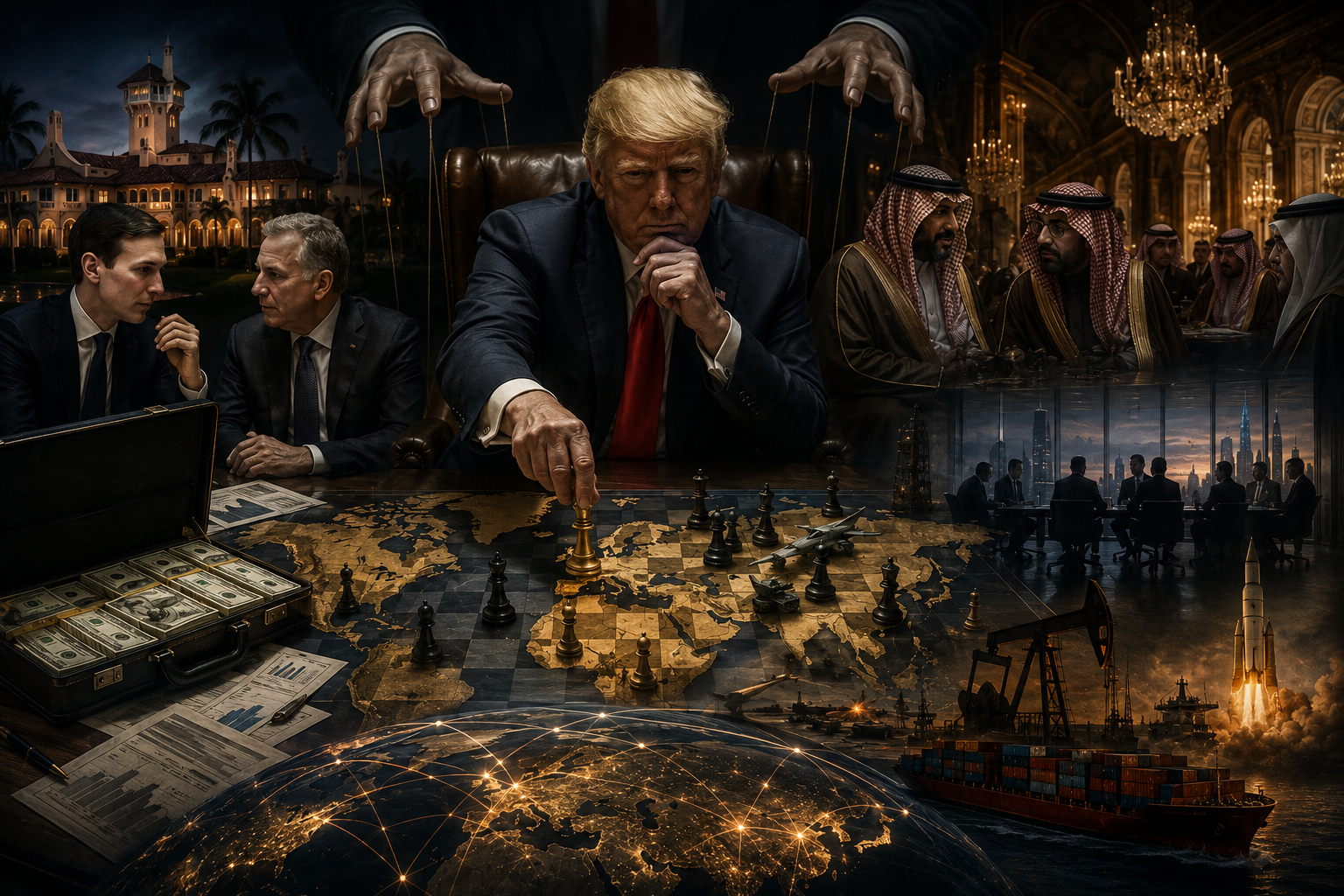
Before Donald Trump placed his hand on the Bible on January 20, 2025, the plan was already in place.
Not improvised. Not reactive. Designed. In Mar-a-Lago. In Gulf royal palaces. In private equity boardrooms where Jared Kushner raised $6 billion — 99 percent from foreign nationals — and Steve Witkoff received $31 million from a UAE royal sovereign fund. The plan was operational before the inauguration. The oath was the public launch of something that had been running for months in private.
To understand what is happening to America — and to the world — in 2026, you must start not with the Iran war or the tariffs or the SpaceX IPO or the 39 deal announcements. You must start with three things Trump’s team knew before January 20 that they could not say publicly.
They knew inflation was a monster with no quick cure.
They knew a recession was probable before the 2026 midterms.
And they knew that if the economy failed on its own terms — with no external explanation — Republicans would lose the House, the investigations would begin, and the second term agenda would be destroyed.
The strategy was not to fix the economy. The strategy was to make sure that when it failed — and they knew it would fail — it failed with someone else’s name on it.
Everything that has happened since January 20 must be understood through this single lens.
READ: Deal number 39: And what India pays for it (
Biden left office with inflation still running above the Federal Reserve’s 2 percent target. The American consumer was exhausted — groceries, rent, mortgage rates, car loans. All expensive. All resistant to quick solutions.
The inflation itself had four structural causes that no incoming president could fix in one year.
COVID destroyed global supply chains for three years — creating shortages in everything from semiconductors to shipping containers. Prices rose because supply could not meet demand regardless of who was in the White House.
The $5 trillion in COVID stimulus — printed by both Trump in 2020 and Biden in 2021 — was the largest peacetime monetary expansion in American history. That money was always going to produce inflation. It was delayed by supply disruption and then arrived all at once.
Corporate America used the inflation cover to expand profit margins beyond their actual cost increases. Grocery chains, oil companies, pharmaceutical firms reported record profits during the inflation period. They were not victims of inflation. Some of them were its architects — raising prices beyond cost and calling it a supply chain problem.
And the Fed’s own medicine created the stickiest problem. When rates went to 7-8 percent, existing homeowners with 3 percent mortgages refused to sell. Housing supply collapsed. Rent and home prices stayed elevated even as other prices fell. Housing is 40 percent of the inflation basket. It would not move.
Trump inherited all four structural problems. None of them could be fixed by tariffs, by firing government workers, or by starting a war with Iran.
But all of them could be explained by tariffs, by DOGE theater, by a war — long enough to get through November 2026.
READ: The leaking bucket: India’s GDP rises as investment slips away (June
The architecture of explanation
Every piece of the strategy serves one purpose — to ensure that when economic pain arrives it has a pre-built explanation that protects Republican candidates in the midterms.
DOGE and the government worker firings were not primarily a fiscal policy. They were an unemployment buffer. Two hundred thousand federal workers fired or pressured to resign. When unemployment rises in 2026 — which it was going to do as the economic cycle turned — Trump has the explanation ready. “We cut government bloat. The numbers are temporarily elevated by our own deliberate restructuring.” Structural unemployment becomes attributed to a policy choice rather than economic failure. The patient is told the pain is medicine.
READ: Satyameva Jayate. So let us have all of it. (June 10, 2026)
The ICE raids with masks were not primarily immigration policy. They were content production. When constituents are economically anxious — when their grocery bills are high and their mortgage rates are brutal — you give them an enemy with a face. The masked agent dragging someone from a workplace does not reduce inflation. It redirects the anger that inflation creates away from the economic system and toward an identifiable human target. The oldest political strategy in history — updated for streaming on X.
The tariff games were not primarily trade policy. They followed the same playbook as the Iran deal announcements. Announce massive tariffs. Markets fall. Businesses panic. Then negotiate, grant exceptions, pause implementation. Markets recover. Trump claims credit for resolving the threat he created. The tariff cycle — announce, panic, negotiate, relief — is the Iran deal cycle applied to trade. Create the fear. Manage the response to the fear. Claim credit for the resolution.
Maligning Powell and replacing him with Warsh was not primarily about monetary policy. It was about electoral timing. Powell would not cut rates for political reasons. He said so explicitly. Warsh will cut when November needs a cut. The maligning was the preparation for the replacement. The replacement is the preparation for October.
And then — the mother of all explanations.
READ: Sarve bhavantu sukhinah — And what Indian Journalism did with it (June 6, 2026)
The war that was always the plan
The Iran war did not happen because of a miscalculation. The Omani Foreign Minister — America’s own diplomatic back channel — said the United States had “lost control of its own foreign policy” and that Israel had persuaded the Trump administration to engage in what he called “a grave miscalculation” and “a catastrophe.”
But what if it was not a miscalculation?
Consider what the Iran war delivers for Trump’s domestic political strategy that no other instrument could provide.
It explains inflation completely and externally. Oil at $115 per barrel. Petrol prices surging. LPG costs jumping. These are real economic pain points that were going to arrive anyway from the structural inflation the Biden economy left behind. The Iran war gives them an external address. “Prices are high because of the war.” Not because of structural economic failure. Because of a war Trump is heroically managing.
It creates a wartime political environment. Wartime presidents do not lose midterms. The American instinct to support the commander in chief during conflict overrides economic anxiety in a significant portion of swing voters. The voters who were going to blame Trump for inflation — some of them now stand behind him for fighting Iran.
It creates the peace dividend timed for October. If the war ends in October — oil falls, inflation drops, Warsh cuts rates, market surges, 401(k) statements arrive at record highs one month before voters go to the booths. The timing is not coincidental. It is architectural.
The capital flows that make the whole machine run
Now here is the piece of the theory that most completely escapes mainstream analysis. And it is the piece you identified that ties everything together.
The war did not just explain inflation domestically. It created a global capital flow into American markets that no peacetime policy could have generated.
The Gulf sovereign wealth funds — Saudi Arabia’s Public Investment Fund, Abu Dhabi Investment Authority, Mubadala, L’imad, Qatar Investment Authority — collectively deployed almost $26 billion in the three months of March, April and May 2026 alone. Most of it flowed into developed market assets. Meaning America.
This is not despite the war. It is because of it.
The logic is counterintuitive but completely rational from the Gulf’s perspective. The war has closed the Strait. Gulf oil revenues are partially disrupted. The Gulf states cannot easily deploy capital into regional real estate or regional business when a war is destabilizing the neighborhood. So the capital goes where it is safe. Where the rule of law is stable. Where the returns are highest. Where the relationships with the decision makers are strongest.
It goes to America. To American tech. To American private equity. To American AI infrastructure.
Middle Eastern sovereigns invested $42.5 billion in direct venture capital last year — up from $13.3 billion in 2024. The UAE’s total sovereign assets reached $3.08 trillion. The UAE Ambassador to Washington wrote in the Wall Street Journal — “Our $1.4 trillion commitment to the United States is firm.” Saudi Arabia and UAE have gone from outside the top twenty global FDI destinations a decade ago to inside the top ten today.
Read more Akhlaq Siddiqi’s column : Fed, not freed: Can India sustain its own population? (June 5, 2026)
The Gulf states have mobilized their sovereign wealth to participate in investment opportunities from which Trump and his associates personally benefit. SWF investments have strengthened relationships with Kushner, Witkoff, Eric Trump — alongside Trump-allied tech leaders including Musk and Sam Altman. Those investments delivered a specific return — US export licenses for the most advanced semiconductor chips, access to the AI infrastructure deals, and the diplomatic protection that comes from being the capital backbone of the American technology economy.
The war created the crisis. The crisis created the capital flight from the Gulf into America. The capital flight funded the AI boom. The AI boom kept the stock market at record highs. The record stock market kept 58 percent of American households feeling wealthy enough to vote Republican in November.
It is a closed loop. And it was designed to be a closed loop before the first bomb fell on Iran.
The men who designed the loop
Three men thinking for Trump. Each with personal financial interests inseparable from the foreign policy they are making.
Witkoff — the operating brain. Received $31 million from a UAE royal’s investment in the crypto company he co-founded with Trump. Simultaneously negotiated America’s Iran deal and approved AI chip exports to the UAE with the same UAE royal present at the table. His personal wealth and his diplomatic portfolio are the same portfolio.
Kushner — the Gulf brain. His private equity firm raised $6 billion — 99 percent from foreign nationals including Saudi, UAE, and Qatari sovereign wealth funds. The Saudi sovereign wealth fund whose investment was personally recommended by MBS is his largest backer. The same MBS who privately lobbied Trump to escalate the war with Iran that Kushner is supposedly helping to end. The man ending the war is funded by the man who wants the war to continue.
Musk — the domestic infrastructure. SpaceX at $1.75 trillion requires a bull market. A bull market requires Gulf capital flowing into American tech. Gulf capital flowing into American tech requires Trump’s foreign policy to keep the Gulf states feeling protected, valued, and invested in American success. Musk needs Witkoff’s Gulf relationships. Witkoff needs Musk’s platform. Both need Trump’s presidency. All three need the war to end at exactly the right moment.
The question nobody is asking
Who benefits from oil at $115 per barrel?
Not the American consumer. Not India. Not any net oil importer.
Read more Akhlaq Siddiqi’s column : The new East India Company has no ships (June 4, 2026)
The Gulf states benefit. Their sovereign wealth funds accumulated at record speed during the high oil price period. That accumulation funded the record investment pace into American markets. Which funded the AI boom. Which funded the stock market record highs. Which funded the 401(k) wealth effect that will carry Republicans through November.
High oil prices hurt consumers. High oil prices enrich sovereigns. Enriched sovereigns invest in America. America’s markets rise. Trump wins the midterms.
The consumer’s pain is the investor’s gain. And the investors — the Gulf sovereign wealth funds, the private equity firms, the AI infrastructure players — are the same people whose money flows through Kushner’s firm and Witkoff’s crypto company and Musk’s SpaceX.
The war created the crisis. The crisis created the capital. The capital created the market. The market creates the votes.
This is not a conspiracy. Every element is documented. The investment flows are public. The personal financial relationships are on Congressional record — a sitting US Representative confronted the Secretary of State about them last week. The market correlation with deal announcements is timestamped and verified by financial press.
It is not a conspiracy. It is a system.
And it was designed before the oath was taken.
Read more Akhlaq Siddiqi’s column : Eid Mubarak, if they let you (May 28, 2026)
What comes next
October 2026. The deal is signed — real or performed. The Strait reopens. Oil falls to $80-85. Inflation drops visibly within 60 days. Warsh cuts 50 basis points. American households open their October 401(k) statements and see record highs.
November 2026. Midterm elections. The economy feels better than it did in January. The Iran war is over. Trump is the peacemaker. Unemployment is elevated but explained — DOGE restructuring. Prices are falling — the war is over. The stock market is at records — Gulf capital still flowing.
Republicans hold the House.
The investigations do not begin.
The second term agenda continues.
And somewhere in a Gulf royal palace — in a private equity boardroom — in a Mar-a-Lago meeting room that had no cameras — the men who designed this system before January 20 look at the November results and understand that the plan worked.
The mother of all distractions.
The mother of all capital flows.
The mother of all midterm strategies.
It was planned before the oath.
The oath was just the opening ceremony.