



Democratic decline seldom announces itself. There are no boots in the street, no banners, no dramatic suspension of the constitution. More often it arrives as a slip of the tongue—a phrase spoken too casually from a high place, revealing an assumption its speaker did not know they were carrying. The phrase does not create the danger. It exposes it, the way a sudden light shows the dust that was always in the room.
The most telling political sentences are rarely the ones a speechwriter prepares. They are the accidental ones, and they tend to escape at exactly the moment authority has grown too comfortable to guard itself. Watch the language before you watch the institutions. Citizens become “statistics,” then “elements,” then “miscreants.” The grammar of governance shifts by degrees until, somewhere along the way, the people in whose name power claims to act stop being quite so clearly people. This is not a rhetorical flourish; it is a documented mechanic. The twentieth century ran the experiment repeatedly, under regimes that otherwise shared nothing—the vocabulary of vermin in one place, of traitors in another, of enemies of the people in a third. The ideologies were incompatible. The instinct was identical: to describe the governed as less than fully human is to license yourself to hear them less, and eventually to govern them as obstacles rather than as equals.

That is the frame worth holding when reading a single remark from India’s Supreme Court in the summer of 2026.
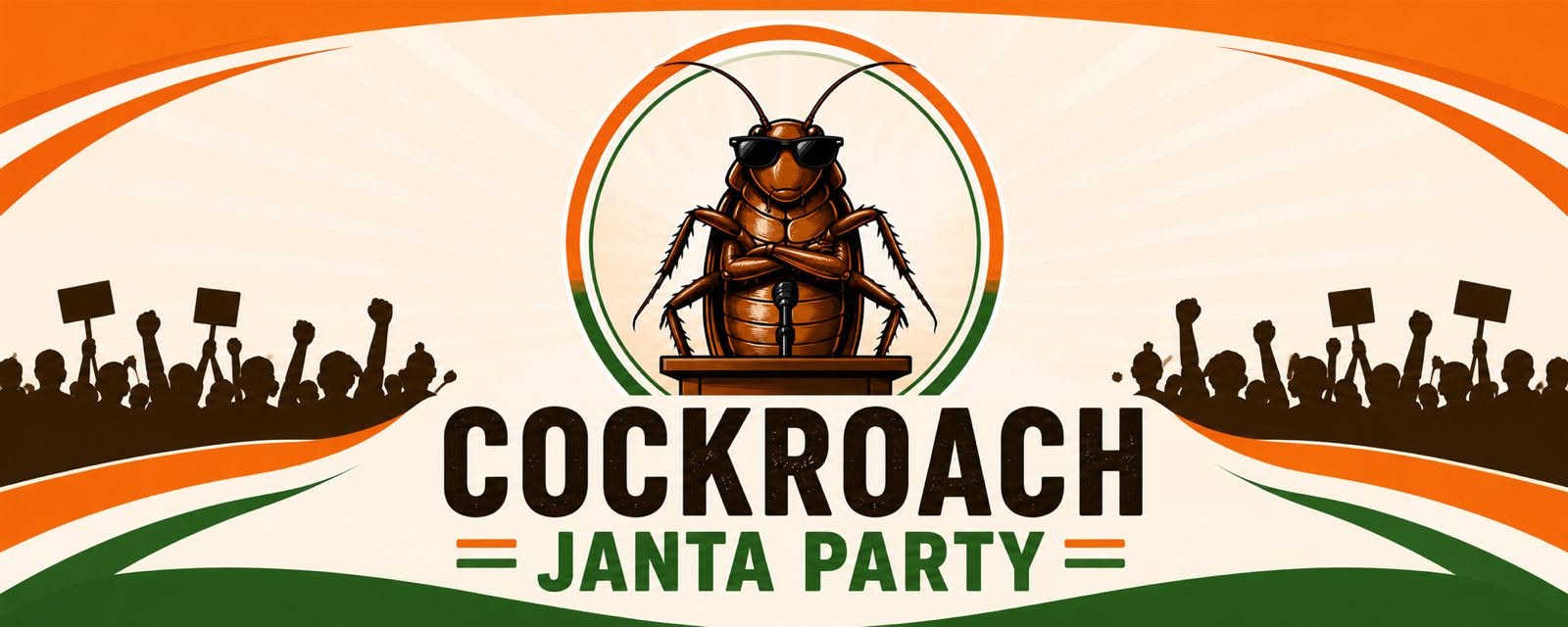
During a hearing, the Chief Justice described unemployed activists and critics of the state as “cockroaches” and “parasites of society.” The word choice mattered less for the offense it caused—democracies have absorbed uglier language and survived—than for what it briefly made visible: an unspoken hierarchy already hardening inside public life. On one side sat those who imagined themselves productive, rational, indispensable to the running of the country. On the other stood those who questioned them, now recast as irritants to be swept from the corners of the national household. The metaphor was meant to close an argument. Instead it opened one, because it named the very contempt that a healthy republic is supposed to keep out of its own mouth.
What happened next is the part worth studying closely, because it is where the essay’s real argument lives—not in the insult, but in what a society chose to do with it.
READ: Satish Jha | The tyranny of the immediate (July 25, 2026)
The insult was meant as dismissal. It was received as a flag.
Here it helps to be precise about a claim that is easy to assert and harder to earn: that ridicule is uniquely corrosive to power. The reason is structural, not sentimental. Repression can answer criticism with counter-argument, with force, with the machinery of the state; every one of those responses treats the critic as a serious adversary and thereby concedes the critic’s seriousness. Ridicule offers no such handhold. To answer mockery with force is to confirm the mockery; to ignore it is to let it spread; to laugh along is to surrender the dignity that authority depends on. Satirists have exploited this trap for three centuries—Swift dressing a famine policy as a modest recipe, Kraus turning a newspaper’s own sentences into its indictment, Havel writing a greengrocer’s window sign into a parable of complicity. None of them proposed a program. Each of them removed a regime’s ability to be taken at its own valuation.
The movement that formed around the cockroach remark worked by the same logic. Its cleverness was not a rival ideology; it was a refusal of the terms on offer. If the state insisted that frustrated young Indians were pests, then very well—they would be the most cheerful, most organized, most publicly delighted pests a democracy had ever produced. An insult accepted by millions at once stops functioning as an insult. Humiliation depends on isolation, on the private conviction that the shame is yours alone. Shared aloud and laughed at, it inverts: the shame migrates back to the one who issued it.
But satire without a grievance underneath it is only a pose, and this is where accounts of such movements usually go soft. So it is worth stating plainly what the wound actually was, because the joke had no force without it.
READ: Satish Jha | Between fear and confidence (July 8, 2026)
For a decade and more, India had been producing educated young people faster than it could produce dignified work for them. That gap is not an abstraction; it is a specific and grinding arithmetic. Families across the country poured their savings and their hopes into competitive examinations—for civil service posts, for teaching jobs, for railway and banking positions—that functioned as the recognized ladder out of precarity. The ladder held only so long as the examinations were trusted to be fair. When question papers began leaking before test dates, when results were annulled and re-held, when the bodies administering these exams lost the presumption of integrity, something more than a scheduling problem broke. The implicit contract of any meritocracy—that effort, honestly applied, yields a fair hearing—came apart in full view of the people who had staked their twenties on it.
At that point the cockroach stopped being a joke about a judge. It became the emblem of a cohort that had done everything asked of it—studied longer, waited longer, sacrificed more—only to learn that the institutions sitting in judgment had failed their own examination first. The metaphor fit because the humiliation was already there. The movement did not manufacture the anger; it gave the anger a shape it could recognize.
Movements turn historically consequential at the moment separate grievances discover they are the same grievance. That recognition needs carriers. It found two.
Sonam Wangchuk lent the protests something that slogans cannot generate on their own: the moral weight of a person willing to place his own body between conscience and power. His fasts and his record of putting himself at physical risk converted diffuse frustration into something with an ethical spine—resistance that could not be dismissed as mere appetite for disorder. Shabana Azmi supplied the other necessary element, which is memory. A democracy survives not only because it inherits institutions but because each generation inherits a tradition of dissent—a sense that this kind of standing-up has been done before and can be done again. The young brought the energy and the numbers. The older figures brought continuity and the reassurance that this was not a rupture but a renewal. Legitimacy tends to live in the space between the two.
READ: Satish Jha | The Proprietor and the Inheritance (July 6, 2026)
The state’s response followed a script so familiar it barely needs narrating: police action, administrative orders, warnings, the measured application of force. What governments reaching for that script rarely register is its central miscalculation. Force assumes that a crowd is a body, and that a dispersed body is a solved problem. But a movement of this kind is not primarily a body; it is information. Batons scatter the first; they accelerate the second. In an age when every phone is a press and every arrest arrives pre-packaged as an argument, each attempt to restore order tends to enlarge the audience for disorder. This is not a law of nature—repression has crushed movements before and will again—but it is a reliable trap for a government that mistakes visible calm for actual consent.
The concrete outcomes—examination reforms, resignations, procedural reviews—were real, and they mattered to the people they affected. But outcomes are the least durable part of any such episode. What outlasts them are the two things the episode revealed.
The first is that democratic opposition no longer waits on the machinery it once required. Parties, unions, printed manifestos—these still matter, but they are no longer the precondition for coordinated dissent. A shared symbol can now assemble a constituency faster than any organization could recruit one, and legitimacy can accumulate horizontally, among peers, before any institution recognizes it from above. This is a genuine shift, and it cuts both ways: the same mechanics that mobilize a movement for fair examinations can mobilize one for far uglier ends. The lesson is not that networks are virtuous. It is that they are fast, and that any power assuming it faces only slow, visible, organized opposition is preparing for the wrong fight.
The second revelation runs deeper, and it is the one worth carrying away from the whole affair. Republics do not usually collapse into something more authoritarian by abolishing their constitutions. They drift there by a subtler route: a governing class begins to treat electoral victory as a form of ownership. An election is a grant of authority for a term, conditional and revocable. It is not a transfer of title. The state does not become the property of those who win the right to administer it, and the moment a government starts behaving as though it does—as though citizens who object are trespassing on something that now belongs to the winners—it has begun, quietly, to stop being a republic in anything but name.
READ: Satish Jha | The Proprietor of the Void (July 5, 2026)
This is not, in the end, a story about one country or one court.
Every republic carries two competing pictures of itself, and the contest between them is never finally settled. In the first, citizens are the source from which all authority continuously flows, and office is a form of stewardship held in trust. In the second, citizens are friction—interruptions in the efficient exercise of power already secured. The vocabulary changes from era to era. The underlying argument does not.
That is why a single word from a single bench was worth this much attention. Not because ridicule won a debate, or embarrassed a government, or forced a few resignations—those are the outcomes, and outcomes fade. It was worth attention because it exposed something a healthy politics is supposed to keep hidden even from itself: the assumption that some of the governed are disposable. A democracy can withstand a great deal—disagreement, corruption, incompetence, even stretches of plain injustice. The one thing it cannot indefinitely withstand is a ruling class that forgets the equal dignity of the people in whose name it claims to act.
Power tends to assume that history belongs to those who command it.
It more often belongs to those who declined to be diminished.