



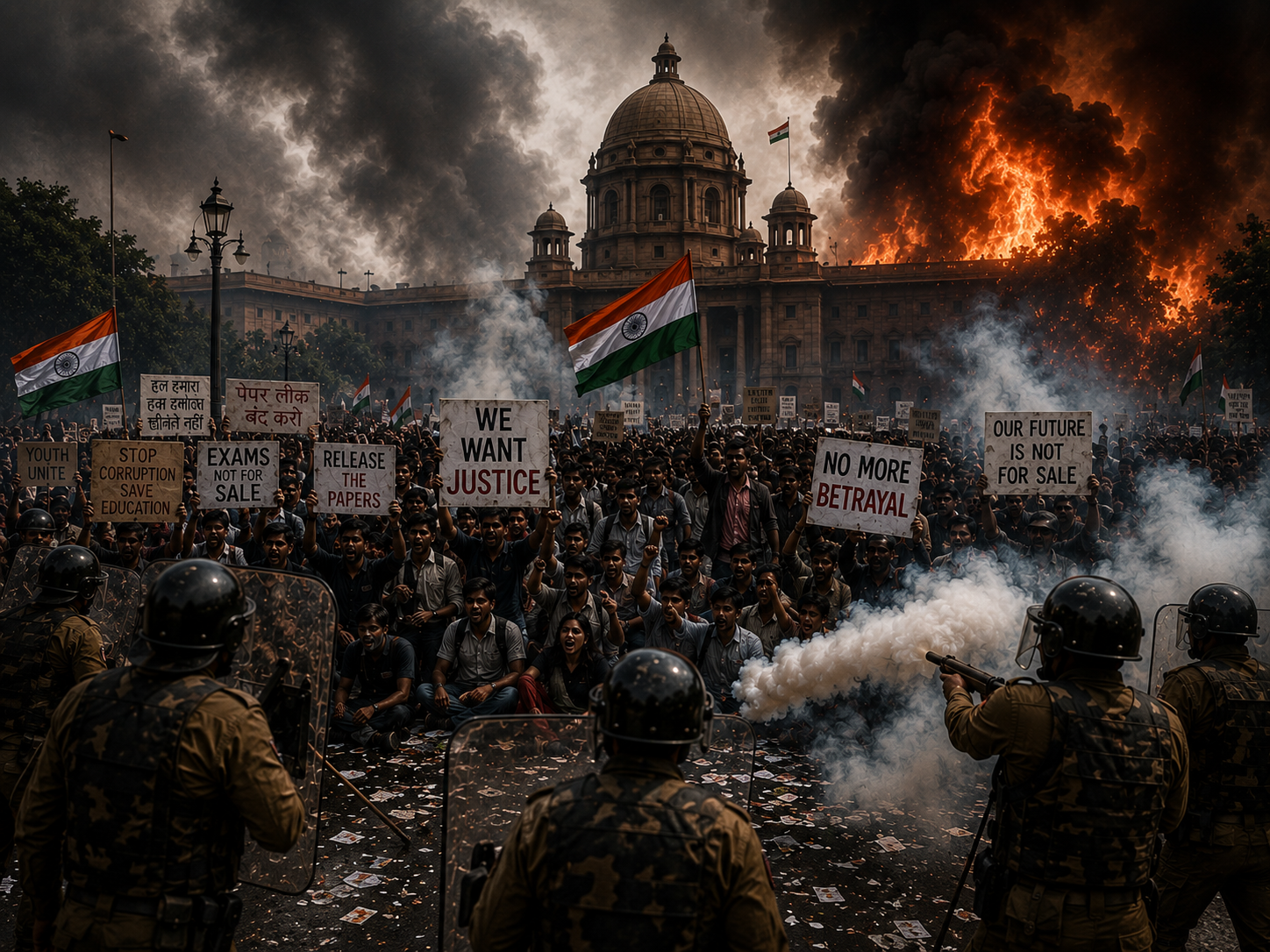
Whenever an institution of the Indian state catches fire, the smoke arrives on schedule. First comes the failure itself, which has usually been smoldering for years in the dark: a testing board quietly rotten, a question paper sold before it is printed, a policy handed down overnight to a country that was never consulted. Then the flame becomes visible, and visibility summons its crowd—students massed in the capital’s protest squares, tear gas thickening the summer air, hunger strikes, and an opposition that reads every institutional wound as a ballot already cast.
Last, arriving with the punctuality of the monsoon, comes the commentary: the essayists, the economists, the architects of policy and its dismantlers, each with a lens already polished and a remedy cut precisely to fit.
One discerns an autocratic state in a crisis of accountability—a government that has perfected the winning of elections and forgotten the keeping of institutions. Another sees the slow withdrawal of the state from its own constitutional obligations, austerity dressed as principle, the conversion of a right into a commodity. A third waves away talk of values as sentimental noise and insists the trouble is merely mechanical: a matter of plumbing, of the fatal friction between what schools produce and what employers will pay for. A fourth, from the altitude of global competition, marvels that a state can require classical languages of children destined for an economy run by machines, even as it proves unable to administer a single examination without theft. A fifth reduces the disaster to three nouns—communalization, commercialization, centralization—and calls for the dismantling of the testing agency and the head of the minister who runs it. A sixth defends the apparatus as an overdue decolonization of the national mind and detects behind the protests the hand of a coaching industry defending its franchise. Each is, within its own frame, correct. That is precisely the trouble.
READ: Satish Jha | Between fear and confidence (July 8, 2026)
The reader moves through these six positions in a single sitting, nodding at each, and rises with the warm sensation of having understood—having understood everything except why none of it will change.
For what these commentaries share is not a thesis but a target. All are aimed at the immediate: the leak, the decree, the crowd, the minister. All are aimed at effects. The intelligentsia has refined itself into an exquisite instrument for the description of symptoms, and the refinement itself has become the sedative.
A nation able to name its affliction in six competing registers feels no urgent need to be cured of it. The essay does not lead to reform. The essay is what the country does instead of reform. Look past the burning building to the thing that was built to burn.
Some years ago I described the Indian classroom by way of a plate. The child sits before an impossible abundance—dozens of subjects, three languages, a syllabus assembled as though schooling meant setting the entire inheritance of human knowledge before a ten-year-old at one sitting and calling the display nourishment.
The plate is heaped. It is also, in the only sense that matters, bare. No child alive can eat from it. What is served is not food but the image of food.
I called the book The Full Plate, believing I was describing a mistake. I was describing a solution.
The plate is not overloaded through carelessness. It is overloaded because a system that promises everything can be indicted for nothing. When a child emerges after twelve years unable to read a paragraph or carry a subtraction, there is no single broken vow to hold up to the light; every vow was made at once, and each dissolves into the others. Breadth is not generosity. Breadth is the smearing of responsibility across so many nominal promises that no failure can ever be traced to a source. What cannot be traced cannot be judged. The full plate is a ledger kept deliberately too complex to audit.
This is not incompetence. It is design functioning exactly as designed.
READ: Satish Jha | The Proprietor and the Inheritance (July 6, 2026)
That is the more frightening reading, because incompetence can be corrected. A working machine cannot be talked out of working.
See what the machine actually does. It has allowed the measuring of learning to be replaced almost entirely by the measuring of the examination—two things that were never the same and have now drifted so far apart that an entire economy lives in the space between them, selling the distance between passing and knowing. The examination becomes the only gate. Because it is the only gate, every force in the system converges upon it: the leaked paper, the impersonation racket, the cram school, the bought result.
The commentators who fix upon the stolen paper mistake the pressure for a flaw in the pipe. The pressure exists because the state has arranged for a single valve to bear the entire weight of a nation’s hope. It bursts not because something went wrong. It bursts because this is what a single valve under the weight of a civilization is designed to do.
I later argued that a state does not so much teach as learn. A state that cannot learn does not remain still. It rots. There is no third condition.
A learning state is one whose institutions digest failure, in which what goes wrong at the edge travels back to the center and alters the center itself. What we have instead is a performing state. The difference has ceased to be academic.
The performing state does not metabolize failure. It stages it. The paper leaks. The students gather. The apparatus awakens. But watch carefully what awakens: not the will to mend the pipe, only the will to manage the appearance of the pipe. Committees are announced. Ministers are defended or sacrificed. Agencies are dissolved and recreated under fresh names. The architecture remains untouched. The commentaries appear. The outrage expires. The machine resumes.
Nothing has been learned because learning was never its function. The performing state possesses no organ for turning visible failure into structural change. It possesses only an organ for converting visible failure into managed silence.
Yet this pathology is not uniquely Indian. Every mature bureaucracy discovers, sooner or later, that managing perception is cheaper than redesigning reality. Institutions everywhere learn to optimize what can be seen before they optimize what must be repaired. Governments measure announcements instead of outcomes. Universities measure credentials instead of learning. Corporations measure quarterly narratives instead of long-term capability. The technologies differ. The civilizational instinct does not.
Modern societies have become extraordinarily adept at manufacturing the appearance of adaptation while protecting the architecture that makes adaptation impossible. That is why intelligent societies repeat failures they have already explained. Explanation is mistaken for correction. Recognition is mistaken for reform. Awareness is mistaken for learning.
And so the brilliance of the commentary is not merely useless. It is load-bearing. The performing state requires, as one of its working parts, a class of minds capable of converting structural failures into self-contained episodes—controversies with an opening, a climax, and an exhaustion. The essay becomes the mechanism by which permanence masquerades as event. The sharper the analysis, the more effectively it drains public alarm into the safe reservoir of having been explained.
A country that has read six brilliant essays about failing examinations believes something has happened. Nothing has happened. The essays are the something. Their deepest function is to be mistaken for reform itself.
READ: Satish Jha | The Proprietor of the Void (July 5, 2026)
Nor would this matter so much were the world changing slowly. For generations the system’s mediocrity carried an accidental mercy: the poorly educated entered an economy changing at roughly the same pace. That mercy is ending.
Artificial intelligence does not merely reward excellence. It compounds it. One child learns to command machines. Another competes against them. They leave the same school carrying identical certificates and never again inhabit the same economic universe. The inequality is no longer gradual. It is geological. The cliff is cut long before society notices anyone has fallen. Here the argument closes. The full plate ensures responsibility cannot be located. The performing state ensures located failure cannot produce change. The commentariat ensures public outrage is spent on comprehension rather than demand. Three mechanisms. One machine.
Remove any one of them and the system may yet escape itself. Together they manufacture the indefinite postponement of reform.
But there remains one final question: Why do civilizations repeatedly build institutions that cannot learn? Perhaps because learning is expensive. To learn is to admit error. To admit error is to redistribute authority. To redistribute authority is to unsettle those who possess it. Every bureaucracy therefore discovers the same temptation: to optimize stability rather than truth. This is not an Indian temptation. It is a human one.
Civilizations do not decay because they stop producing intelligence. They decay because intelligence becomes increasingly devoted to explaining the world that exists instead of redesigning the world that ought to exist.
That is the tyranny of the immediate. Not that the urgent crowds out the important—every columnist already knows that sermon. The deeper tragedy is that institutions learn to manufacture urgency precisely so that importance remains permanently deferred.
The fire is not the emergency. The fire is the distraction. The emergency is the machine standing quietly behind the smoke—untroubled, admired, and perfected by every explanation that leaves it standing.