



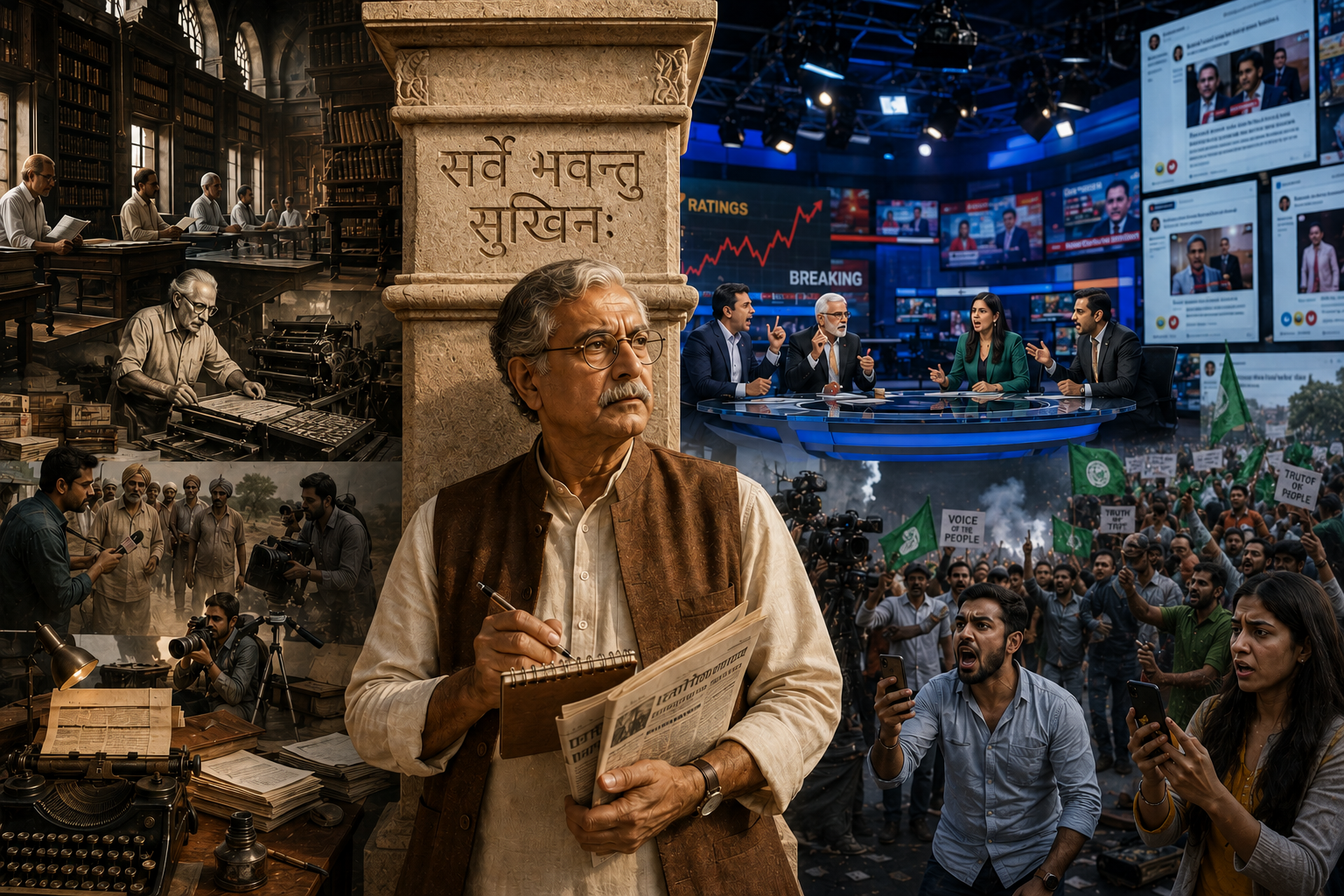
There is a prayer that every Indian child once learned. It is older than the Constitution, older than the idea of India as a nation state, older than every temple and mosque that has been fought over in the last thirty years. It goes like this:
Sarve bhavantu sukhinah.
Sarve santu niramayah.
Sarve bhadrani pashyantu.
Ma kashchid duhkhabhag bhavet.
May all beings be happy. May all beings be free from illness. May all see what is auspicious. May no one suffer.
This is the real Sanskar. Not the WhatsApp forwards. Not the prime time shouting. Not the cow vigilante with a lathi. Not the PhD who believes ancient India had aeroplanes. Not the Baba selling immunity booster capsules at five hundred rupees a bottle. This four-line prayer — inclusive, generous, asking for the wellbeing of all beings without exception — is what Indian civilization actually produced at its greatest.
Indian journalism had one job. To protect this civilization. To speak truth to the powerful. To hold the mirror up to the nation and say — here is what you are, here is what you promised to be, here is the distance between the two.
It failed. And the failure was not accidental. It was chosen. It was profitable. And it has cost India something it does not yet know how to measure.
The decline of Indian journalism is not a media story. It is a political story first. And the political story has a specific date.
December 6, 1992.
READ: The leaking bucket: India’s GDP rises as investment slips away (June
The day the Babri Masjid was demolished in Ayodhya, something broke in Indian public life that has not been repaired since. Not the mosque — though that too. What broke was the implicit contract of Indian democracy — that the state would protect every citizen equally, that the Constitution meant what it said, that the rule of law applied to mobs as well as to individuals.
The politicians who presided over the demolition — who looked away, who enabled, who later celebrated — discovered something intoxicating that day. That communal mobilization was the most powerful electoral tool in Indian history. That fear travels faster than hope. That a voter who is afraid of his neighbor will forget his empty stomach, his unemployed son, his unaffordable hospital bill, and vote for the man who promises to protect him from the threat next door.
This discovery did not stay with one party. It spread. Because in a democracy, if one party finds a winning formula, every other party must respond to it. The Congress tried secularism as a counter. It failed. Regional parties tried caste arithmetic. It partially worked. But the communal market — once created — never closed.
And Indian journalism, which should have been the immune system of democracy, looked at this market and saw not a disease to be diagnosed but an opportunity to be monetized.
The television explosion of the 1990s arrived at exactly the wrong moment.
Suddenly there were dozens of channels competing for the same eyeballs. Advertising revenue followed ratings. Ratings followed emotion. And nothing — nothing in the history of Indian broadcasting — generated emotion like Hindu-Muslim content.
A story about a mosque generated more views than a story about a school. A debate about beef generated more advertising revenue than a debate about unemployment. A screaming match about love jihad kept viewers on the channel through the commercial break. A careful analysis of agricultural policy did not.
The editors who understood this were not evil people. Most of them were intelligent, educated, professionally trained journalists who had grown up reading the greats — who admired Kuldeep Nayar, who had framed copies of the Indian Express blank editorial from the Emergency on their office walls. They knew what journalism was supposed to be.
They chose something else. Because something else paid better.
This is the original sin of Indian journalism. Not coercion. Choice. The government did not force Arnab Goswami to spend three hours a night questioning the patriotism of Muslims. The market rewarded him for it. Republic TV became the highest rated English news channel in India within months of launch. The lesson was learned by every news director in the country within a year.
The race to the bottom became the race for ratings. And the race for ratings became the race to generate the most fear, the most outrage, the most communal electricity per prime time hour.
But the damage went deeper than politics. Far deeper.
When a nation’s primary intellectual diet for thirty years is communal content — when the most watched, most shared, most discussed public discourse is about which religion is superior and which community is dangerous — it does not just poison politics. It poisons minds.
An entire generation of Indians has grown up in a media ecosystem that taught them the following things:
READ: The truth does change with a headline, Byju (May 27, 2026)
That the Muslim is the primary threat to India’s existence. That ancient India was scientifically superior to modern civilization. That questioning a Baba is an attack on Hindu culture. That Western medicine is colonial but cow urine is Ayurvedic. That critical thinking is Western arrogance. That Sanskar means defending the majority religion, not practicing universal compassion.
None of these things are true. All of them are profitable.
The Baba economy that has flourished in modern India is a direct product of journalism’s failure. When news channels give Baba Ramdev two hours of free prime time to denounce allopathic medicine, they are not covering religion. They are advertising a ₹30,000 crore business empire whose products — Patanjali noodles, Patanjali toothpaste, Patanjali immunity boosters — advertise on those same channels. The Baba is the content and the advertiser simultaneously. The channel profits twice.
Asaram Bapu had millions of followers, political protection from multiple state governments, and decades of media coverage that presented him as a spiritual leader — before he was finally convicted of rape. The journalists who interviewed him reverentially knew what they were doing. The producers who booked him knew the ratings he delivered. The system protected him not despite his crimes but while his crimes were ongoing, because his content was valuable and his political connections were useful.
This is not journalism. This is the demolition of the very civilization it claimed to protect.
And then there is the Sanskar PhD.
This is the figure that haunts modern India most. Not the uneducated villager who believes what he is told — he has been failed by the education system and cannot fairly be blamed for what he was never given. The Sanskar PhD is different. He has a degree from IIT or IIM or a foreign university. He speaks English fluently. He can cite research papers. He has traveled abroad. And he believes that ancient India had nuclear weapons, that Darwin was wrong, that astrology is a science, that the Muslim population is a demographic threat, that cow urine has medicinal properties that Western pharmaceutical companies are suppressing.
He is the product of thirty years of media that fed his pride while starving his critical faculties. He was told, every night on prime time television, that India’s greatness was ancient and that its enemies were internal. He was never told that greatness requires honesty. That civilization requires self-examination. That the prayer his grandmother taught him — Sarve bhavantu sukhinah, may all beings be happy — includes the Muslim next door and the Christian in the south and the Dalit in the village and the poor man on free ration and every human being on this earth without exception.
Nobody told him that. Because telling him that would not have sold advertising
The real Sanskar — the one that produced the Upanishads, the one that gave the world the concept of ahimsa, the one that built universities at Nalanda and Takshashila where students came from across Asia to learn — that Sanskar was built on inquiry. On questioning. On the fearless pursuit of truth regardless of where it led.
It was not built on protecting one community’s pride from another community’s existence.
Indian journalism’s greatest crime is not that it was captured by politicians or purchased by corporates — though both happened. Its greatest crime is that it took the most intellectually rich civilization in human history and fed it a diet of fear and pride until it forgot how to think.
The democracy declined because the politics became communal. The journalism declined because it monetized the communal politics. And the real Sanskar — the Sarve bhavantu sukhinah civilization — declined because journalism, which should have been its guardian, became its gravedigger.
There are journalists in India today doing real work. The Wire. Scroll. Newslaundry. Article 14. The Reporters Collective. Small, underfunded, legally harassed, algorithmically suppressed. They are the Indian Express of the Emergency era — publishing into the dark, not knowing if anyone is listening, doing it anyway because it is the only honest thing to do.
They are keeping the prayer alive.
But the prayer deserves more than a handful of brave journalists on shoe-string budgets. It deserves a media ecosystem that takes seriously what it means to speak to a civilization.
Sarve bhavantu sukhinah.
May all beings be happy.
Not some. Not the majority. Not the ones who watch our channel and share our content and generate our advertising revenue.
All.
That word — all — is the most radical, most demanding, most civilizationally serious word in the Indian tradition.
Indian journalism forgot it.
It needs to remember.
1 Comment
Mr Akhlaq, the core of his being, his soul, knows that he doesn’t believe in “Sarve bhavantu sukhinah”. A majority of British-indeoendenr India functioned as a Darbari media for Khangress. Vernacular media has had its own favourites including Urdu media.Has he opened his eyes only in 2014 and after. There are many journalists in the left / liberal ecosystem…who are cantankerous and cacophonous…who are more of a an ideologue than being objective…who have blemished the sanctified field of journalism through their persistent, manipulative and deceitful twist of facts, theough whataboutery and through condescension. The slogan he should learn to “satyameva jayate nānṛtaṃ”