



India received $90.8 billion in foreign direct investment last year.
That is a remarkable number. Thirteen percent higher than the year before. A three-year high when you strip out the accounting noise. Morgan Stanley — one of the most respected financial institutions on Wall Street — called the trend encouraging. The government called it validation. Indian Prime Minister Narendra Modi called it proof that India is riding a Reform Express toward destiny.
Nobody mentioned the other number.
Net FDI — the actual money that stayed in India after foreign companies took their profits home — was $0.5 billion.
Not $90 billion. Half a billion dollars. On a $4.5 trillion economy. A rounding error. An afterthought. The statistical equivalent of finding a ten rupee coin in the pocket of a suit that cost five lakh rupees.
This is the Morgan Stanley report that India’s financial press covered politely and India’s government did not cover at all. And it is the most important economic story in the country right now — because it tells you, in a single number, the difference between what India is and what India is performing.
Let us understand what these two numbers actually mean.
Gross FDI is the total money that foreign investors bring into India. It includes everything — new factories, acquisitions, joint ventures, private equity investments, venture capital. When an American tech company opens a data center in Hyderabad, that is gross FDI. When a European automaker buys a stake in an Indian manufacturer, that is gross FDI. The $90.8 billion represents all of this activity — and it is genuinely impressive.
Read more Akhlaq Siddiqi’s column : Fed, not freed: Can India sustain its own population? (June 5, 2026)
Net FDI is what remains after you subtract two things. First — repatriation, which is the money foreign companies take back out of India as profits, dividends, and capital returns. Second — outward FDI, which is Indian companies investing abroad.
Repatriation has stayed above $50 billion for the second consecutive year. Outward FDI by Indian companies increased to $35.8 billion — rising 2.6 times over the past two years.
Do the arithmetic. $90.8 billion comes in. More than $90 billion leaves. What stays — $0.5 billion.
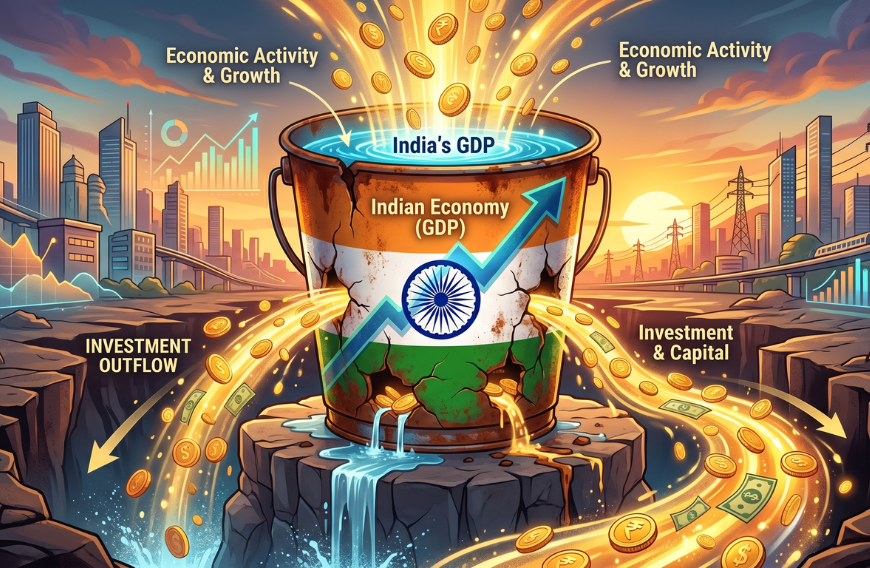
India is a bucket with a hole in the bottom. The tap is running impressively. The bucket is nearly empty.
The government will offer two defenses of this number. Both are partially true. Neither is sufficient.
Defense one — repatriation is a sign of confidence. When foreign companies take profits home, it means they made profits. Making profits means their Indian operations are successful. Successful operations attract more investment. The cycle is positive.
This is true as far as it goes. But it does not go far enough. The question is not whether foreign companies are profitable in India. The question is whether India is retaining enough of the value its economy generates to fund its own development. When more than $50 billion leaves the country as repatriation every year — that is $50 billion that does not build Indian hospitals, Indian schools, Indian infrastructure, Indian jobs.
Defense two — Indian companies investing abroad is a sign of maturity. India Inc is going global. Tata, Infosys, Wipro, Mahindra — Indian companies acquiring foreign assets and building global businesses. This is sophistication, not weakness.
Again — true as far as it goes. Indian companies investing abroad is genuinely a sign of economic confidence and capability. But when outward FDI rises 2.6 times in two years to $35.8 billion — the question must be asked. Is Indian capital going abroad because the opportunities abroad are better than the opportunities at home? Is the money leaving because the regulatory environment, the infrastructure, the rule of law, the ease of doing business in India is still not compelling enough to keep it here?
Read more Akhlaq Siddiqi’s column : The new East India Company has no ships (June 4, 2026)
When your own companies prefer to invest outside your borders — that is not a sign of maturity. That is a signal worth investigating seriously.
Now let us connect this to everything else.
Two weeks ago this column wrote about India being the fourth largest economy in the world — and simultaneously feeding 81 crore of its citizens for free because they cannot afford to buy grain. The GDP number is real. The hunger is real. Both are true simultaneously.
Last week this column wrote about the AI stock market bubble — Wall Street at all time highs, Dell up 234 percent, the Dow at 51,000. American investors are growing wealthy at an extraordinary speed.
And here is the connection nobody is making explicitly.
The sustained weakness in net FDI could increase reliance on volatile portfolio capital, impacting currency stability and external balance metrics.
Portfolio capital is the money that comes into India’s stock market — the foreign institutional investors buying Sensex and Nifty stocks. Unlike FDI — which builds factories and creates jobs — portfolio capital is hot money. It arrives when global markets are bullish and leaves the moment they turn nervous.
When the AI stock market bubble we wrote about last week eventually corrects — and all bubbles correct — that portfolio money will leave India faster than it arrived. The rupee will fall. Import costs will rise. Petrol prices — already hiked four times in two weeks — will rise further. Gold — already at one and a half lakh rupees per ten grams — will become even more unaffordable for the families saving for a daughter’s wedding.
The $0.5 billion net FDI number is not just an accounting curiosity. It is the indicator that India’s growth story, as currently constructed, is more dependent on volatile external capital than its government acknowledges. And volatile external capital has a way of leaving at exactly the moment it is needed most.
India’s Prime Minister recently described the country as riding a Reform Express. The metaphor is vivid. The Reform Express is real — infrastructure has improved, digital payments have transformed commerce, the GST has rationalized taxation, production-linked incentive schemes are attracting manufacturing investment.
But a Reform Express needs passengers.
The passenger that India needs most is long-term productive capital — money that comes to build, to employ, to manufacture, to create the jobs that 81 crore people on free ration are waiting for. Not money that comes to buy stocks and leaves when the market turns. Not money that builds a data center and repatriates its profits. Real, sticky, job-creating, factory-building, supply-chain-developing capital.
Net FDI at $0.5 billion means that for all the impressive gross inflows, India is not yet retaining the long-term productive capital it needs. The services sector dominates. Manufacturing is diversifying — automobiles and electronics showing promise — but not yet at the scale that absorbs the workforce India needs to absorb.
The Reform Express is running. The question is whether it is taking the right passengers to the right destination — or whether it is a very impressive train that most Indians are watching from the platform.
Here is the most uncomfortable implication of the Morgan Stanley report.
India’s government has, in recent years, made political stability its primary selling point to foreign investors. The argument is — Modi wins elections, coalition is stable, policy is predictable, invest with confidence. The BJP’s historic victory in West Bengal last month was presented partly as an investor confidence signal — political certainty translates to economic certainty.
Read more Akhlaq Siddiqi’s column : Eid Mubarak, if they let you (May 28, 2026)
But the $0.5 billion net FDI number suggests that political certainty alone is not enough. Investors need more than a stable government. They need a predictable legal system. They need land acquisition that does not take decades. They need labour laws that allow flexibility. They need regulatory clarity that does not shift overnight. They need an environment where if something goes wrong they can seek remedy in a court that functions on a reasonable timeline.
Political stability is necessary. It is not sufficient.
The bucket needs more than an impressive tap. It needs the hole in the bottom fixed.
India is the fourth largest economy in the world. It received $90.8 billion in gross FDI last year. Its stock market is near record highs. Its Prime Minister is winning elections across the country.
And $0.5 billion of actual investment stayed.
The tap is running. The bucket is leaking.
Until someone fixes the bucket — the Reform Express will keep running, the speeches will keep coming, the GDP rankings will keep improving, and the 81 crore on free ration will keep waiting for the prosperity that the numbers say must surely be arriving any day now.
It is not arriving.
Not at $0.5 billion net FDI per year.
Not in a leaking bucket.