



By Yash Patel
More than half a century after her passing, Madhubala continues to inspire not only audiences, but also artists who seek to understand the woman behind one of Indian cinema’s most enduring legends.
Her smile remains instantly recognizable. Her performances continue to be celebrated. Her songs still echo across radio stations, streaming platforms, family gatherings, and film festivals.
Yet somewhere between admiration and memory, something often disappears.
The person.
When audiences remember Madhubala today, they often remember an icon. Far fewer remember Mumtaz Jehan Begum Dehlavi the young girl who entered films to support her family, the artist who became one of Indian cinema’s brightest stars, and the woman whose life was marked by extraordinary success, personal sacrifice, fragile health, and remarkable resilience.
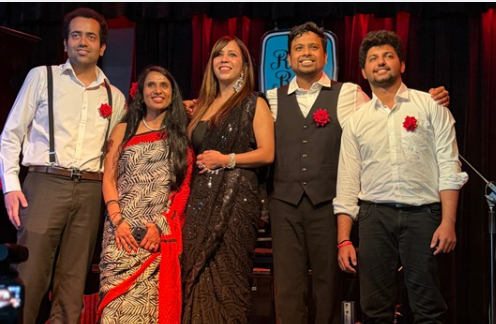
That realization eventually inspired Soul Jam, a Seattle-based artistic initiative founded by Yash Patel and Arunima Agarwal. One of its earliest productions, “Soul Jam Madhubala: The Shadows Behind the Spotlight,” asked a simple but profound question: “Can India cinema heritage be experienced rather than simply remembered?”
For us, Soul Jam begins where nostalgia ends. It invites audiences not only to remember India’s cultural icons, but to meet the people behind them.
From Film Appreciation to Film Heritage
Classic Indian retro cinema has never disappeared from the Indian diaspora.
Whether through family VHS collections, DVDs, YouTube clips, streaming platforms, or anniversary screenings, films continue to travel wherever Indian communities settle.
What often fades, however, is historical context.
The lives behind the films.
The creative struggles.
The cultural environment.
The artistic collaborations that transformed cinema into history.
Without context, heritage gradually becomes nostalgia.
With context, it becomes understanding.
Started in Seattle by Patel and Agarwal, Soul Jam combines historical research, storytelling, live acoustic music, poetry, shayari, and thoughtfully designed sensory experiences to reconnect audiences with the real-life stories behind India’s cultural legacy.
Its purpose is not to recreate cinema.
READ: Kumail Nanjiani, Lilly Singh join ‘Deli Boys’ Season 2 as it challenges South Asian stereotypes (April 28, 2026)
It is to deepen our relationship with it.
An Artist-Led Exploration
Although I founded Soul Jam with Arunima Agarwal, the initiative has always been rooted in artistic collaboration rather than individual performance.
For “Soul Jam Madhubala: The Shadows Behind the Spotlight,” Arunima, Nikita, and I spent months researching Madhubala’s life, films, cinematography, music, biographies, interviews, and the social and cultural context surrounding her extraordinary journey. Together, we immersed ourselves in understanding not only the legendary actress remembered by generations, but also the woman behind the icon, her dreams, struggles, relationships, artistic evolution, and the circumstances that shaped her remarkable life.
Building upon that shared research, I conceptualized the overall musical narrative, composed and arranged the musical journey, directed the production, and carefully wove melodies around Nikita Singh’s storytelling so that every song became an emotional continuation of the narrative rather than a standalone musical performance.
Performing live throughout the evening alongside Nikita’s narration became one of the most meaningful aspects of this Soul Jam production. Music was never intended to interrupt the story; it became another voice within it, expressing emotions that words alone could not.
While our months of research shaped the historical and emotional foundation of the production, Arunima also envisioned the audience experience beyond the stage. She thoughtfully designed the subtle sensory elements that transformed the performance into an intimate journey. From visual aesthetics and décor to carefully curated fragrances, flavors, lighting, and interactive details, every element was intended to help audiences feel emotionally present rather than simply watch a performance. Her ability to translate research into atmosphere became one of Soul Jam’s defining strengths, reminding us that meaningful storytelling can engage not only through sound, but also through memory, atmosphere, and shared human experience.
Why Madhubala?
During the early planning of Soul Jam, our collaborator Nikita Singh suggested exploring Madhubala’s real-life story. The idea immediately resonated with us and naturally became the first presentation in Soul Jam’s Indian Cultural Icons Series.
Madhubala’s cinematic legacy is universally celebrated.
Her personal journey deserves equal attention.
Over several months, Arunima, Nikita, and I immersed ourselves in biographies, historical accounts, interviews, films, cinematography, songs, and archival material to better understand both Madhubala’s artistic legacy and her deeply personal journey. Our goal was never simply to recount historical events, but to understand the emotions, relationships, and experiences that shaped the woman behind the screen.
The resulting production did not attempt to chronologically narrate her filmography.
Instead, it invited audiences to encounter the emotional landscape of her life.
Songs were never selected simply because they were popular. Every composition was carefully chosen to reflect a particular chapter of Madhubala’s journey, allowing familiar melodies to take on entirely new emotional meaning once audiences understood the story surrounding them.
Nikita’s storytelling provided historical context. Her original poetry and shayari reflected the emotional transitions within Madhubala’s life.
Live acoustic performances by Soul Jam’s musicians connected audiences directly to that era without relying solely on recorded nostalgia.
The objective was simple: Allow audiences to pause, be present in the moment, and experience Madhubala as a human being before remembering her as a legend.
A Collaborative Exploration of Retro Cinema
One of Soul Jam’s defining characteristics is that every collaborator approaches Indian retro cinema from a different perspective.
Our storyteller, Nikita Singh, whose childhood bedroom displayed a black-and-white poster of Madhubala, spent years wondering about the woman behind the celebrated image. Growing up, she often found herself staring at that poster and asking who the woman behind that unforgettable smile really was. Years later, Soul Jam finally became the platform through which she could answer that childhood question.
Pianist Aman Mahajan brought an emotional sensitivity shaped by his own rediscovery of music during the COVID-19 pandemic. His belief that music communicates beyond language helped shape the production’s intimate atmosphere, proving that emotion often reaches audiences long before words do.
Classically trained tabla artist Yash Malpathak contributed the discipline and depth of Hindustani classical traditions, demonstrating how classical rhythm could enrich narrative-driven musical storytelling without overwhelming it.
What united the entire team was months of shared curiosity. Research discussions often extended beyond rehearsals, exploring everything from the visual language of Indian cinema’s golden age and the evolution of Hindi film music to Madhubala’s performances, relationships, and artistic legacy. Those conversations became as much a part of the production as the music itself.
Together, the artists approached Madhubala not as a distant historical figure, but as a shared cultural inheritance.
Heritage as a Living Conversation
Perhaps one of the greatest challenges facing cinema heritage today is that preservation is often associated only with restoration.
Restoring prints.
Digitizing archives.
Cataloguing memorabilia.
These efforts are indispensable.
But preservation also requires continued engagement.
Every generation must find its own language for understanding the past.
For younger audiences raised outside India, classic cinema can sometimes feel historically distant despite its cultural significance.
Immersive storytelling offers another pathway into that history.
Instead of asking audiences to admire a restored film, it invites them to emotionally inhabit the world from which that film emerged.
In that sense, artistic reinterpretation complements archival preservation.
One protects the material legacy.
The other renews the emotional connection.
Both are essential.
Cinema has always been more than entertainment. It preserves language, music, literature, fashion, architecture, and the social history of its time. Revisiting the lives of cinema’s artists therefore becomes an act of preserving much more than film, it becomes a way of preserving the cultural memory of an era.
Seattle, thousands of miles from Bombay
Perhaps the most remarkable aspect of Soul Jam is not the production itself but its location.
Thousands of miles from the studios where Madhubala once worked, a community of Indian artists gathered in Seattle to celebrate her legacy through live performance.
Together with co-founder Arunima Agarwal, the artists spend their weekdays as software engineers, project managers, researchers, and technology professionals.
Yet beyond their professions, they remain storytellers, musicians, dancers, theatre artists, and custodians of cultural memory.
READ: Christopher Nolan, Tom Holland surprise Mumbai with chai stop (July 12, 2026)
The sold-out audience demonstrated that geography does not diminish cultural memory.
If anything, distance often strengthens the desire to reconnect with it.
Looking Forward
“Soul Jam Madhubala: The Shadows Behind the Spotlight” was never created as a one-time tribute. It became the first chapter in Soul Jam’s larger vision of bringing India’s cultural heritage to life through immersive storytelling.
India’s cinematic legacy extends far beyond its films. It lives in the lives of actors, musicians, lyricists, writers, filmmakers, and countless artists whose work continues to shape generations. While archives and restoration preserve the films themselves, there is also a need to preserve the emotions, human stories, and creative journeys behind them.
That is the space Soul Jam hopes to explore.
Each future production will begin with research, shaped by collaboration, and brought to life through storytelling, live music, poetry, shayari, and thoughtfully curated sensory experiences that invite audiences to slow down, reflect, and connect personally with the stories being told. The subjects will change, the artistic expressions will evolve, and new collaborators will bring fresh perspectives, but the purpose will remain the same: to transform cultural memory into a living, shared experience.
Cinema heritage is not sustained by archives alone. It survives because people continue asking questions.
Who were these artists?
What shaped their work?
Why do their stories still matter today?
Those questions have inspired historians, archivists, and filmmakers for decades.
Today, they are also inspiring musicians, storytellers, and artists across the world.
Perhaps that is the greatest tribute we can offer the pioneers of Indian cinema not simply remembering their films, but ensuring that the remarkable lives behind those films continue to be discovered, understood, experienced, and shared by every new generation.
(Yash Patel is a Seattle-based musician and one of the creators of Soul Jam, an independent artistic initiative combining live music, storytelling, poetry, and contemporary acoustic arrangements to bring the lives of Indian cultural icons to new audiences.)