



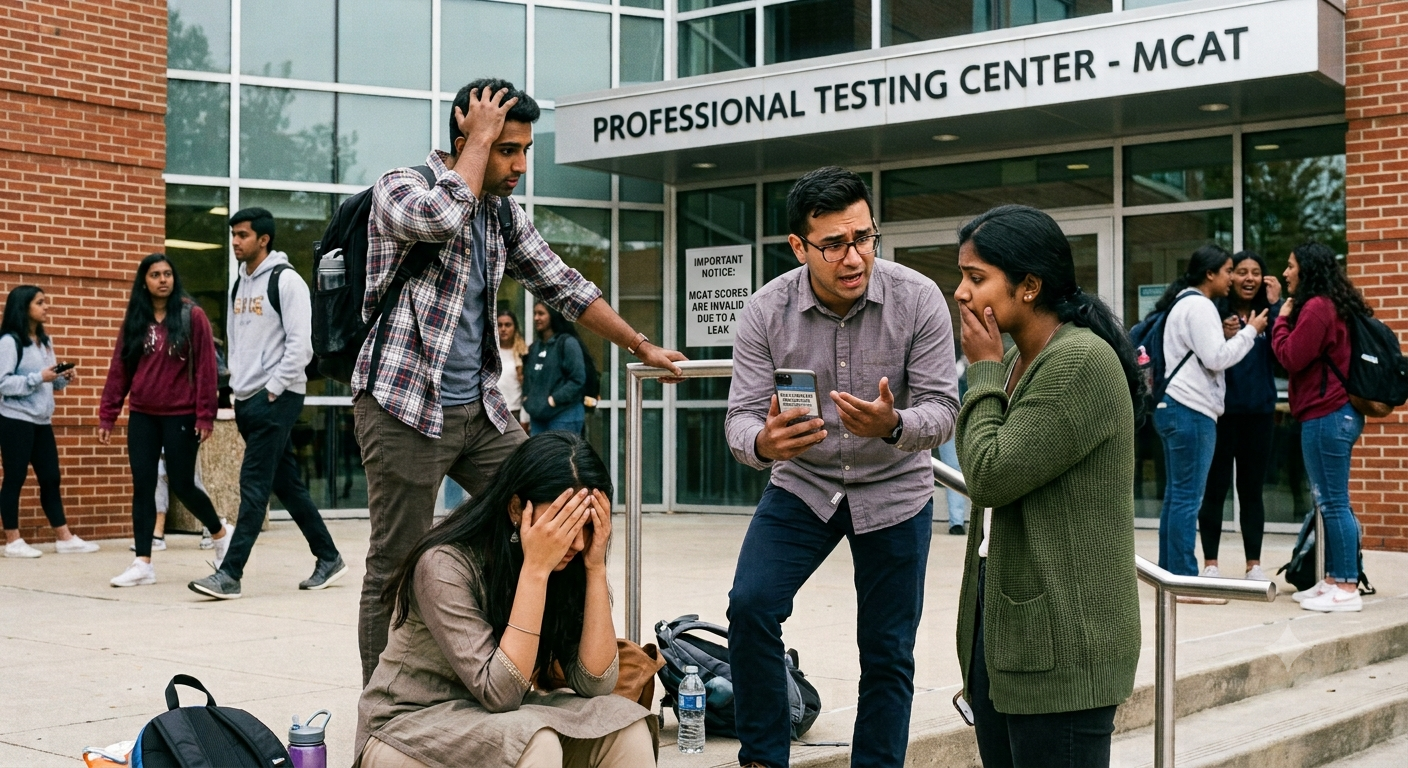
Would Indian students studying in America tolerate the MCAT being leaked and their scores being invalidated through no fault of their own? The answer is obvious. If thousands of American students spent years preparing for the examination that determines their entry into medical school, sacrificed their time and resources, earned scores that reflected their hard work and then discovered that the examination had been compromised by a leak, there would be an enormous public outcry.
The idea that students who had followed the rules should simply accept the loss of a year or more of their lives because someone else had corrupted the system would be considered unacceptable.
And importantly The MCAT exam for medical school admissions has never been leaked.
Yet in India, this has become an increasingly familiar story.
India is a country that prides itself on education, and with good reason. The country has produced extraordinary doctors, engineers, scientists, entrepreneurs and technologists who have made important contributions not only within India but throughout the world. Indian physicians have become an essential part of the American healthcare system, while Indian engineers and technology professionals have helped build some of the most important companies and technologies of the modern era.
The success of these individuals reflects the extraordinary talent that exists within India, but it also raises an uncomfortable question about how many talented young people never receive the opportunity to fulfill their potential because the system designed to identify merit fails them.
For millions of Indian students, a single examination can determine the direction of an entire life. Students spend years preparing for highly competitive examinations while families invest enormous financial resources and young people sacrifice their adolescence in coaching centers, classrooms and libraries. They are told that if they work hard enough, their effort will eventually be rewarded and that education is the pathway to opportunity
READ: Sreedhar Potarazu | AI is burning through free cash flow (July 25, 2026)
Then the examination is leaked, the integrity of the process is compromised and the students who followed the rules are often the ones who suffer the consequences.
I know individuals who passed medical entrance examinations with high scores only to have their results nullified because of an examination leak. They had worked tirelessly, competed honestly and earned their scores, yet the failure of the system effectively erased years of their lives. Some eventually abandoned medicine altogether and chose entirely different professions. We should not underestimate what that means. When a young person has spent years preparing for a career and is then told that the opportunity has disappeared because of corruption that had nothing to do with them, the consequences extend far beyond a delayed examination.
. The real cost is measured in lost years, opportunities and faith in the idea that hard work matters. In a country where academic success can determine not only a student’s future but also the economic future of an entire family, the consequences can be devastating.
The tragic reality is that the pressure created by this system has also contributed to the loss of young lives by suicide , leaving families to mourn children who had been told that their education was their pathway to a better future.This is why the scenes on the streets of India are so heartbreaking.
India’s Gen Z is increasingly unwilling to accept that corruption, opacity and institutional failure should simply be considered part of the cost of pursuing an education. The recent protests have demonstrated that this generation is prepared to challenge a system that has too often demanded sacrifice from students while failing to accept responsibility when the system itself breaks down.
READ: Sreedhar Potarazu | Chatbots can Auto-Tune our minds and voice: The Maya of AI (July 21, 2026)
A youth movement that grew from online activism into a powerful protest movement ultimately forced a major political concession from the government, including the resignation of Education Minister Dharmendra Pradhan and agreement to other demands, including compensation for families of students whose deaths were linked to the examination crisis.
The origins of the movement are almost as remarkable as its growth. The Cockroach Janta Party began as satire after a remark comparing unemployed young people and critics of the government to “cockroaches” and “parasites.” Rather than retreat from the insult, activist Abhijeet Dipke turned it into a political identity, asking what might happen if all the so-called cockroaches came together. What began as an online joke quickly evolved into a youth movement that connected anger over examination leaks with broader frustration over unemployment, economic opportunity and government accountability.
The symbolism was powerful because the cockroach is difficult to eliminate, survives adverse conditions and keeps reappearing, an unlikely metaphor for a generation that increasingly believes it has been ignored but refuses to disappear.
The role of activist Sonam Wangchuk, whose hunger strike helped galvanize attention around the demands of young protesters, also illustrates the broader significance of this moment.
India wants to compete with the United States and China in artificial intelligence and become one of the world’s leading technology and innovation economies. It wants to develop advanced research capabilities, build globally important companies and take advantage of the extraordinary talent within its population. However, there is a fundamental relationship between education and innovation that cannot be ignored.
Artificial intelligence is built on talent and education depends on trust. If students do not believe that the education system rewards merit, then India is weakening the very foundation upon which its future technological ambitions depend.
READ: Sreedhar Potarazu | China’s open weight could break the trillion-dollar AI model (July 18, 2026)
The integrity of the education system is therefore not a luxury for India. It is a prerequisite.
A country cannot seriously aspire to lead the world in artificial intelligence while allowing examination papers to become commodities in a criminal marketplace. The student who cheats should face consequences, as should the person who leaks an examination, the official who facilitates the leak and the middleman who turns examination corruption into a business. What should not happen is that the student who studied honestly becomes the person who pays the price for the failure of the system.
However, protest alone will not be enough. The collective energy now visible on the streets of India needs to be converted into reform, opportunity and growth. Young people should not simply be heard when they are angry; they should be included in the process of designing the systems that will determine their future.
India needs an examination system designed for the digital age, with strong cybersecurity, transparent procedures, independent oversight and meaningful accountability. Students need to know that the examination they are taking is the same examination being taken by everyone else and that the results will not be discarded because institutions failed to protect the integrity of the process.
The United States has benefited enormously from the talent produced by India’s education system, but India should not have to lose its best young people to other countries simply because its own systems failed to give them a fair opportunity. A country that wants to lead in artificial intelligence must understand that its most important resource is not simply its population, its capital or its infrastructure. Its most important resource is the ability to identify, develop and reward talent.
The country that prides itself on education can do better. The country that wants to lead in artificial intelligence must do better. The country that sends doctors, engineers and scientists to the rest of the world must do better for the students who made that success possible.
India’s future should be determined by talent, effort and opportunity, not by who can obtain an examination paper before everyone else.