



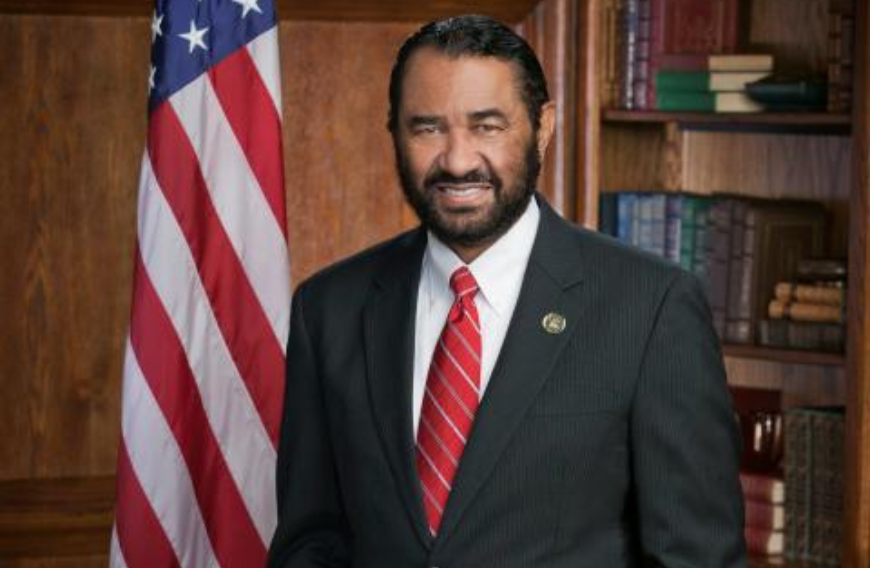
President Donald Trump was confronted by Democratic Representative Al Green during his State of the Union address. Green said he confronted Trump at his State of the Union speech over a “deplorable” video on the Republican’s social media account earlier this month depicting former President Barack Obama and his wife Michelle Obama as apes.
“I wanted him to know that portraying President Obama and First Lady Obama as members of the primate family is not only unacceptable, it is something that is deplorable and something we will not tolerate,” Green said in an interview with Reuters in the Capitol after being ejected from Trump’s speech.
As Trump entered the House chamber, Green, of Texas, unfurled a white sign that read: “Black people aren’t apes.” The White House eventually took down the video and Trump said a staffer had posted it.
READ: Trump touts ‘golden age of America’ in State of the Union address (
“Judging from the look on his face that he turned away quickly, he was at a moment of vulnerability because he’s not confronted by people who are willing to speak truth to him,” Green said.
Who is Democratic Rep. Al Green?
Al Green is an American lawyer and Democratic politician who has represented Texas’s 9th Congressional District in the U.S. House of Representatives since 2005. His district includes parts of Houston and surrounding communities. Born on Sept. 1, 1947, in New Orleans, Louisiana, Green later moved to Texas, where he built a career in law and public service.
Before being elected to Congress, Green served for 26 years as a justice of the peace in Harris County, Texas. He was also president of the Houston branch of the National Association for the Advancement of Colored People (NAACP), where he focused on civil rights advocacy, voter engagement, and economic equality initiatives.
In Congress, Green has worked on issues including affordable housing, financial regulation, civil rights, healthcare access, and disaster recovery. He has served on the House Financial Services Committee, where he has focused on banking oversight, housing policy, and consumer protection.
Green gained national attention as one of the earliest members of Congress to call for the impeachment of President Trump during his first term. Known for his outspoken style, he has remained an active and sometimes controversial voice within the Democratic caucus.
READ: Ro Khanna to bring Epstein survivor to Trump’s State of the Union address (
Public confrontations during major national addresses are rare and tend to reflect deeper tensions beyond a single moment or incident. When disputes involve race, historical symbolism, and the conduct of public officials, they often resonate far beyond the chamber where they occur.
The situation underscores how political disagreements today frequently extend into social media, where messages — whether intentional or posted by staff — can quickly spark national controversy.
It also illustrates how elected officials sometimes use high-visibility events to draw attention to issues they believe require immediate moral or public accountability. Such actions can carry political risk, including formal reprimand or removal from proceedings, but they may also amplify a message to a wider audience.