



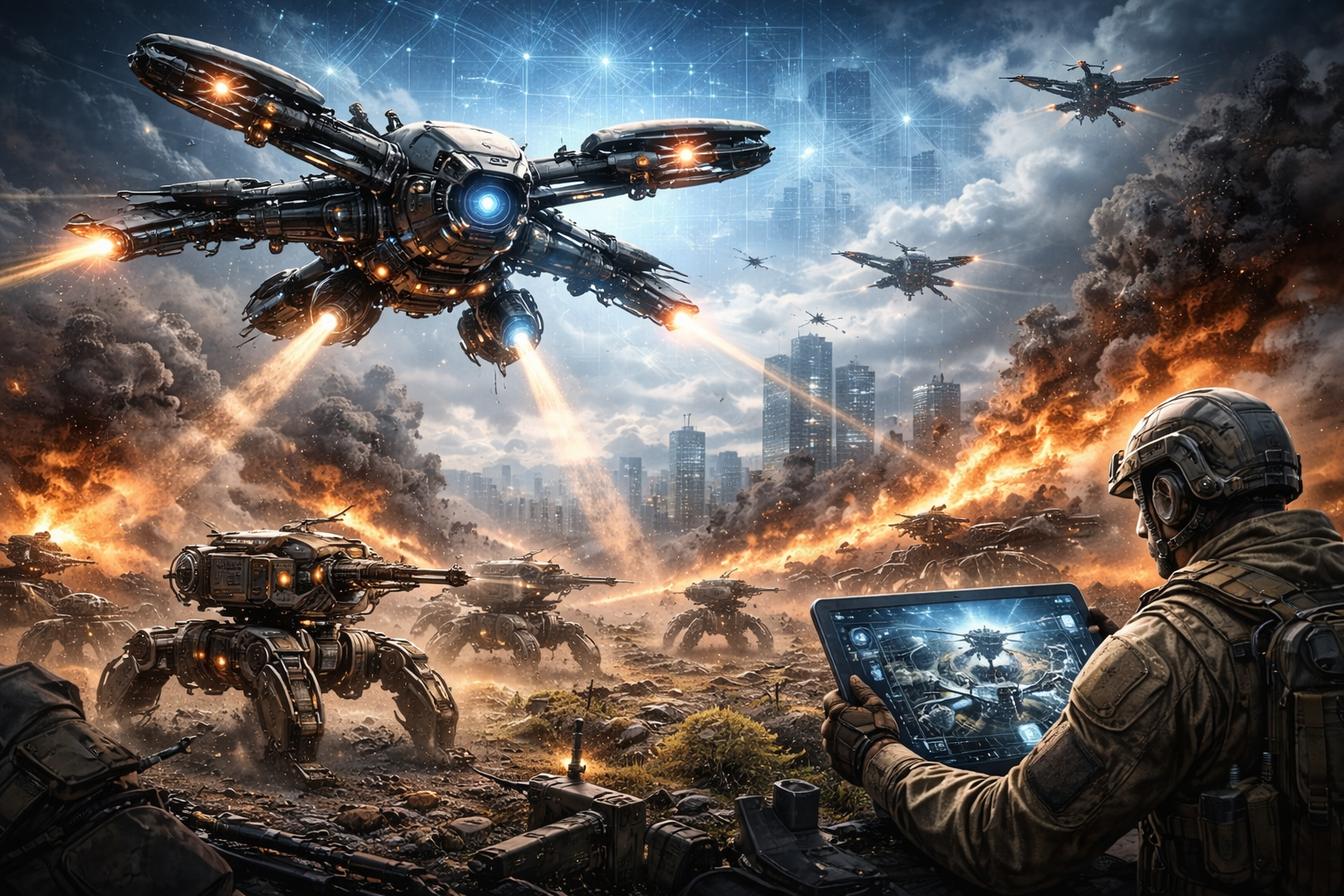
As an ophthalmologist and technology commentator, I have been intrigued by how artificial intelligence and computer vision are transforming drone capabilities and reshaping modern warfare.
In the new era of war, the decisive edge belongs not just to the biggest bombers or stealth fighters, but to drones that can see and act with superhuman precision.
Unmanned aerial vehicles, once simple airborne cameras, have become autonomous warriors whose vision systems, powered by artificial intelligence (AI), define strategy, tactics, and geopolitical tactics. Nowhere is this transformation starker than in the ongoing Iran conflict, where drones are flooding the airspace. AI-powered vision, and autonomous targeting have turned the sky into a contested battlefield.
READ: Sreedhar| Who’s making money from your data in dynamic pricing (March 6, 2026)
Drones have evolved from simple remote-controlled devices to sophisticated autonomous platforms, with vision at the core of this transformation. Early experiments in unmanned flight, from Austrian explosive balloons in 1849 to the World War I Kettering Bug and later mass-produced radio-controlled aircraft like the Radioplane OQ-2, laid the groundwork for modern aerial systems.
By the 1970s, platforms like Israel’s Tadiran Mastiff demonstrated the potential of real-time video surveillance, and today drones operate across civilian and military domains. Vision has shifted drones from passive cameras into intelligent agents capable of interpreting their surroundings, making decisions, and performing complex missions.
The integration of AI and computer vision has revolutionized drone capabilities. Modern drones can autonomously avoid collisions, detect and track objects, navigate complex environments, and create 3D maps for mission planning. In military contexts, these vision systems enable real-time reconnaissance, target identification, adaptive mission execution, and swarm tactics that overwhelm defenses. By combining rapid data processing with autonomous decision-making, drones now extend human perception, operate in hazardous conditions, and perform tasks that would be impossible or extremely risky for human operators.
Human vision is extraordinarily sophisticated. It adapts instantly to varying light conditions, interprets depth and motion, and integrates context, memory, and experience to recognize patterns and make rapid decisions. Soldiers spotting camouflage, pilots navigating shifting terrain, or commanders assessing intent rely on these faculties every day.
Drone vision, in contrast, is engineered for speed, scale, and consistency. Modern drones use AI-powered systems combining high-resolution cameras, infrared sensors, and sometimes LIDAR to capture visual data. Neural networks analyze this information in real time, detecting objects, calculating movement, and predicting hazards.
Unlike humans, drones can track hundreds of objects simultaneously, operate in total darkness or inclement weather, and process inputs in milliseconds. While humans excel at interpretation, drones dominate in relentless detection and rapid reaction.
READ: Sreedhar Potarazu | India’s AI content crackdown: Why it matters to Big Tech and the US (February 10, 2026)
At the core of today’s military drones is computer vision. Cameras, infrared sensors, and LIDAR feed streams of visual data into convolutional neural networks (CNNs) and other AI models that classify targets, estimate distances, and prioritize threats. This data is fused to create three-dimensional maps for navigation, obstacle avoidance, and autonomous target tracking. In conflict zones like Iran, this allows drones to detect incoming threats, evade counter-fire, and hunt other drones with minimal human oversight. Unlike human eyes, which interpret context and cues, drone AI converts raw pixels into actionable intelligence at speeds humans cannot match.
Iran’s use of low-cost attack drones in swarms has challenged traditional U.S. and allied air defenses. These drones exploit the saturation tactic: hundreds of cheap, autonomous drones with vision systems can overwhelm radar and missile batteries, forcing expensive interceptors to neutralize relatively inexpensive threats. This has prompted the U.S. and Gulf allies to adopt AI-powered interceptors and collaborate with Ukraine, which pioneered similar drone countermeasures during its conflict with Russia. Expertise from Ukraine is now in high demand as nations scramble to defend against Iran’s swarm drone tactics. Drone vision is no longer just reconnaissance; it is a force multiplier, a shield, and a weapon all in one.
Can drones identify mosques and schools to avoid?
Despite the sophistication of AI-powered drone vision, humans remain critical. Human perception brings context, ethical reasoning, and intuition that machines cannot replicate. Commanders must still interpret intent, weigh collateral impact, and make strategic decisions. However, drones increasingly blur the line: AI vision enables autonomous detection, tracking, and engagement, performing in milliseconds what would take humans much longer. The result is a battlefield where seeing first and acting fastest can decisively alter outcomes.
Current drones that rely on computer vision and machine learning still struggle with context and interpretation, which is where the biggest limitations of today’s learning models appear. AI systems are very good at recognizing visual patterns, but they often lack deeper understanding of meaning, intent, and cultural context.
For example, a neural network trained to identify buildings might classify structures based on shapes, rooftops, or entrances, but a school, mosque, temple, hospital, or apartment complex can look visually similar from the air. Without additional contextual data—such as signage, activity patterns, location information, or human oversight—the model may misclassify the building. This is especially true when training data is limited or biased toward certain architectural styles.
Another limitation is that AI models struggle with generalization and ambiguity. Many vision systems are trained on large datasets, but those datasets may not include the diversity of buildings, cultural architecture, or real-world conditions found in conflict zones.
A mosque dome might be mistaken for another round structure, or a school playground might be confused with a public courtyard. Models can also fail when buildings are partially damaged, obscured by smoke or shadows, or when viewing angles change.
Because neural networks rely on statistical patterns rather than true understanding, they can make confident but incorrect predictions, which is one reason why human oversight is still critical in military drone operations. These limitations highlight a key challenge in AI vision: recognizing objects is not the same as understanding what they represent in the real world.
Who is the leader in making drones?
China remains the world’s dominant drone manufacturer, producing the majority of commercial and consumer unmanned aerial vehicles and supplying key technologies that have long shaped global markets. China’s dominance in drone production is overwhelming: government‑backed industrial policy and subsidies have helped Chinese firms control roughly 90 % of the global consumer drone market, 70 % or more of enterprise drones, and over 90 % of drones used by state and local responders — with one company alone holding the majority of that share.
India, by contrast, is quickly emerging as one of the fastest‑growing drone markets within the Asia‑Pacific region, with projected market value rising from hundreds of millions to several billion dollars over the coming decade. While Indian manufacturers are scaling up and benefiting from incentives and innovation, much of the current supply chain still depends on imported components, and local production has not yet reached the level of China’s integrated drone ecosystem
READ: Sreedhar Potarazu | AI sovereignty race: US and China lead, India watches (
In the defense arena, however, the United States is rapidly trying to catch up, especially as drones play an increasingly central role in conflicts like the Iran war. In the U.S., high‑profile private investment is now intertwining with national strategy: Eric Trump and Donald Trump Jr. are backing a domestic drone venture called Powerus, which is merging to go public and aims to supply advanced autonomous systems to the Pentagon as Washington pushes for American‑made drones amid bans on Chinese imports and surging military demand.
Drones need more clarity in vision
To make drones far more sophisticated, their vision systems need major improvements.
- They require better 3D perception and depth understanding so they can navigate safely through forests, cities, or indoor spaces even without GPS.
- Enhanced object recognition in low light, bad weather, smoke, or partial obstructions will let them operate where humans and current sensors struggle.
- Drones also need real-time scene understanding to interpret context—like distinguishing civilians from combatants, moving vehicles from obstacles, or recognizing dangerous areas—and long-range visual tracking to follow multiple moving targets and predict their movements.
- Integrating AI-powered autonomous decision-making will allow drones to interpret complex visual data and make mission-critical choices without human input.
- Swarm coordination and distributed vision will enable groups of drones to share what they see, create a unified map of the environment, detect threats together, and execute coordinated strategies.
- Miniaturization and energy-efficient computing will let drones carry these advanced vision systems without sacrificing flight time or maneuverability, unlocking fully autonomous and intelligent flight in challenging environments.
In this new reality, dominance in the sky is defined not just by the size of the aircraft fleet but by whose drones can see, interpret, and respond most effectively. AI-driven drone vision has become the defining edge — and countries that fail to integrate it risk falling behind in the future of warfare.
The Iran war illustrates a broader trend: nations now face adversaries who can deploy swarms of low-cost, AI-guided drones capable of evading defenses and striking critical targets. Vision-powered drones are forcing a reevaluation of air power, air defense, and tactical doctrine.