



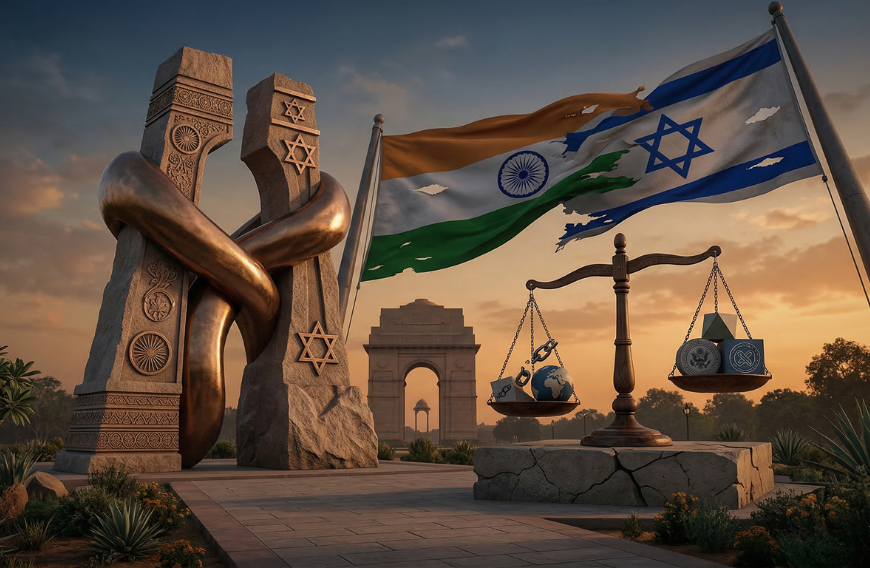
There is a photograph from last month that captures, more clearly than any communiqué, the direction of India’s foreign policy. Narendra Modi stands at the podium of the Israeli Knesset. Benjamin Netanyahu, facing an arrest warrant from the International Criminal Court over alleged war crimes, sits nearby, at ease.
For many in the room, it was a moment of diplomatic warmth. For many beyond it, particularly across the Global South, it signaled something else: a shift in how India is choosing to be seen.
Symbolism in diplomacy is rarely accidental. It accumulates meaning precisely because it is staged, repeated and noticed. For decades, India cultivated a reputation—sometimes overstated, often contested, but nonetheless real—for strategic autonomy: the ability to engage competing powers without appearing captive to any.
That reputation was not built on sentiment alone. It rested on habits of calibration: ties with Israel, yes, but also public solidarity with Palestine; defence cooperation, but conducted with discretion; alignment, but rarely embrace. The contrast with the present moment is difficult to miss.
India was among the first non-Western democracies to recognize Israel in 1950, yet it waited more than four decades to establish full diplomatic relations. That delay reflected a mix of principle and prudence: solidarity with anti-colonial movements, sensitivity to domestic pluralism, and a desire to avoid the perception of alignment within Cold War blocs.
When Prime Minister P.V. Narasimha Rao normalized relations in 1992, the partnership deepened—quietly. Israeli technology proved valuable, including during the Kargil conflict. But the relationship was managed with care, its visibility calibrated to preserve India’s wider diplomatic room. That calibration has, in recent years, given way to something more overt.
The strategic rationale is not difficult to understand. India faces real and evolving security challenges: the rapid diffusion of drone warfare, gaps in air defence, and the demands of modern surveillance and precision strike capabilities.
READ: Satish Jha | India had the chair. It chose silence! (March 17, 2026)
Israel, with a defence industry shaped by continuous conflict, offers solutions that are tested and available. In this sense, cooperation reflects a familiar logic of statecraft: governments procure where capability meets urgency. Yet procurement alone does not explain the texture of the relationship.
India today is among the largest markets for Israeli defence exports. Indian companies have entered joint ventures with Israeli firms. Corporate ties have expanded, including high-profile investments in Israeli infrastructure. None of this is unusual in itself; many countries maintain similar relationships. What is different is the degree of political signaling that now accompanies these ties—the public embrace, the asymmetry in diplomatic gestures, the absence of visible engagement with Palestinian leadership in parallel.
To some analysts, this reflects not just pragmatism but affinity. Scholars of the governing Bharatiya Janata Party have long noted perceived parallels between strands of Hindutva thought and aspects of Zionism: an emphasis on civilizational identity, a majoritarian understanding of nationhood, and a security framework shaped by enduring conflict. These comparisons are debated, and often contested, but they have moved from the margins of academic discussion closer to the language of policy interpretation. The consequences of that shift are not confined to optics.
India’s foreign policy has historically drawn strength from its ability to speak, credibly, across divides—between North and South, West and non-West, developed and developing. That positioning has underpinned its claims to leadership in forums ranging from climate negotiations to the G20. It has also depended, in part, on a perception—again, imperfect but meaningful—that India’s external conduct was not tightly bound to any single axis of power or ideology. That perception is now under strain.
READ: Satish Jha | The arithmetic of impunity (March 18, 2026)
Across much of the Global South, the war in Gaza has been framed in stark moral terms. Governments from South Africa to Brazil have used the language of international law, with some invoking genocide in proceedings before international courts.
In that context, India’s expanding defence relationship with Israel, combined with its relative diplomatic silence on the conflict, has raised questions about consistency. Critics argue that a country seeking to represent post-colonial solidarity cannot appear indifferent to the grievances of populations that see themselves in similar historical terms.
Indian officials would counter that foreign policy cannot be reduced to moral signaling. They would point, with some justification, to the inconsistencies of other major powers: Western governments that speak of human rights while pursuing arms sales, or regional actors that condemn violence selectively.
They would also note that several Arab states have, in recent years, normalized relations with Israel, reflecting their own strategic calculations. In this view, India is neither exceptional nor uniquely compromised; it is behaving as states do.
READ: Satish Jha | Who decides when the world burns? (
And yet the question is not whether India is behaving like other powers. It is whether, in doing so, it is relinquishing a distinct advantage.
Consider Iran. For decades, it has been more than a geopolitical variable in Indian policy: a civilizational interlocutor, an energy partner, and a gateway to Central Asia through projects like the Chabahar Port. The relationship has never been uncomplicated, but it has been sustained. Recent tensions in the region, including attacks on Iranian assets and escalating U.S.-Israel operations, have placed India in a difficult position. Its muted response has been read, in some quarters, as caution. In others, as distance.
These perceptions matter because foreign policy is not only about capabilities; it is also about credibility.
India has invested considerable diplomatic capital in presenting itself as a voice of the Global South—a country that can articulate the concerns of nations wary of great-power dominance. That role does not require moral perfection. It does, however, require a degree of consistency between rhetoric and action. When the gap between the two widens, influence tends to narrow.
There is also a more transactional dimension to consider. For Israel, facing growing international scrutiny, visible support from a country of India’s scale and standing carries significant value. It signals that isolation is not complete; that partnerships endure. For India, the benefits are more tangible: access to technology, intelligence cooperation, and defence capabilities that address immediate needs. The exchange is not symmetrical, but it is real. The question is how it will be judged over time.
READ: Satish Jha | Trump time: America in the mirror (March 10, 2026)
Strategic choices are rarely costless. They involve trade-offs that become visible only in retrospect: relationships weakened, options foreclosed, reputations altered. India’s current trajectory may well deliver near-term gains in security capacity. It may also, as some critics fear, complicate its relations with parts of the Middle East, affect public opinion in key regions, and narrow the space in which it can claim impartial leadership.
None of this is predetermined. Foreign policy is, by design, adjustable. Countries recalibrate when circumstances change or when costs become clearer. But recalibration begins with recognition.
India does not need to abandon its partnership with Israel to restore balance. It would, however, need to demonstrate—through actions as much as words—that its engagement is not exclusive, that its principles are not entirely contingent, and that its long-asserted autonomy remains more than a historical memory.
The photograph at the Knesset will not, on its own, define India’s place in the world. But it captures a moment when that place is being renegotiated—by India itself, and by those watching it.
The price of an embrace is not always visible at the moment it is offered. It becomes clearer in the distance that follows.