


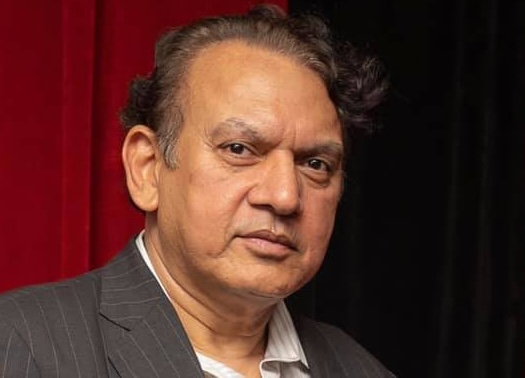
Technology creates opportunity, but it must be applied thoughtfully, says Satish Jha, a Boston-based journalist, edtech pioneer, and investor who led the One Laptop per Child initiative in India.
By Kesav Dama
Few careers move as seamlessly across journalism, global corporate leadership, investing, and social impact as that of Satish Jha. From co-founding Jansatta, one of India’s most influential Hindi dailies, and editing Dinamaan at the Times of India Group, to serving in CXO roles with Fortune 100 companies in Switzerland and the United States, Jha’s journey spans institutions, geographies, and ideas. In more recent years, he has been an early-stage investor in dozens of U.S. startups and a driving force behind technology-led social initiatives, including leading One Laptop per Child (OLPC) in India and supporting large-scale education efforts through the Vidyabharati Foundation of America and Ashraya.
Jha’s is also the author of The Full Plate: India’s Education Revolution and the Race for Human Capital, and a prolific writer who contributes a regular column to The American Bazaar.
In this wide-ranging conversation with Kesav Dama, Jha reflects on the formative influence of his upbringing and his years at Jawaharlal Nehru University, the bold decisions that helped build a modern Hindi newspaper from scratch, and the evolving role of journalism in an age of social media and misinformation. He also discusses his transition into global corporate leadership, his approach to investing, and his long-standing commitment to using technology to drive social impact—from rural development and digital infrastructure to energy, healthcare, and education.
At its core, the conversation returns to a few enduring themes: the power of ideas when paired with execution, the importance of humanizing technology, and the belief that while circumstances shape opportunity, they need not define outcomes. The interview has been edited for clarity.
Kesav Dama: You were born in Bihar and spent time in Lucknow and Varanasi. Tell us about your upbringing—especially your parents and their influence on you.
Satish Jha: My upbringing was shaped by two very different yet complementary influences. On my father’s side, there was a strong emphasis on education and scholarship. My grandfather was a professor of Sanskrit, and even though my father lost him at a very young age, that intellectual tradition continued in our household.
On my mother’s side, the family had a more aristocratic background—there were administrators, lawyers, and professionals of various kinds. It was a family that valued leadership and public life. So, in a way, I grew up at the intersection of intellectual rigor and social awareness. One side grounded me in discipline and learning; the other exposed me to ambition and public engagement. That combination stayed with me throughout my life.
Do you agree with the idea that where and when you are born largely determines your future?
I would say it determines a significant part of it—perhaps 70-80 percent. Your environment, access, and early influences shape your opportunities. But I don’t think it is destiny. There is still room for agency, for effort, and for making choices that alter your trajectory.
You studied economics at Jawaharlal Nehru University (JNU) in the late 1970s. What was that experience like?
At the time I was there, JNU was probably one of the most extraordinary academic environments in India. It brought together an incredibly talented group of students and thinkers. To give you a sense of that ecosystem—people from my extended academic circle went on to become global leaders. Abhijit Banerjee, who later won the Nobel Prize in Economics, was part of that intellectual milieu. Others went on to lead major institutions, join policymaking bodies, or build global corporations. JNU was not just about academics. It was about exposure to ideas—politics, economics, philosophy—and learning how to question, debate, and engage. That environment shaped how we thought about the world.
You’ve consistently worked at the intersection of technology and social impact. Why is that important to you?
Technology, by itself, is just a tool. What matters is how societies absorb and use it.
Different societies exist at different stages of development. Some create cutting-edge technologies, while others are still trying to absorb earlier innovations. Progress depends on how effectively a society can adopt and apply technology. If technology is too advanced for a society to absorb, it has little impact. If there is no access to technology at all, progress stalls. So the key is alignment—using the right level of technology to drive meaningful social outcomes. Technology is necessary for progress, but it is not sufficient. It must be humanized. It must serve people.
You co-founded a Hindi daily and scaled it rapidly. What were the key decisions that drove that success?
I came into journalism without prior experience, which, in hindsight, was an advantage. I had no preconceived notions and was willing to experiment. One of the most important decisions we made was to adopt computers for publishing. At that time, no newspaper in India was fully composed using computers. We took that leap despite not knowing exactly how to implement it. The second key decision was about language. We chose to write in a way that ordinary people spoke—not in overly formal or translated Hindi. That made the newspaper accessible. We also focused on presentation—better layout, better readability, and a modern look. Combined with strong content and distribution support, it helped us stand out. In short, we were willing to take risks others were not willing to take.
How do you see the difference between traditional journalism and today’s social media-driven landscape?
Journalism and social media are fundamentally different. Journalism is an institution. It operates within a framework of accountability, standards, and professional norms. Journalists are trained, and their work is subject to scrutiny.
Social media, on the other hand, is a platform for expression. Anyone can publish anything. That democratization has value, but it also creates challenges—especially around misinformation.
Today, the biggest issue is not access to information—it is the ability to distinguish between what is real and what is not. Even I find myself questioning what I see. However, over time, people will adapt. They will learn to ask questions, verify sources, and use tools—including AI—to check authenticity. Progress is never linear. It is messy, but it moves forward.
With so much free content available, how can journalism remain financially viable?
Journalism survives where there is demand. If people value credible information, they will pay for it—directly or indirectly. The challenge today is that attention is fragmented. But credibility still matters. In the long run, institutions that build trust will endure.
How did you transition from journalism into global corporate leadership?
That transition happened largely because of circumstances and opportunities.
When my wife moved to Geneva for her work with global health initiatives, I relocated as well. While there, I pursued further education and began exploring opportunities.
I received offers from major global organizations, including leadership roles in technology and strategy. I chose a path that allowed me to work internationally and engage with global markets. One of my guiding principles was simple: if you give me a dollar, I will return more than a dollar. That mindset helped build trust.
You later moved into investing and entrepreneurship. How did that evolve?
After years in corporate leadership and consulting, I began to understand how businesses are built and scaled. That naturally led to investing. I started investing in early-stage companies—particularly those working on technologies that could create new possibilities or make things cheaper, faster, or better. Over time, I made dozens of investments. Some succeeded, some didn’t. That’s the nature of early-stage investing. For me, investing is not just about returns. It is about people, ideas, and the potential to create impact.
What do you look for when deciding whether to invest in a startup?
There are a few key criteria:
Sustainability: Can the business sustain itself?
Scalability: Can it grow significantly?
Profitability potential: Even if not immediate, is there a path?
Impact: Does it create meaningful value?
But beyond all that, it comes down to people. Do I believe in the founders? Do I understand the space? Does it excite me?
You’ve been involved in rural development initiatives since a young age. How did that shape your later work?
I started working in rural areas when I was about 16 or 17. It wasn’t driven by a grand plan—it was more of an instinct to contribute. Later, when I worked on initiatives like Digital Partners India, the idea was to use technology to bridge gaps—especially where physical infrastructure was lacking. We talked about “digital highways” instead of physical roads. That idea later influenced various models adopted by corporations and governments.
You’ve been associated with ideas that resemble today’s digital infrastructure systems in India. How do you view that evolution?
The core idea was always about simplifying access—using technology to connect identity, finance, and services. There are many ways to build such systems. Some are more efficient than others. What matters is usability, scalability, and cost-effectiveness. India has made significant progress, but there is always room for simplification.
Tell us about your work in energy and healthcare for underserved communities.
In energy, we worked on decentralized systems—using biomass and local resources to generate power. The goal was to create small, self-sustaining units that could serve rural communities. In healthcare, we focused on digitizing patient data. We built systems where doctors could access a patient’s history through a digital platform—something that seems obvious today but was quite innovative at the time.
Both efforts were about leveraging technology to solve real-world problems.
What is your vision for the future of education in India?
Education is the single most powerful lever for societal transformation. The issue in India is not just access—it is quality. A large percentage of students are not receiving education that equips them for the future. The solution is not necessarily more spending—it is smarter spending. Technology can reduce costs and improve outcomes, but it must be applied effectively. If we invest meaningfully in education, the economic impact could be transformative.
You’ve mentored many entrepreneurs. What drives that?
At this stage of my life, I feel a responsibility to contribute. I don’t look at mentorship as a structured activity. I engage where I feel I can make a difference—where my experience can help someone move forward. It’s not about scale. It’s about impact.
You’ve been closely associated with TiE. How do you see its role today?
TiE has played an important role in building the startup ecosystem, especially in early-stage investing and mentorship. But ecosystems evolve. New institutions emerge to address new needs. TiE remains relevant, but it is part of a larger, multi-layered ecosystem.
How did you get involved with the One Laptop Per Child initiative?
I was introduced to the initiative and felt it was being misunderstood—especially in India. I reached out, got involved, and eventually took responsibility for driving it in India. It was an extraordinary experience—both in terms of learning and impact. Not everything scaled the way we hoped, but the idea was powerful.
If you had to summarize your journey and message, what would it be?
The message is simple: you can do it. Where you come from matters, but it does not define your limits. Technology creates opportunities, but it must be applied thoughtfully. And ultimately, progress happens when people connect ideas with action.